
Cooktop repair cost depends on the technology—gas, radiant electric, or induction—the failed part, access beneath the counter, and whether the replacement must fit an existing cutout. A burner or element issue may be contained, while cracked glass, induction electronics, controls, or a gas-related fault can make repair or replacement a larger decision.
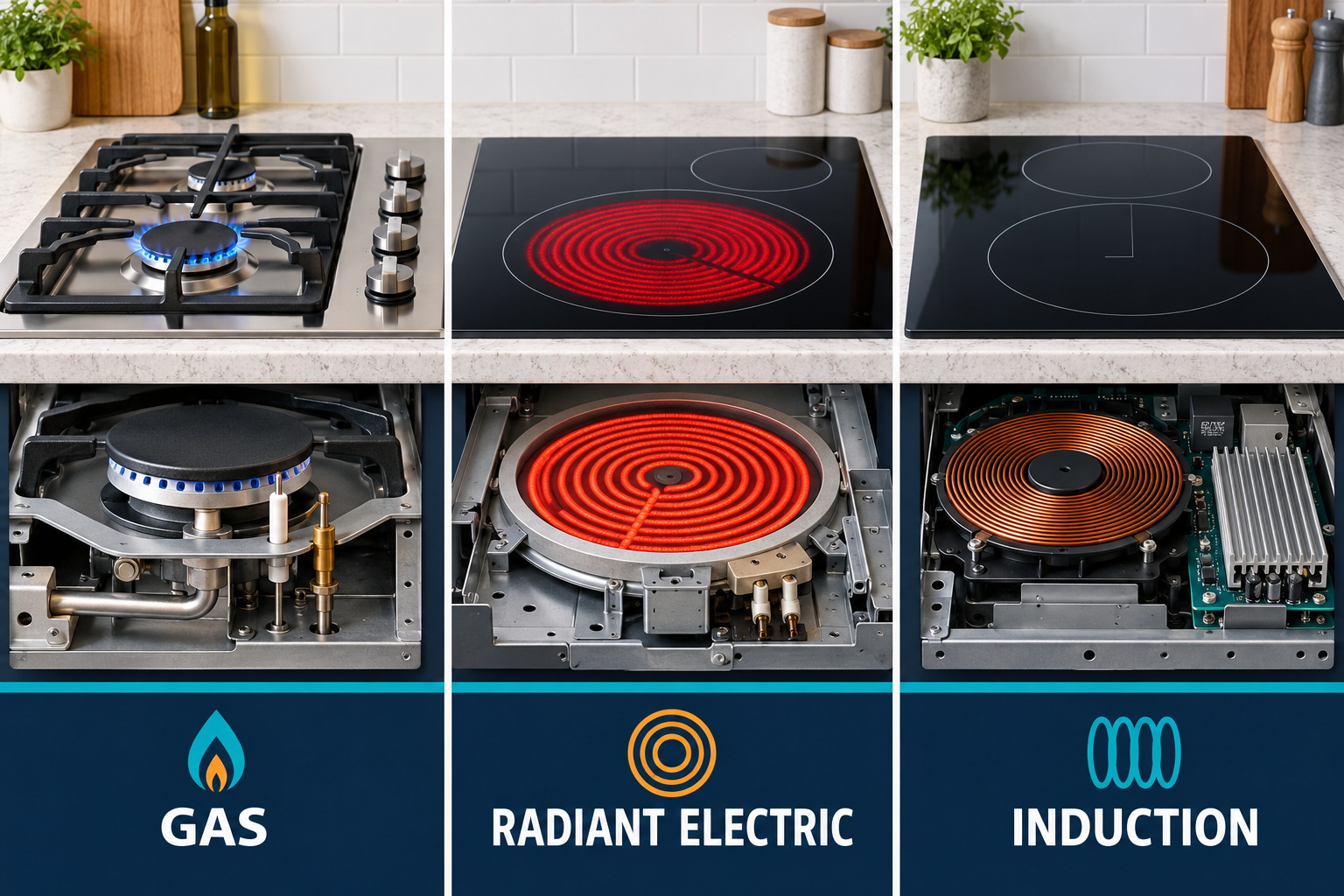
Identify the cooktop type
Gas cooktops use fuel controls and ignition systems. Radiant-electric cooktops commonly use heating elements and a glass-ceramic surface. Induction cooktops use electromagnetic heating and compatible cookware, with electronics that can be expensive to replace. Product construction varies by model and brand.
Record the model, age, fuel or power source, symptom, error display, and whether one zone or the whole cooktop is affected. Do not remove a built-in cooktop or perform gas or electrical tests without qualified service.
Common repair groups
Possible repair groups include burners, elements, switches, igniters, valves, sensors, controls, power modules, fans, wiring, knobs, and glass surfaces. The same “one burner does not work” complaint can involve a component, control, connection, or supply problem.
Request a diagnosis before ordering a part. Ask whether the provider has worked on the exact model and whether the part is available. Built-in access can require removing the cooktop from the counter and protecting the surrounding surface, so labor may exceed the component price.
Glass and surface damage
Cracked or badly damaged glass is more than a cosmetic issue. It can affect safe operation and may make continued use inappropriate. The manufacturer should control whether the surface can be repaired and which replacement part applies. A visually similar glass panel may not be compatible.
Scratches, discoloration, or trim damage may be technically repairable but economically poor if matching parts are discontinued. Compare the value of appearance, function, and the cost of replacing the whole unit.
Gas and electrical boundaries
Gas and electrical repair require appropriately qualified professionals. The cooktop may also depend on a household supply, shutoff, wiring, or circuit outside the appliance. If the problem is building-side, the relevant trade owns that work. Do not publish or follow generic gas or electrical repair procedures.
The selected model’s instructions and local requirements control connection, clearance, ventilation, and testing. ENERGY STAR’s electric-cooking guidance describes product choices and induction cookware compatibility, but it does not establish service-capacity sufficiency or installation requirements for a particular home.
Repair versus replacement
Repair is more attractive when the defect is localized, the glass and cabinet are sound, the model has parts support, and the existing cutout is difficult to match. Replacement deserves comparison when the surface or main electronics are damaged, failures repeat, the model is obsolete, or a current appliance fits without counter work.
Include removal, lifting, counter protection, new model, installation, electrical or gas work, ventilation interaction, disposal, and any cabinet or countertop correction. A replacement can cost more than expected if its cutout differs by even a small amount.
Induction-specific considerations
Induction cookware compatibility, electronics, power requirements, and service support affect the economics. A magnet screening check can indicate whether some existing cookware may work, but the product manual and cookware manufacturer control the final compatibility. Do not assume that all pots, pans, or induction models behave the same way.
U.S. and Canadian market context
Specialist repair figures are broad U.S. signals. Canadian prices, service networks, taxes, appliance availability, and connection rules need separate local verification. Do not convert the U.S. range into Canadian dollars.
Questions for the service provider
Ask what failed, how it was tested, whether the issue is appliance-side, whether the surface or electronics can be repaired, what access is included, whether the part is available, and what warranty applies. If replacement is recommended, obtain the exact cutout and connection requirements before ordering.
The useful cooktop budget is a comparison between a model-specific repair and a model-specific replacement that includes the counter, utility, access, and disposal consequences.
Decide when the repair remains economical
Use the confirmed failure, part availability, access, repair warranty, remaining condition, and replacement opening to define the repair branch. A control or ignition issue can be a contained job; a damaged surface, unavailable power module, repeated failure, or poor service support can turn it into a replacement decision. The same dollar amount can be sensible in a hard-to-fit built-in installation and weak in a readily replaceable freestanding setup.
Use a repair decision worksheet
Record the model, cooktop type, symptom, affected zone, tests performed, utility boundary, access plan, parts availability, labor, return visit, warranty, and replacement opening. Then record the consequence of each outcome: continued use, partial use, temporary cooking, counter work, or disposal. This turns an uncertain service conversation into a comparison the household can revisit.
If the quote changes from a component repair to a power module, sealed control, cracked surface, or utility correction, pause and rebuild the comparison. The new scope may change the best answer even if the original service call was reasonable.
Set a stop point before authorizing work
Agree on what the initial visit will establish and what would trigger a replacement comparison: an unavailable part, a major control or power module, a cracked surface, a repeat visit, or damage to the opening. This gives the household a decision boundary without relying on a universal repair percentage. Keep the quote, model information, and measured cutout together.
Compare a contained repair with a cutout project
A repair is easier to price when the exact failure is supported by testing, the unit can be accessed without removing surrounding work, parts are available, and the cooktop remains serviceable after repair. A replacement comparison should include the opening, counter, utility, ventilation, delivery, removal, disposal, testing, and any finish correction. A new unit that is inexpensive but does not fit the opening can create a larger project than the original repair.
Ask how the technician will protect the counter and adjacent finish, whether the old unit can be removed without damage, and who owns a callback if the control or connection fails after the first cooking test. Keep electrical or gas work with the appropriately qualified trade. Do not treat a model-specific installation diagram as a universal local requirement.
Trace the symptom before buying a part
One burner or zone not working can involve the burner assembly, element, switch, igniter, valve, sensor, control, power module, wiring, cookware interaction, or household supply. A cracked surface can create a different safety and replacement decision from a control fault. Ask the technician to identify the tested failure group and whether the diagnosis was made with the cooktop in place.
The access question matters because a built-in cooktop sits in a finished counter. Removal may require disconnecting utilities, lifting the unit without damaging stone or laminate, protecting the counter, and reinstalling or resealing it after service. Ask whether the quoted labor includes those steps and what happens if the cutout or surrounding material is not in suitable condition.
Compare the three main repair outcomes
A contained repair may be a knob, igniter, switch, sensor, or other supported component. An electronics or power-module repair may have a larger parts and service burden. Surface damage or a discontinued model may make replacement more practical, but replacement can trigger a new cutout, counter correction, cabinet change, utility work, and disposal.
For induction, cookware compatibility is a selection issue rather than a repair diagnosis. A magnet check can be a screening aid, but the exact cookware and model instructions control. Do not assume a replacement induction unit will use every existing pan or that its electrical requirements match a radiant or gas cooktop.
Decide how to use the appliance while waiting
If one zone is unavailable but the surface and connection are otherwise safe, the household may have a temporary cooking option. If there is a crack, gas odor, burning smell, uncontrolled heat, repeated tripping, or another safety concern, stop using the appliance and obtain qualified help. A temporary workaround should not conceal a condition that needs immediate attention.
Plan for the surrounding finish
Photograph the existing cutout, countertop edge, backsplash, controls, and adjacent appliances before removal. Ask who repairs a chipped counter, replaces a trim strip, or restores a cabinet if the old unit cannot be removed cleanly. Cabinet and countertop work should be priced separately from appliance labor, even when the appliance caused the need.
U.S. specialist repair figures are broad planning signals; Canadian parts, labor, service networks, and model availability need local verification. The most useful quote identifies the exact model, failure, access, utility boundary, repair warranty, replacement cutout, finish risk, and total disposal path.