
A five-minute repair can still produce a substantial invoice because the contractor may need to travel, schedule the visit, carry insurance, bring tools, set up, document the work, and meet a minimum billable time. The price is not always proportional to the minutes spent on the final task.
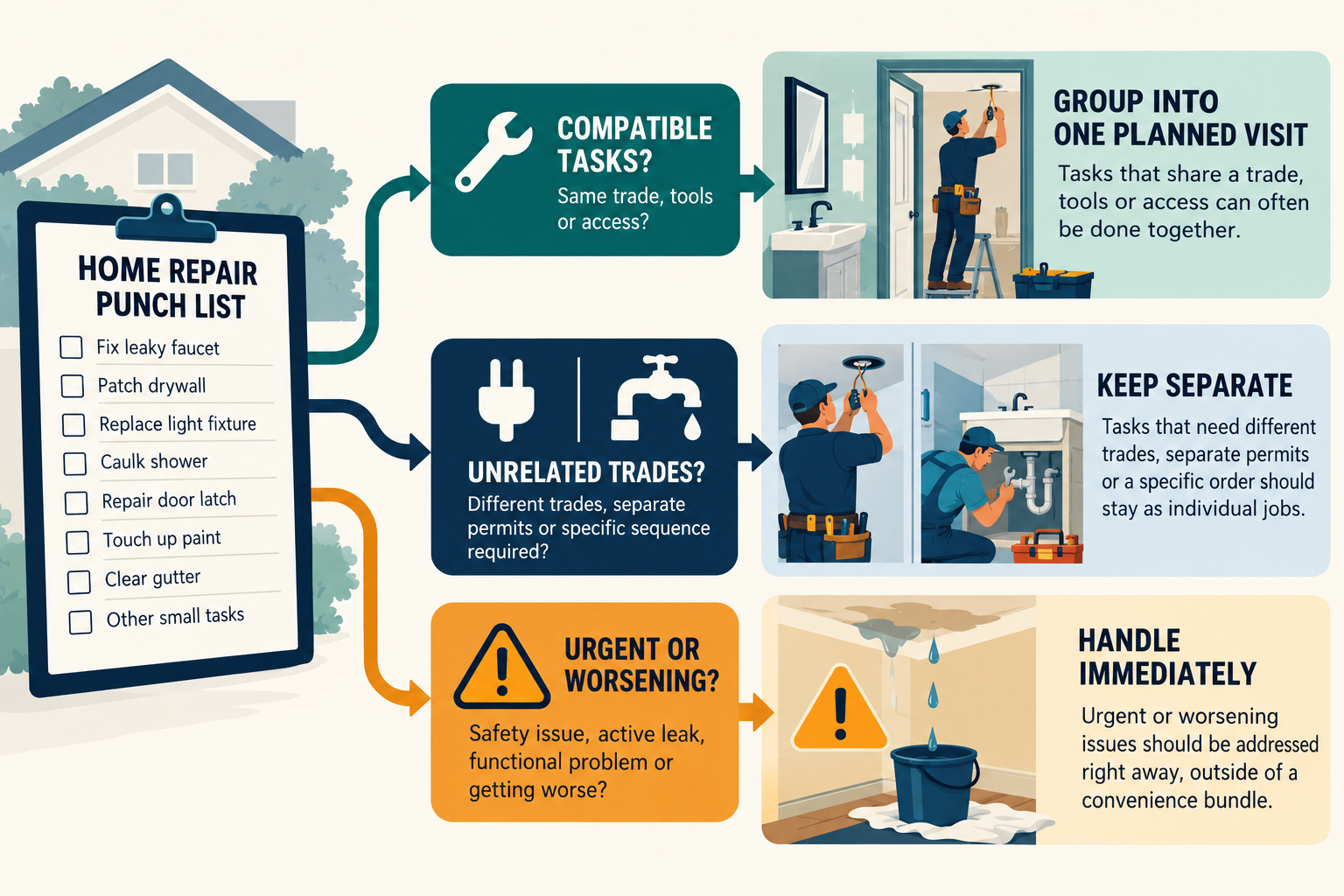
Bundling compatible work can reduce repeated mobilization, but it is not a reason to combine unrelated trades or delay a worsening problem. The useful goal is to make one visit more productive without making the scope less clear.
What a minimum charge can cover
Ask what sits behind the minimum. It may include:
- dispatch and travel from the contractor’s service area;
- a minimum amount of on-site labor;
- scheduling, communication, and payment administration;
- tools, equipment, setup, and cleanup;
- procurement or a trip to obtain a part;
- licensing, insurance, supervision, or a qualified second worker;
- testing or diagnosis before the repair can be defined.
Some businesses show these items as a service-call fee. Others embed them in a task price or hourly minimum. A named line is not automatically excessive, and an apparently free visit may recover the same cost elsewhere.
Prepare a useful punch list
For a nonurgent visit, list every issue you want the same trade to evaluate. Include its location, symptoms, access limits, photographs, model information, and whether it is getting worse. Ask whether the tasks can be handled by the same qualification, tools, parts, and visit window.
Before the appointment, ask:
- Is there a minimum time or service-call charge?
- Does it include diagnosis, materials, and a written estimate?
- Can several compatible tasks be priced together?
- Will a second technician, permit, test, or special tool be required?
- Which tasks may need to be scheduled separately?
- Can the contractor provide a combined scope and identify any discount or avoided second mobilization without promising a saving?
Bundling is most coherent when one contractor or trade can perform the work in one visit or sequence. It may be less useful when the tasks require different licenses, parts, access points, or inspections.
Do not use bundling to hide scope
Ask for an itemized list even when the contractor offers one combined price. You should be able to see which problem is being repaired, what remains uncertain, and what happens if one task reveals a larger condition. A bundle that makes every line “miscellaneous” is harder to compare and harder to approve.
Keep diagnosis separate from repair when the cause is unknown. A contractor may need to investigate first and then return with parts or a different trade. Paying for a focused diagnostic visit can be more efficient than asking several providers to make unrelated guesses.
Know when waiting costs more
Do not defer an active leak, electrical or gas concern, structural movement, sewage exposure, loss of essential heat, fire or health hazard, or other worsening condition merely to assemble a larger punch list. Ask a qualified professional what immediate protection is appropriate and schedule the remaining nonurgent work afterward.
The cost of waiting can include damage to adjacent materials, emergency labor, temporary accommodation, lost use, or a second repair. Those consequences can outweigh the travel cost you hoped to avoid.
Compare the actual alternatives
When a contractor offers a combined visit, compare:
- the cost of separate visits;
- the work, materials, and testing included in each option;
- the time until the most important issue is addressed;
- the chance that one task will block or change another;
- warranty and callback treatment;
- any parts, permits, or specialist visits still outside the bundle.
There is no universal minimum charge or guaranteed bundling discount across U.S. and Canadian trades. The economics are local and contractor-specific. A prepared, accurately bounded punch list can reduce repeated mobilization while preserving the safety and clarity that matter more than a small invoice shortcut.
Decide whether tasks actually belong together
Bundling works best when the jobs share a trade, qualification, access route, tools, materials, and schedule. A plumber may be able to address several fixtures in one visit. An electrician may combine several defined repairs after confirming that the circuits and work area are related. A general contractor may coordinate several small finish items, but each additional trade can introduce a separate mobilization and inspection.
Do not bundle tasks merely because they are in the same room. A bathroom punch list can contain plumbing, electrical, waterproofing, structural, ventilation, and finish work with different qualifications and dependencies. Ask the contractor to identify the sequence and the point at which another trade must be involved.
Calculate the avoided cost carefully
Compare a bundled option with separate visits using the complete cost, not just the visible minimum:
separate visits
- bundled visits
= potential avoided mobilization and setup cost
Then add any change in labor, parts, access, schedule, testing, travel, warranty, or follow-up. A combined appointment can cost more if the crew waits between tasks, carries additional equipment, or requires a longer disruption period. A discount is useful only when the scope, quality, and response time remain acceptable.
Ask whether the contractor is offering a real price change or simply a single total for work that would have been charged separately anyway. An itemized bundle lets you decide which tasks to keep if the budget changes. It also prevents a broad “miscellaneous repairs” line from hiding an unpriced condition.
Prepare information before the visit
For each item, write its location, symptom, age or model if known, access condition, photographs, and whether it is worsening. Note related observations without declaring a diagnosis. Tell the contractor if one task depends on another or if the property will be occupied during the visit.
Before confirming, ask about the minimum, diagnosis, materials, permits, testing, disposal, and return visits. Ask whether the contractor will provide a written scope after inspection and obtain approval before expanding the work. If the provider needs to investigate first, treat the diagnostic phase separately from a later repair bundle.
Calculate the benefit without assuming a discount
List the visits you would otherwise need, the travel or dispatch amount for each, the minimum billable time, and any separate parts or access costs. Then ask the provider whether one visit can complete the tasks with the same qualifications, tools, materials, and warranty. The potential saving comes from avoided repeated mobilization—not from a guaranteed percentage reduction in every line.
Bundling may be a poor choice when tasks require different licenses, different equipment, separate permits, different sequencing, or unrelated specialists. It can also create a larger scope that is harder to inspect and approve. Give the contractor a written punch list, identify which items are symptoms rather than known repairs, and ask for a separate price or authorization boundary for each task.
If one item is urgent, split it from the convenience bundle. Stabilize the urgent condition, then decide whether the remaining work can be combined on a later visit. The best bundle reduces repeated access while keeping the homeowner able to see what was diagnosed, what was fixed, and what remains.
An active leak, gas or electrical concern, structural movement, sewage exposure, fire or health hazard, loss of essential heat, and other worsening conditions should be triaged on their own. A task should not wait for a more convenient bundle when delay can increase the consequence. A professional may recommend immediate stabilization followed by a planned visit for related nonurgent work.
Bundling is a scheduling and mobilization strategy, not a substitute for diagnosis. It is most useful when it makes a defined visit more productive without weakening the scope, safety boundary, or homeowner’s ability to approve each task.
Keep the visit auditable
Ask for each task to appear separately on the estimate and invoice, even when the contractor offers one bundled total. Show the diagnostic charge, minimum or mobilization amount, labor, materials, access, disposal, testing, and any return visit. This lets you see whether the bundle changes the economics and preserves the option to remove a nonurgent item if the visit uncovers a more important condition.
Before work begins, agree on the order of operations and the point at which additional approval is required. If one task is only a symptom, do not ask the contractor to “fix everything” without a defined diagnostic boundary. If two tasks share access, note that the shared setup is the reason to combine them; do not imply that unrelated work is covered by a general minimum.
After the visit, record what was diagnosed, what was completed, what remains, and whether a follow-up should be bundled or handled separately. A small-job strategy has succeeded when it reduces repeated mobilization while keeping every decision and unresolved risk visible.
Choose the bundle by dependency
Group tasks when one visit can safely diagnose or complete them without obscuring responsibility. For example, several defined fixture issues may share a trade and access point; a symptom that may have one source should remain a diagnostic question until the cause is established. Ask whether the proposed order prevents rework and whether a missed item can be removed without changing the rest of the scope.
Keep urgent work outside the convenience calculation. The most economical visit is not useful if it delays protection or makes the provider rush a task that needs testing, curing, or a separate qualification.