
“Can someone come look at it?” can describe several different services. A charge may pay for dispatch and a minimum visit, diagnostic labor, a written estimate, a formal inspection, or a consultation. Companies and trades use these labels inconsistently, so the label alone does not tell you what you are buying.
The common fee types
Service call or dispatch fee. This usually covers sending a person and vehicle to the property, a minimum amount of time on site, or the contractor’s mobilization cost. It may include a brief visual check but not a complete diagnosis or repair.
Diagnostic fee. This pays for time and tools used to identify a likely cause, test a system, access a concealed area, or define the next step. Diagnosis can end with a recommendation rather than a repair price.
Estimate or quote fee. Some businesses provide a free estimate for clearly defined work; others charge when estimating requires travel, design, measurement, engineering, or extensive investigation. Ask whether the result is a budget number, a firm proposal, or a written scope subject to assumptions.
Inspection. An inspection is an assessment against a stated purpose and scope. A general home inspection is not the same as a repair diagnosis and is not a contractor-grade price. A specialist inspection may be needed for structure, electrical work, HVAC, water intrusion, environmental hazards, or another defined system.
Consultation or assessment. This may be a planning conversation, second opinion, design review, or advice on alternatives. Its value depends on the deliverable: verbal observations, a report, measurements, a repair scope, or a design concept.
Ask what happens after the visit
Before booking, ask:
- What exactly is included in the fee and how much time is allowed?
- Is testing, opening an assembly, equipment access, or a written report included?
- Will the person diagnose the cause, price the repair, or only describe conditions?
- Is the fee credited against approved work, and under what written terms?
- Does the credit apply to labor only, the whole project, or a specific time window?
- Are travel, parking, emergency response, parts, testing, or a second visit extra?
- What is the cancellation or rescheduling charge?
- Can the same report be used to request comparable bids from other contractors?
Do not assume that a “free estimate” includes a thorough diagnosis. Do not assume that a paid visit is independent of the company that hopes to sell the repair. Both arrangements can be appropriate; the important issue is that the service and potential conflict are clear.
Why a fee can reduce total cost
An unknown cause produces unreliable bids. Paying for a focused diagnosis can prevent three contractors from making three different assumptions, reduce repeated service calls, and identify a needed specialist before work starts. It can also expose a repair that would be unsafe or ineffective without correcting a larger cause.
The value is lower when the task is already fully specified, the diagnosing contractor must inspect the same condition before pricing, or the fee buys only a brief visit that does not narrow the scope. Avoid paying several professionals to repeat the same limited observation. Ask whether an existing report, photographs, test result, or equipment history is enough for the next step.
General inspection versus specialist diagnosis
When buying a home, the inspection and appraisal serve different purposes. The Consumer Financial Protection Bureau recommends an independent inspection early enough to address problems and notes that additional inspections may be needed. A general inspector can identify conditions that deserve attention, but a specialist is usually better placed to define a trade-specific repair.
For an owned home, choose the level of investigation that matches the consequence. A minor cosmetic question may need a contractor visit. A suspected structural, gas, electrical, health, or active-water problem may require an appropriately qualified professional. This article does not replace the system-specific safety guidance or local requirements for that work.
Prevent double-counting in quote comparisons
If one proposal includes diagnosis and another bills diagnosis separately, move both into the same comparison table. Record whether a diagnostic fee is:
- an owner-paid cost in every scenario;
- credited if the contractor performs the work;
- included in a project price but not shown separately;
- an allowance for investigation;
- a separate specialist cost that remains due even if the repair is declined.
The same principle applies to design, engineering, testing, permits, and inspections. A lower construction bid may simply place those costs elsewhere.
Paying for clarity is worthwhile when it changes the scope, protects against unsafe guesswork, or allows comparable proposals. Book it with a written description of the deliverable so you can judge whether the fee solved the uncertainty you paid to reduce.
A fee is easier to judge when its unit is clear
Ask what the provider is charging for: a truck dispatch, a minimum period on site, diagnostic testing, a written report, a design opinion, or a price proposal. A “diagnostic fee” may cover only the first stage of testing. An “inspection” may identify visible conditions without opening a wall or proving the cause. An estimate may be free because the contractor expects to recover the visit through the repair contract, but free does not mean comprehensive.
Before booking, ask whether travel, parking, equipment, testing, photographs, measurements, laboratory work, return visits, and taxes are included. Ask whether the provider will stop and request approval if a test becomes invasive or reveals a larger issue. If the fee is credited toward a repair, record the conditions: expiration date, eligible scope, minimum contract value, and whether the credit survives if you choose another contractor.
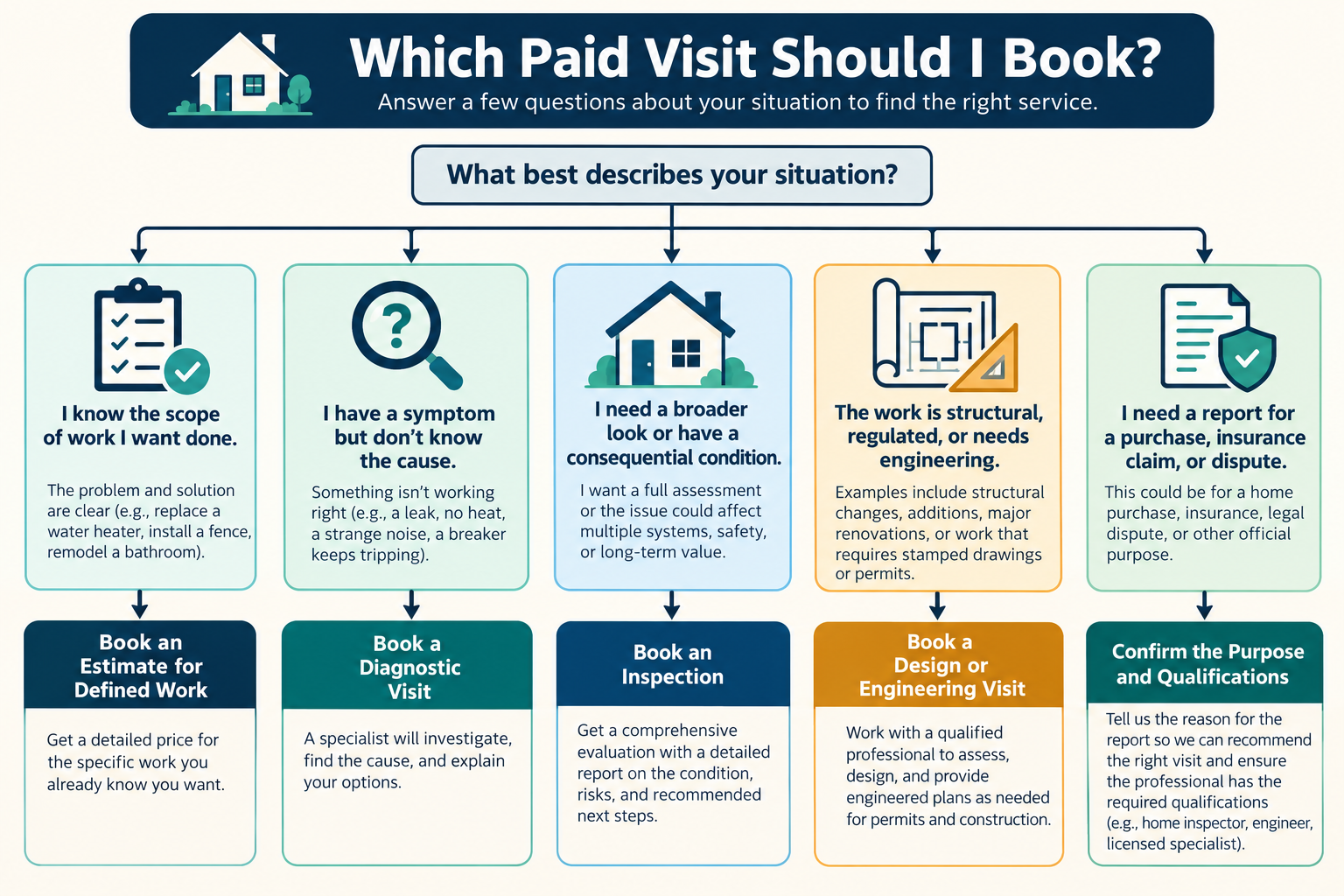
Use a simple service decision tree
Use the least expensive service that can answer the next important question safely:
- Is the problem and scope already known? Request a price for defined work.
- Is the symptom clear but the cause uncertain? Ask for a diagnostic visit and its testing limits.
- Is the property or system condition broad and consequential? Consider an independent or specialist inspection.
- Will the work change structure, layout, regulated systems, or engineered performance? Ask whether design or engineering is needed before bids.
- Does the result need to support a purchase, insurance, or dispute? Confirm the report’s purpose and qualifications before paying.
The tree is not a rule that an independent inspector is always better. A contractor may diagnose a straightforward failure efficiently because that firm already has the tools and trade qualification. Independence can still matter when the report will be used to compare competing repair options or when the person diagnosing the problem is also seeking the work. State the relationship openly and judge the deliverable.
What makes a diagnostic deliverable useful
A useful report does not need to promise a final repair price. It should identify what was observed, what was tested, what remains unknown, and what next action is justified. For a water-intrusion assessment, that might mean distinguishing visible staining from a verified source and listing the specialist needed to define the repair. For a tripping breaker, it might document the conditions observed without giving a homeowner permission to open energized equipment.
Ask whether the report will distinguish facts from hypotheses. A confident label without supporting observations may not reduce uncertainty. Conversely, a report that states “cause not established; further testing required” can be valuable if it prevents several contractors from bidding on different assumptions.
Include the fee in the project economics
Put the service fee in the same budget as the repair, even when it might be credited. Compare the cost of one focused assessment with the cost of several providers repeating the same limited visit. Add the cost of waiting if the assessment delays a decision, and the cost of not diagnosing if a wrong repair could damage finishes or conceal a hazardous condition.
For a home purchase, a general inspection is not a contractor estimate or a guarantee that every defect has been found. Major findings may lead to specialist work, seller negotiations, financing questions, or a decision not to proceed. Contract and lender treatment is local. The economic value of the inspection is the better decision it enables, not the number of pages in the report.
Use a fee worksheet before you book
Write down the service you think you need, the uncertainty it should reduce, and the deliverable that would make the visit useful. Then ask the provider to complete the same fields:
| Question | Why it matters |
|---|---|
| What is the visit called and how is it billed? | A dispatch fee, diagnostic hour, inspection, and estimate may not be comparable units. |
| What is included in the first visit? | You may be paying for observation, testing, disassembly, a repair, or only travel and setup. |
| What will you receive? | A written scope, test result, photographs, estimate, or verbal recommendation has different decision value. |
| What happens next? | Ask about credits, follow-up pricing, repair availability, and whether another specialist is needed. |
| What can change the fee? | Confirm travel, parts, invasive testing, after-hours time, taxes, and minimum charges. |
This worksheet helps prevent two opposite mistakes: rejecting a useful paid assessment because it is not free, or paying several providers to repeat the same limited visit without producing a clearer scope. If the provider will also sell the repair, ask what is independent about the assessment and compare the recommendation with the stated observations. Independence is not automatic, but a clear deliverable and a defined authorization boundary make the service easier to evaluate.