
The hourly figure on a home-repair quote is a selling rate, not a direct statement of what the worker takes home. It may recover wages, payroll burdens, insurance, travel, tools, supervision, estimating, administration, idle time, warranty work, and operating profit. Some contractors do not show an hourly rate at all; they price the completed task or project.
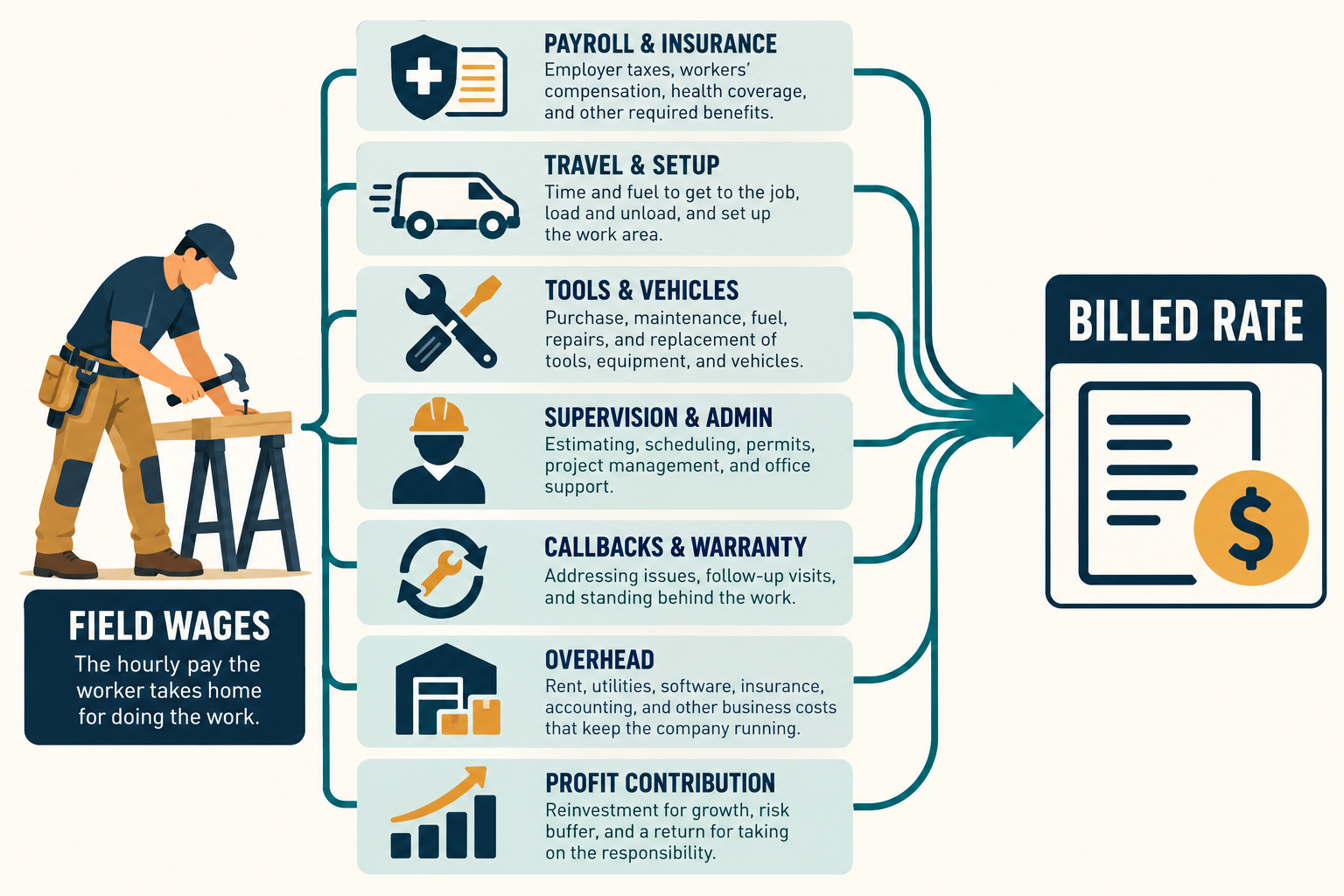
Wage and billable rate are different measurements
A worker’s wage is one cost of employing that person. The business may also pay payroll taxes, benefits, workers’ compensation, training, paid time that cannot be billed to one customer, and supervision. A self-employed specialist has a different mix of insurance, unpaid estimating, vehicle, equipment, and business costs.
The billed rate also assumes some level of productive time. A worker may spend part of a day traveling, collecting materials, setting up protection, waiting for an inspection, explaining options, cleaning, or returning under warranty. If a business has only a few billable hours on a short visit, those non-billable costs still have to be recovered somewhere.
Crew composition changes the result
Two people for three hours is not economically equivalent to one person for six hours. A lead tradesperson may work with an apprentice, laborer, project manager, or specialist subcontractor. The crew can be faster, safer, or more capable for a complex task, but the proposal should make the composition and expected hours understandable.
Ask whether the labor line includes supervision and coordination. If subcontractors are separate, ask who schedules them, who handles their warranty, and whether their cost is marked up or carried as a pass-through.
What the labor line may recover
Depending on the business and the quote, the labor price may include:
- wages, payroll burdens, benefits, and workers’ compensation;
- liability and property-damage insurance;
- travel, vehicles, fuel, parking, and mobilization;
- tools, equipment, maintenance, calibration, and replacement;
- estimating, scheduling, purchasing, invoicing, and customer communication;
- supervision, licensing, continuing education, and compliance;
- protection, setup, cleanup, disposal, and warranty callbacks;
- general business overhead and a profit contribution.
Not every contractor allocates these items to labor. One may show a separate service call, another may use a higher labor rate, and a third may embed everything in a fixed project price.
Hourly, task, and project pricing
Hourly pricing can be useful when the work is exploratory or the time is genuinely difficult to predict. It exposes the time component but may leave the final total uncertain. Task pricing can be easier to budget when the scope is repeatable, yet the contractor has still priced expected labor and risk internally. Fixed project pricing gives a clearer total for the stated work but usually includes an allowance for uncertainty, exclusions, or change procedures.
None is automatically cheaper. Compare the scope, assumptions, documentation, not-to-exceed limits, and treatment of concealed conditions. The relationship between the labor method and the material markup matters more than a single displayed rate.
Regional and project differences are normal
Rates vary by trade, licensing, demand, remoteness, insurance exposure, local wages, travel, tools, project complexity, and whether the work is emergency or scheduled. U.S. and Canadian markets also use different currencies and labor markets. A U.S. rate is not a Canadian benchmark, and neither is a universal fair price.
Published specialist pricing discussions can explain cost classes, but public examples do not establish one correct homeowner rate. Treat them as context, not as a test that a local bid must pass.
Questions a homeowner can reasonably ask
You do not need the contractor’s private payroll records to understand a quote. Ask:
- Is the labor line hourly, task-based, or a fixed project amount?
- How many workers and what skill mix are assumed?
- Does the price include travel, setup, protection, cleanup, supervision, and callbacks?
- Are subcontractors included, and who is responsible for coordinating them?
- What minimum charge applies if the work takes less time than expected?
- What conditions would require additional labor or a change order?
- Is the quoted rate the same for normal, after-hours, and return visits?
Compare the answers across proposals. A higher labor rate may buy a shorter duration, better access planning, specialist capability, or more complete service. A lower rate may be appropriate for a simple, well-defined task. The useful comparison is the total cost for the outcome, including the work that must happen around the labor itself.
What can be inside a billed labor rate
The selling rate may recover several kinds of time and cost that do not appear as a worker’s wage:
| Cost class | Examples |
|---|---|
| Productive field time | Installation, repair, testing, and closeout work at the property |
| Non-billable or partly billable time | Travel, loading, estimating, procurement, coordination, training, and callbacks |
| Employment cost | Payroll burden, benefits, workers’ compensation, and required insurance |
| Business support | Supervision, scheduling, office work, tools, vehicles, software, and facilities |
| Risk and responsibility | Warranty response, rework, compliance, and coordination when an assumption fails |
The same cost can appear in different places. One contractor may show a service call and a lower hourly rate. Another may quote a higher task price with no separate dispatch line. Comparing one visible line without comparing the complete scope can make the accounting look more different than the economics.
Hours, crew size, and productivity matter
A two-person crew is not automatically twice as expensive as a one-person crew. It may finish a lifting, protection, or installation task sooner and reduce the total time the home is disrupted. Conversely, a larger crew can be inefficient when the work is confined or waiting on another trade. Ask what crew composition the price assumes and whether the rate changes when the job requires a qualified supervisor, specialist, helper, or second visit.
Productivity depends on access, preparation, the condition of the assembly, material handling, occupied-home restrictions, weather, and how much testing is required. A contractor who has performed the same work repeatedly may complete it in fewer hours than a generalist without making the work less thorough. A low hourly rate can therefore produce a higher completed cost when the scope takes longer or requires more coordination.
Ask what the rate actually buys
Before comparing rates, ask:
- Is time billed from departure, arrival, or the start of work?
- Is there a minimum charge or a separate diagnostic fee?
- Are travel, parking, setup, cleanup, and disposal included?
- Is the rate different for regular, evening, emergency, or return visits?
- What materials, tools, equipment, testing, and subcontractors are separate?
- Is the work billed by the hour, by task, by unit, or as a fixed price?
- What happens if the expected hours are exceeded?
If the contractor uses a task price, ask for the assumptions rather than demanding an hourly breakdown that may not exist. A task price can be easier to budget when the scope is defined. An hourly structure can be more transparent for exploratory work, but it places more cost risk on the homeowner unless hours, materials, approvals, and a limit are documented.
Do not use wage data as a fair-price test
Government wage statistics can provide labor-market context, but they are not a schedule of what a residential contractor must charge. The billed rate must support the work environment, the business, and the responsibility attached to the result. U.S. and Canadian markets also differ in wages, insurance, taxes, travel, and contracting practice. A currency conversion cannot make the markets comparable.
The most useful comparison is an effective cost for a defined outcome: expected labor time, crew, materials, support costs, follow-up, and uncertainty. Ask for a written scope and a clear approval point before additional hours. That gives you a way to manage labor cost without treating a professional’s wage, rate, or markup as the whole project.
Turn a labor line into a decision question
When a proposal lists an hourly rate, ask what the rate includes and what is billed separately. A useful clarification covers the expected crew, minimum time, travel, setup, material pickup, supervision, equipment, disposal, testing, and return visits. You do not need the contractor’s private payroll records. You need enough information to understand whether two labor lines describe the same work.
For a defined repair, compare the total labor allowance and the finished scope rather than multiplying an advertised hourly rate by an idealized task time. For exploratory work, ask for a diagnostic phase, a maximum number of hours, or a not-to-exceed authorization with a written stop point. Confirm whether materials and subcontractors require separate approval. These controls are especially useful when the contractor cannot responsibly predict how long concealed work will take.
| If the quote says | Ask |
|---|---|
| “Two technicians, four hours” | Is travel, setup, testing, and cleanup included in those hours? |
| “Labor only” | Who supplies materials, equipment, permits, disposal, and finish restoration? |
| “Time and materials” | What records will show hours and purchases, and when is approval required? |
| “Complete repair” | What outcome, warranty, and follow-up work are included? |
The rate is only one input. A clear boundary around the work is what makes the labor cost manageable.