
A useful home-maintenance budget starts with the property you own, not a standard percentage of its value. A newer home with recent system replacements may need a different near-term plan from an older home with deferred work, harsh weather exposure, or several systems whose condition is unknown.
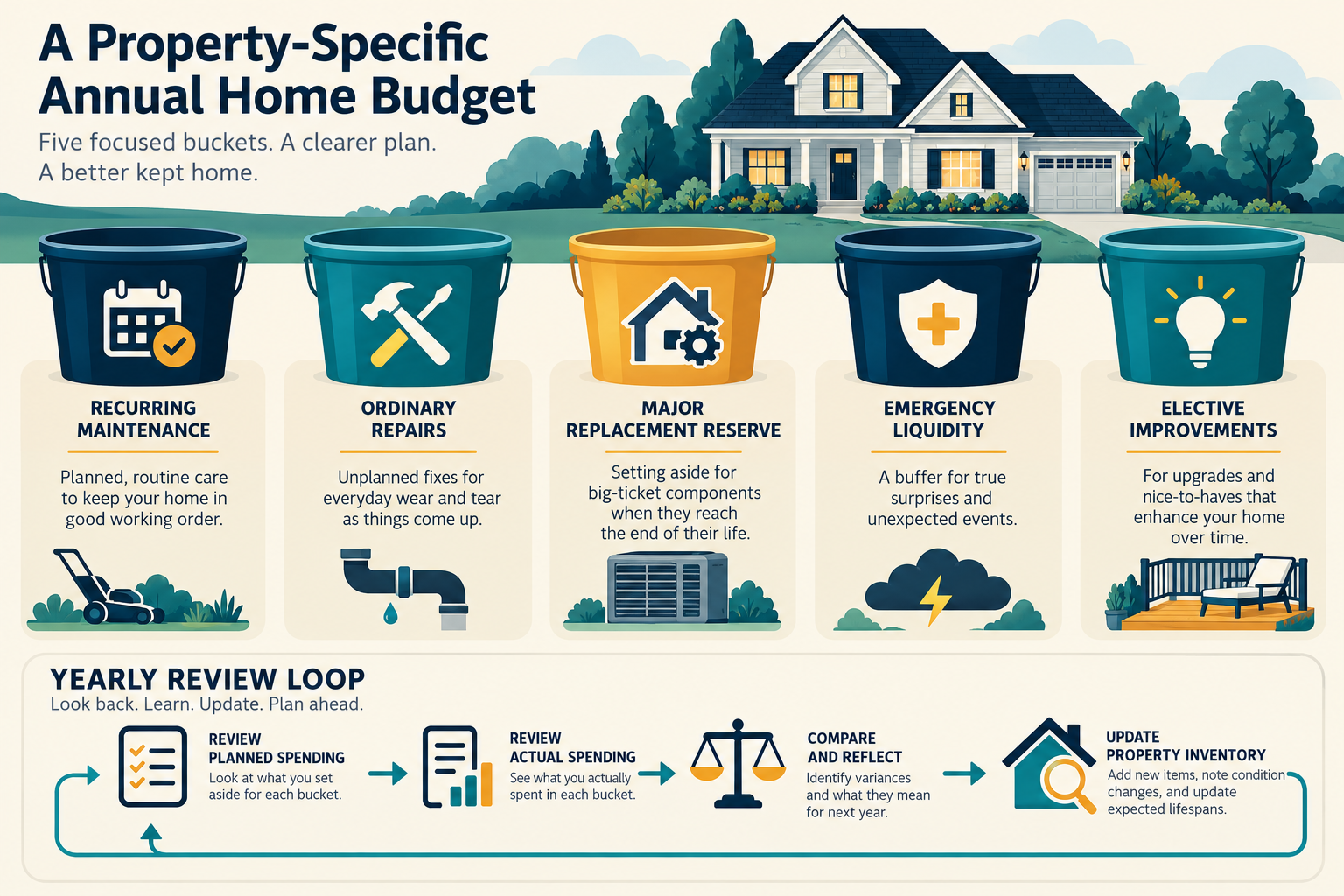
The budget is a planning tool. It helps you fund recurring care, ordinary repairs, and the next information step. It cannot predict the exact date or cost of a failure.
Separate the money by purpose
Keep distinct estimates for:
- Recurring maintenance: inspections, cleaning, filters, seasonal service, sealing, and other predictable upkeep.
- Ordinary repairs: smaller failures that are uncertain in timing but expected over ownership.
- Major replacements: known or foreseeable high-cost projects such as a roof, heating system, or water heater.
- Emergency liquidity: cash available for an unexpected failure, active damage, or urgent safety response.
- Improvements: elective upgrades that change the home’s quality or use rather than maintain its existing condition.
One savings account can hold several of these amounts, but the plan should not treat them as interchangeable. Spending a replacement reserve on an elective upgrade may leave a known future project unfunded. Include owner-performed work and materials in your records so that a low contractor bill does not make the home’s true upkeep look artificially small.
Use published figures as context
Fannie Mae gives U.S. homeowners a rule of thumb of 1% to 4% of home value each year for maintenance, repairs, and replacements. It places newer homes nearer the lower end and homes over 30 years old nearer the higher end. This is a starting heuristic, not a requirement, forecast, or guarantee. It also covers more than routine service. A per-square-foot estimate has similar limits: area alone cannot account for condition, system age, weather, access, property type, or local prices.
Canadian homeowners have a separate population reference. Statistics Canada’s 2023 Survey of Household Spending reports an average of C$1,437 in annual repairs and maintenance for owned living quarters per owner household across the ten provinces. The reported averages were C$1,667 for owners with a mortgage and C$1,139 for owners without one. The measure covers labor and materials for repairs and maintenance; improvements and renovations are counted separately. Statistics Canada updated the 2023 survey weights in September 2026 using demographic projections based on the 2021 Census.
These are historical population averages, not recommended reserve amounts, medians, or forecasts for an individual property. They do not account for your home’s location, age, type, condition, or planned replacements. They also exclude the territories from the national estimate. Do not compare this Canadian repairs-and-maintenance measure directly with a broader U.S. owner-housing total that includes insurance or other dwelling expenses. Use Statistics Canada’s household-tenure table to inspect the measure and its current release.
Build a property-specific inventory
List each system, assembly, or recurring task. Keep the record practical enough to update:
| Record | What to note |
|---|---|
| System or task | Roof, drainage, heating, plumbing, exterior, appliances, site work, or recurring service |
| Condition | Known defect, observed wear, recent assessment, or unknown |
| History | Last work, date, contractor, warranty, and supporting documents |
| Next step | Maintain, diagnose, repair, replace, or monitor |
| Budget treatment | Recurring expense, ordinary repair, replacement reserve, emergency exposure, or improvement |
Review one to three years of invoices, receipts, service visits, supplies, and owner-performed work. Separate unusually large one-time replacements so they do not distort the recurring budget. If records are missing, make a provisional list from inspection reports, equipment labels, warranties, visible conditions, climate exposure, and manufacturer maintenance recommendations.
Do not enter a precise replacement year when the condition is uncertain. Record a planning window or the next action instead, such as “inspect and price within two years.” A useful schedule distinguishes what is known from what needs diagnosis.
Adjust for the home’s exposure
Increase the planned amount or the effort spent gathering information when the home has older or undocumented systems, deferred maintenance, severe weather exposure, difficult access, repeated leaks, or several assets approaching replacement. Small maintenance costs may deserve priority if they protect an expensive assembly or limit consequential damage.
Reduce a planning estimate only when there is evidence: recent work, a documented condition assessment, a transferable warranty, or a current quote. Age alone does not diagnose a failure, and a warranty may not cover labor, access, related damage, or every component.
Think about who will do the work. Owner-performed cleaning or simple upkeep still uses time and supplies. Work that requires a qualified trade may also involve a service visit, diagnosis, permits, testing, access, or restoration. The budget should reflect the likely task and local market rather than assuming every line will be a contractor invoice.
Prioritize by consequence and confidence
When money is limited, rank work by the consequence of delay, the evidence that work is needed, the cost of investigating it, and the likely cost of completion. An inspection or diagnostic visit can move an uncertain item higher or lower. A known active condition deserves a different response from an older component that is still working normally.
Fund the next safe and consequential step before discretionary improvements. That may be an assessment, a limited repair, or temporary protection while a complete scope is prepared. Do not use the budget to conclude that a system is safe because money has been set aside. Structural, gas, electrical, fire, health, water, and habitability concerns require appropriate professional assessment.
For each deferred item, record why it is being delayed, what would trigger action, and when you will review it. “Wait” without a trigger can turn a manageable task into an emergency.
Review the plan once a year
At the annual review:
- Compare planned spending with actual invoices, supplies, and owner-performed work.
- Remove completed work and add new repairs, inspections, warranties, and maintenance requirements.
- Reassess known conditions, upcoming replacements, and any tasks that were deferred.
- Refresh quotes that are still relevant; label old prices as historical instead of carrying them forward as current.
- Set the next action and funding path for each item: schedule, inspect, price, save, monitor, or defer with a review date.
Update the inventory after a major repair, inspection, severe weather event, renovation, or change in occupancy. A completed repair may change the maintenance plan for another system, while a new warranty may reduce one exposure without covering related installation or access costs.
Keep annual spending separate from future exposure
An annual budget answers what may be spent this year. A replacement reserve plans for a larger cost over several years. Emergency liquidity is available when an unexpected failure or urgent response occurs. Keep those horizons visible even if the same account holds the money.
If the provisional total is more than you can fund, show the shortfall and sequence the work. Protect active risks, obtain diagnosis where it can change the decision, and stage discretionary improvements. A realistic plan that funds the next safe action is more useful than one complete-looking number that ignores the property’s actual condition.
Review the budget when you receive a better inspection, a current local quote, or new evidence about a system. The goal is not a perfect annual forecast. It is a record of what the home needs, what remains uncertain, and what you will do next.