
An urgent call can cost more because the contractor is rearranging work, sending a crew outside normal hours, finding parts quickly, or responding before the full repair scope is known. The extra charge is not a universal emergency percentage. It depends on the trade, location, time, access, problem, available parts, and risk of further damage.
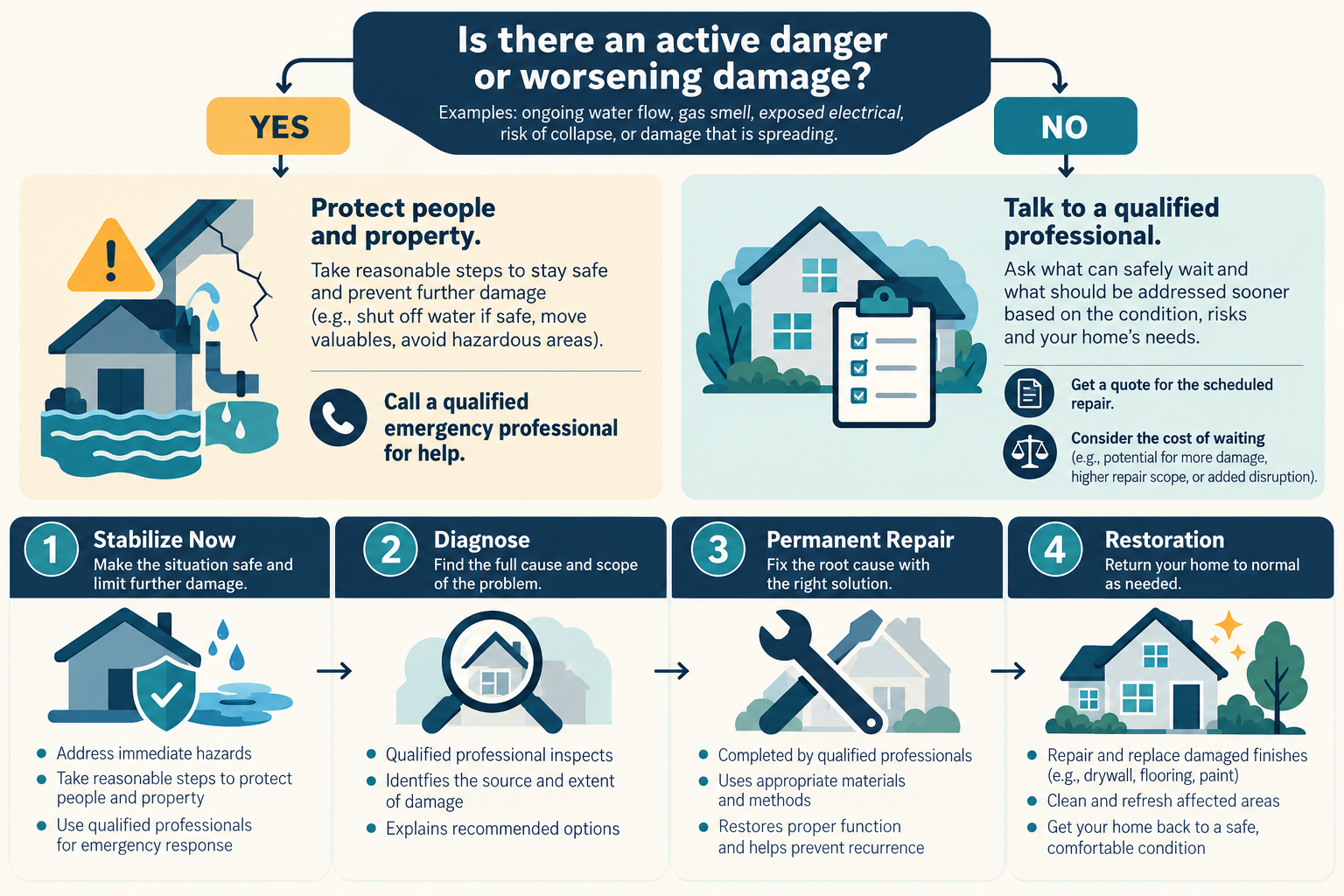
The first decision is not “How do I get the cheapest rate?” It is “What must be made safe or stopped now, and what can be scheduled after the immediate risk is controlled?”
What an emergency visit may include
An emergency invoice can combine several different services:
- dispatch or after-hours mobilization;
- diagnostic time to identify the immediate cause;
- temporary stabilization or isolation;
- parts sourced outside normal supply channels;
- labor at an unusual time or with a minimum charge;
- a follow-up visit for the permanent repair;
- separate drying, cleanup, restoration, or replacement work.
A fast response may therefore be a first step rather than a complete project. Ask whether the quoted amount stops at diagnosis, temporary protection, or a permanent repair. A water-related call, for example, may leave finish restoration or broader damage work to another scope.
Decide what can safely wait
Do not delay work involving an active electrical or gas hazard, fire, structural instability, sewage exposure, loss of essential heat in dangerous conditions, uncontrolled water entry, or another worsening threat merely to obtain a normal-hours price. Move people away from danger and contact the appropriate emergency service or qualified professional.
For a nonurgent problem, ask a qualified contractor whether a temporary measure is safe, how long it can last, and what could worsen while you wait. A small scheduled saving can be outweighed by damaged finishes, mold-supporting moisture, frozen piping, equipment failure, or a second mobilization.
The answer depends on the actual condition. A generic description such as “leak” or “no power” is not enough to rank risk safely.
Ask for the timing cost before dispatch
Before authorizing a visit, ask:
- What is the dispatch or emergency fee, and what time window does it cover?
- Is the first visit diagnostic, corrective, or both?
- What labor, travel, parking, parts, testing, and minimum charges are separate?
- Will the contractor obtain approval before work exceeds the initial scope?
- Is temporary stabilization included, and what remains for a later visit?
- Who handles restoration if walls, flooring, insulation, or finishes are opened?
- Can the contractor provide a written estimate or range before nonurgent work begins?
A reputable provider should be able to explain the basis of the fee even when the final repair cannot yet be priced. Be cautious about pressure to approve a broad replacement before the immediate problem and scope are described.
Compare emergency and scheduled options honestly
Record the cost of the immediate response, the cost of the permanent work, and the cost of waiting. Include temporary accommodation, damaged contents, cleanup, and a second mobilization when relevant. A scheduled quote may appear lower because it assumes normal access and complete diagnosis. An emergency quote may include service outside regular hours but not the final restoration.
Do not compare an after-hours call with a routine project quote as if they were the same unit of work. Compare the outcome, the time, the included protection, and the unresolved exposure.
Timing varies by market
Specialist U.S. plumbing cost guidance illustrates that evening, weekend, and holiday service may be priced differently, but it does not establish a universal emergency rate across trades or a Canadian benchmark. U.S. and Canadian homeowners should obtain a local quote and ask which assumptions apply.
If an emergency call reveals a larger project, pause when safe and request a written scope. Then compare repair, replacement, temporary, and phased options using the same cost categories. Paying more for a timely safe response can be rational; paying for unneeded work under time pressure is not.
Separate response speed from repair scope
“Emergency service” can describe the time of day, the need for immediate dispatch, the severity of the condition, or all three. A contractor may arrive quickly to isolate a leak but need another visit for permanent repair. An HVAC provider may restore limited heat before replacing a failed component. A water-damage company may stop the source while a different trade handles drying or finish replacement.
Ask the provider to identify the immediate objective:
- protect people from an active hazard;
- stop or contain water, smoke, sewage, or weather entry;
- restore a critical service temporarily;
- diagnose the cause;
- complete the permanent repair;
- document the condition for insurance or a property decision.
These objectives can have different providers, qualifications, and prices. A low first invoice may represent only stabilization. A high first invoice may combine dispatch, diagnosis, temporary work, and permanent repair. Neither can be judged without knowing what happens next.
Price the cost of waiting
For a nonurgent condition, compare the immediate option with a scheduled option using the same budget categories. Add the likely cost of:
- temporary protection or monitoring;
- additional damage while waiting;
- a second dispatch or after-hours call if the condition worsens;
- lost use of a room or essential service;
- accommodation, storage, cleanup, or replacement of damaged materials;
- a missed closing, insurance, tenant, or seasonal deadline.
Do not assign a probability you cannot support. Instead, state what is known, what a qualified professional says can safely wait, and what event would require escalation. A short written monitoring plan can be more useful than a made-up emergency premium.
Emergency authorization needs a narrow boundary
Under pressure, authorize only the work needed to make the situation safe or stop active damage unless the permanent scope is already clear. Ask the provider to tell you when the emergency phase ends and when additional approval is required. If the provider cannot price the permanent repair yet, request a description of the next diagnostic step, the expected time, and the pricing method.
Document photos, arrival time, observed condition, work performed, parts used, and advice about follow-up. This record supports later quote comparison and may matter to a carrier, landlord, lender, or property transaction, but it does not guarantee coverage or reimbursement.
Use a three-part timing comparison
Write three separate numbers or ranges: the cost to stabilize now, the cost to complete the permanent work on the current visit or a later scheduled visit, and the estimated cost of waiting. The third line can include monitoring, temporary protection, additional damage, loss of use, travel, accommodation, or a missed deadline. It does not need a made-up probability to be useful.
Then name the condition that would change the plan. Examples include water spreading beyond the original area, a temporary heat source becoming unsafe, a failed test, a part becoming unavailable, or a qualified professional advising that the system cannot remain in service. This turns “wait and see” into a managed decision. If no safe temporary condition can be established, treat the work as an immediate qualified response rather than a price-shopping exercise.
Keep the emergency authorization narrow. Ask for a receipt and description of the work performed, then use the new information to obtain a comparable permanent scope. This protects the homeowner from both unnecessary expansion and the false economy of paying twice for an undefined repair.
Once the immediate risk is controlled, compare repair, partial replacement, full replacement, and phased work. Consider whether the emergency intervention affects warranty, compatibility, efficiency, or the need for another opening of the same assembly. A temporary repair can be rational if it buys time for diagnosis or a planned replacement, but it should have a stated limit and monitoring plan.
Specialist U.S. plumbing guidance can illustrate timing-related prices, while Canadian and other trade markets may differ. There is no universal emergency multiplier. The economically sound choice is the one that controls the immediate consequence, makes the remaining scope visible, and avoids authorizing unrelated work merely because the contractor is already on site.
Ask for a handoff from emergency to planned work
Before the emergency visit closes, ask what was observed, what was done, what remains unknown, and what the next decision requires. Request the photos, measurements, test results, parts information, and temporary limitations that a later contractor would need. If the first provider cannot complete the permanent scope, ask for a written description of the safe interim condition and the date or event that should trigger follow-up.
Compare the scheduled option using the same endpoint as the emergency option. Include removal, access, restoration, testing, disposal, permits where applicable, and any temporary service. A quote that covers only the visible repair is not comparable with one that includes the surrounding work. If the emergency response revealed a broader failure, separate the newly supported scope from optional improvements.
This handoff prevents two common errors: treating a temporary measure as a permanent repair, and authorizing a full replacement before the condition is understood. The timing decision remains open only while the property can be kept in a defined, safe state.