
Changing the start date can affect a home project’s price, availability, and execution risk, but there is no universal cheap season. The result depends on the trade, climate, project type, local backlog, material supply, and whether the work can safely be performed in the proposed conditions.
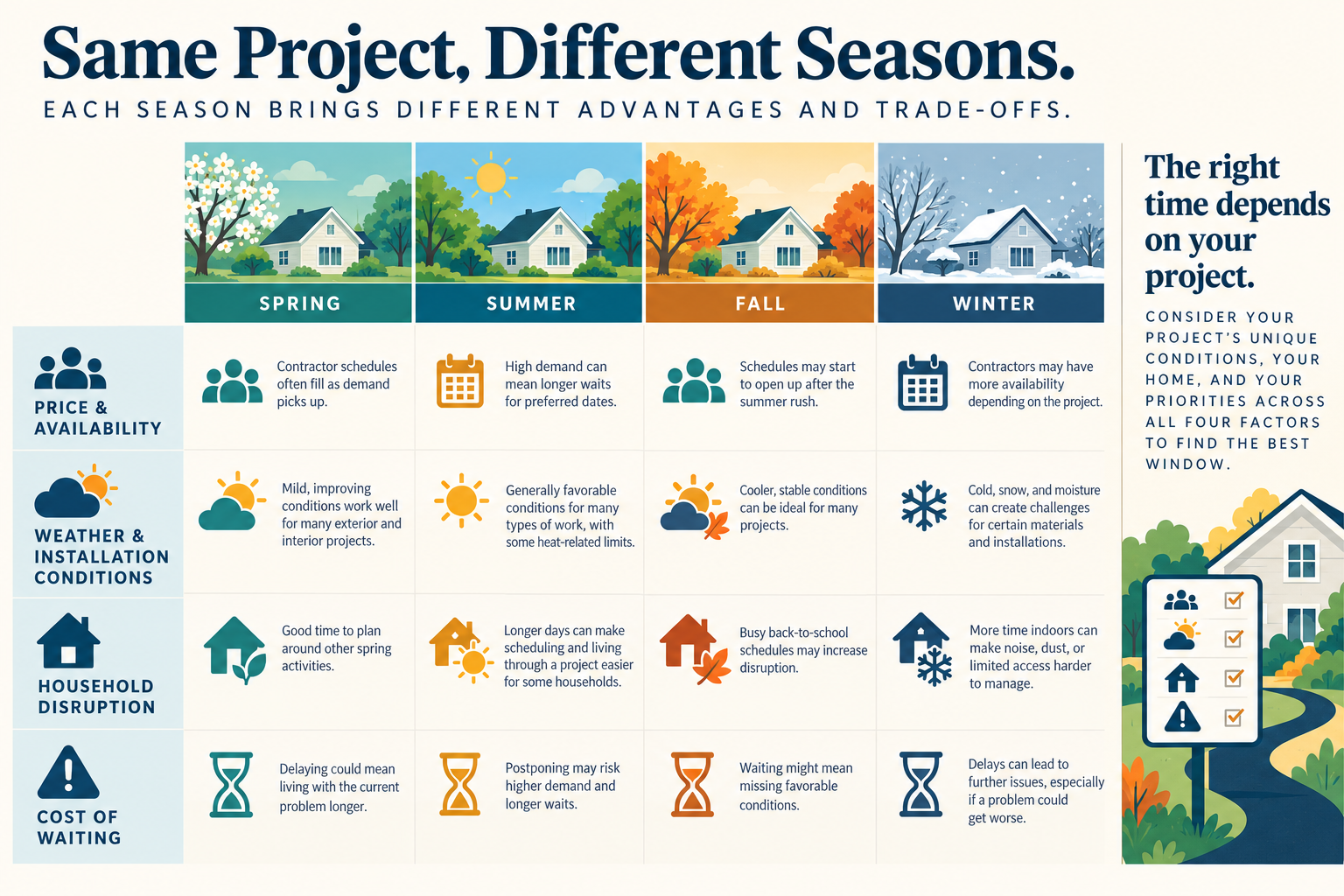
Think of timing as a comparison of three things: the price offered, the quality and safety of the installation window, and the cost of waiting.
What seasonality can change
Seasonal conditions influence a project through several channels:
- Demand: Contractors may be busier when homeowners commonly schedule exterior or weather-related work.
- Availability: A less busy period may offer more flexible scheduling, but not necessarily a lower price.
- Weather: Rain, snow, ice, heat, cold, humidity, and daylight can affect access, curing, drying, temporary protection, and worker safety.
- Materials: Lead times, supplier inventory, shipping, and special-order products can change the workable start date.
- Disruption: A project inside an occupied home can be harder during holidays, school schedules, or extreme weather.
- Urgency: Waiting can turn a manageable repair into active damage or an emergency call.
These drivers can point in different directions. A contractor may have more open capacity in winter but face higher protection or heating costs. An indoor project may be easier to schedule in a slow season while an exterior coating or installation has conditions it cannot safely meet.
Ask whether the work is condition-sensitive
Before chasing an off-season price, ask the contractor and, where applicable, the manufacturer or qualified designer:
- What temperature, moisture, weather, or surface conditions are required?
- Can materials be stored and protected properly at the property?
- What happens if the weather interrupts the work?
- Will temporary protection remain secure between visits?
- Does the shorter daylight window change crew hours or access arrangements?
- Is the proposed start date realistic for inspections, curing, delivery, and closeout?
Do not turn a general seasonal suggestion into technical approval for a specific product or system. Product and local requirements control when conditions matter.
Compare the cost of waiting
For a nonurgent project, request comparable quotes for more than one start window if contractors say timing affects price. Ask them to identify the actual reason: crew availability, overtime, material lead time, temporary protection, or a different scope.
Then estimate the cost of waiting. Include temporary repairs, continued utility or operating cost, carrying cost, loss of use, deterioration, another inspection, and the possibility that the contractor’s schedule fills. A small discount is not a saving if delay increases the scope.
For an active leak, unsafe condition, failing essential service, or damage that is getting worse, protect people and property first. Seasonal price shopping must not delay a necessary response.
Use Canadian market indexes carefully
Statistics Canada’s Residential Renovation Price Index reports average price movement for selected renovation work in Canadian census metropolitan areas. Its contractor prices include materials, labor, equipment, overhead, and profit, but the index is not a project quote, an accepted-bid database, or a guaranteed seasonal discount. It also excludes value-added taxes and project-design costs and can be revised.
Use that type of index to understand broad market movement, not to predict what your contractor will charge or to convert a U.S. quote into Canadian dollars. Local quotes remain the better evidence for a particular property and start date.
Make timing part of the written proposal
Ask each contractor to state the assumed start and completion dates, weather allowances, material lead times, temporary protection, schedule consequences, and price-expiration terms. If the schedule changes, ask whether labor, rental, storage, accommodation, or subcontractor costs change too.
The best timing decision is the one that balances price with a suitable installation window, dependable access, and the cost of delay. Treat an off-season offer as one option to investigate, not as proof that waiting always saves money.
Classify the project before choosing a season
Timing behaves differently for three broad project types:
- Condition-sensitive exterior work: coatings, roofing, masonry, concrete, drainage, and similar work may depend on temperature, moisture, curing, ground conditions, or safe access.
- Interior work: demand, contractor backlog, material lead times, ventilation, humidity, household disruption, and holiday schedules may matter more than outdoor temperature.
- Urgent or failure-driven work: the condition may control the date. Waiting for a preferred season can increase damage or force an after-hours response.
The category is only a starting point. Product instructions, local conditions, and the contractor’s method control. A mild calendar month does not guarantee a suitable installation window, and an unpopular month does not guarantee a discount.
Ask what the price change represents
When a contractor says a different start date is cheaper or more expensive, ask for the mechanism. It may be crew availability, overtime, material storage, temporary weather protection, travel, equipment rental, supplier pricing, inspection timing, or a different scope. “Off-season discount” is not an explanation by itself.
Request comparable written options with the same product, quantity, protection, warranty, and completion standard. If the contractor cannot hold the scope constant, record the difference rather than attributing the whole change to seasonality. A lower quote that removes weather protection or shortens curing time is not a legitimate seasonal saving.
Include household and market timing
Your own calendar can change the real cost. A project during school, a move, a sale, or a holiday may increase temporary accommodation, storage, pet care, work disruption, or the chance that decisions are made under pressure. A project with a flexible start may let you wait for a better-defined scope, combine compatible work, or obtain a more complete material order.
Contractor backlog is also part of timing. A busy period can push the work into a weather-sensitive window or require a rushed decision. A slower period can improve appointment flexibility without changing the contractor’s base price. Ask how long the quote remains valid and whether material or labor assumptions change after that date.
Use a timing comparison sheet
For each proposed start window, record:
| Timing factor | What to compare |
|---|---|
| Price | Same scope, taxes, delivery, equipment, and exclusions |
| Condition | Temperature, moisture, daylight, access, and temporary protection |
| Availability | Crew, permits, inspections, suppliers, and backup dates |
| Disruption | Occupancy, utilities, storage, accommodation, and work-from-home effects |
| Delay exposure | Deterioration, operating cost, insurance, sale, or seasonal deadline |
| Closeout | Testing, curing, cleanup, restoration, and documentation |
Statistics Canada’s renovation price index can describe broad Canadian contractor-price movement for selected projects and markets, but it is not a quote or a guaranteed seasonal saving. Do not use an index to convert a U.S. proposal into a Canadian price.
Choose the start date that keeps the work safe, adequately defined, and manageable. If the project is nonurgent, flexibility is valuable. If the property is deteriorating or an essential service is at risk, the cost of waiting deserves more weight than a possible calendar-based discount.
Confirm the work can close in the chosen window
Ask how weather or seasonal conditions affect not only the start date but also the last day of installation, curing, testing, cleanup, and temporary protection. A start that looks available may not leave enough time for the work to reach a usable endpoint before a freeze, wet period, storm season, holiday, or occupancy deadline. Include a backup date and the cost of maintaining the temporary condition.
For outdoor or weather-sensitive work, confirm who monitors the conditions and who decides whether a day is safe or productive. For indoor work, consider humidity, ventilation, material acclimation, utility shutdowns, and household disruption. The contractor should identify assumptions in the proposal rather than treating a calendar month as a guarantee.
Seasonal flexibility is most valuable when it buys a better-defined scope or safer completion. If the project is already causing active damage, choose the response that controls the condition and document the remaining work instead of waiting for a theoretical low-price period.
Put timing assumptions in the quote
Ask the proposal to state the assumed start window, weather limits, material availability, crew availability, protection, backup dates, and what happens if conditions prevent productive work. Also ask how a delay affects labor, delivery, equipment, permits, inspection, and household disruption. This turns a seasonal conversation into terms that can be compared with another provider’s proposal.
If a quote is valid only briefly, record the expiry date and the assumptions behind it. Reconfirm the price and scope before authorizing work after that date. The aim is not to predict the market perfectly; it is to avoid treating an old, weather-dependent estimate as a current commitment.
That small record also makes a later price change explainable: you can see whether the difference came from scope, timing, conditions, or a changed market assumption.
It also gives the homeowner a clear question to ask before accepting a revised proposal or moving the work into a less suitable season.