
A symptom is not always a repair scope. “The wall is damp,” “the breaker trips,” or “the system is not working” may describe several possible causes with different trades, access, and costs. Asking several contractors to bid an undefined problem can produce several incompatible assumptions rather than comparable prices.
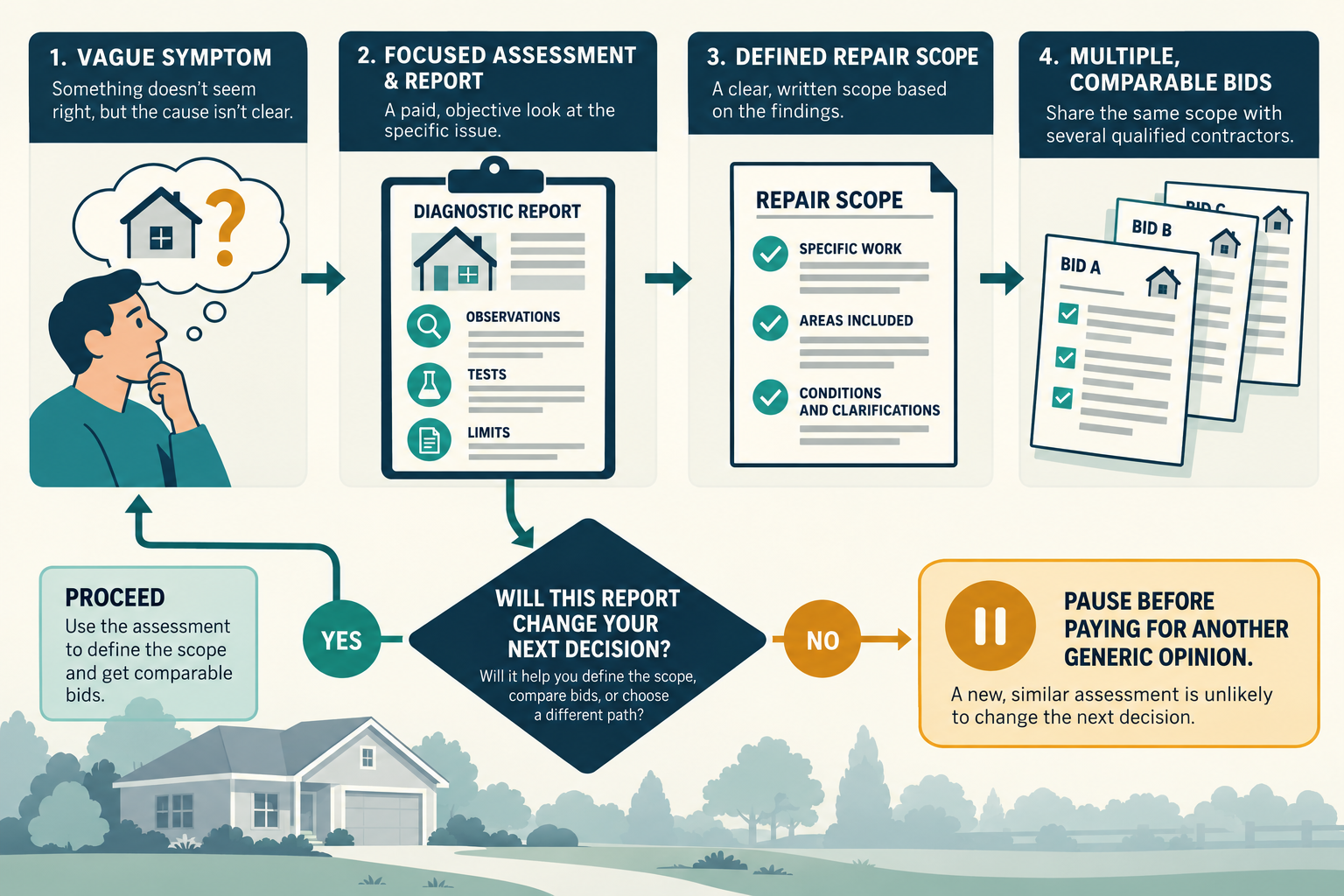
A paid diagnostic or inspection can be worthwhile when it materially narrows the problem, identifies the right specialist, documents the condition, or prevents an unsafe or ineffective repair. It is less useful when every bidder must perform the same investigation before pricing or when the paid visit produces only a brief observation with no usable deliverable.
Match the service to the uncertainty
These services are not interchangeable:
- General home inspection: a broad assessment for a stated inspection purpose. It can identify conditions that deserve attention but is not a contractor estimate.
- Specialist inspection: an assessment of a defined system or condition, such as structure, drainage, electrical work, or water intrusion.
- Diagnostic visit: testing or investigation intended to identify a likely cause or next step.
- Engineering or design investigation: analysis used to define a repair or alteration, often with professional deliverables and approval requirements.
- Estimate visit: a pricing exercise for work the provider believes is sufficiently defined. It may be free or paid.
When buying a home, an independent inspection should be scheduled early enough to allow specialist follow-up and a transaction decision. For an owned home, the right service depends on the consequence and how much scope is unknown.
Ask what you will receive
Before paying, get the deliverable in writing. Ask whether the fee includes:
- a visual assessment, testing, measurements, or limited opening of an assembly;
- a written report, photographs, marked-up plan, or repair scope;
- a likely cause, a list of alternatives, or only observed conditions;
- a budget range, unit prices, or no pricing at all;
- recommendations for another qualified specialist;
- a second visit, follow-up questions, or report revisions;
- a credit toward repair work and the written conditions for that credit.
Do not assume that a “free estimate” includes diagnosis. Do not assume that a paid assessment is independent simply because it has a fee; the same firm may also be seeking the repair contract. Either arrangement can work when the purpose, limitations, and financial relationship are clear.
Compare the value of information
The fee has economic value when it changes a decision. It may let you:
- send the same defined scope to several contractors;
- avoid paying several providers to repeat a limited visit;
- identify concealed damage before committing to finishes;
- choose repair, replacement, or a temporary option more deliberately;
- document a condition for a purchase, insurance, or ownership decision;
- avoid opening an assembly or installing a part that will not address the cause.
The value is lower when the condition is obvious, the scope is already measured, the contractor must diagnose it as part of any proposal, or the report does not reduce uncertainty. Ask what decision the report is meant to support before booking it.
Use safety and independence boundaries
Suspected structural movement, gas, electrical, fire, environmental-health, active-water, or essential-service conditions deserve appropriately qualified evaluation. Do not use a generic report or online opinion as permission to perform hazardous testing or delay protective action.
An independent specialist may provide useful separation between diagnosis and the company selling the repair, but independence does not guarantee a particular conclusion. A repair contractor may be the most efficient diagnostician for a straightforward system. Compare the cost, expertise, deliverable, and potential conflict rather than applying one arrangement universally.
Turn the result into comparable bids
Give each bidder the same report, photographs, measurements, and stated outcome. Ask them to identify what the report establishes, what they still need to verify, and what remains excluded. Put the diagnostic fee in the project budget whether it is credited, embedded, or payable even if the work is declined.
For a home purchase, a general inspection is not a price quote, and transaction, lender, and contract treatment varies. In the United States, the Consumer Financial Protection Bureau notes that major repairs can affect a buyer’s decision or mortgage process and that additional inspections may be needed. Canadian homeowners should apply the same decision discipline while checking provincial and local requirements.
Pay for diagnosis when it buys clarity that changes the next step. If it does not, obtain a clearer scope before paying multiple providers to price the same uncertainty.
The value is the decision it changes
Before booking, write down the decision you cannot make yet. It might be whether to repair or replace, whether the problem belongs to one trade or several, whether the home is safe to occupy, whether a purchase should proceed, or whether a proposal can be compared with another one. If the diagnostic report will not change that decision, the fee may only add paperwork.
The value can be financial, but it can also be avoided disruption or reduced risk. A specialist assessment may prevent an unnecessary opening of a finished wall, identify an active source before restoration begins, or show that a system-specific contractor is needed. It can also tell you that the cause is not established and that more testing is needed. That uncertainty is useful when it prevents a homeowner from treating a guess as a repair scope.
Choose the right independence level
There are several legitimate arrangements:
- a contractor diagnoses and repairs its own trade;
- an independent specialist defines the condition before contractors bid;
- a general inspector identifies concerns and refers the homeowner to specialists;
- an engineer or designer defines a structural or alteration scope;
- several bidders each include a limited diagnostic phase.
The right arrangement depends on consequence, complexity, cost, and the need to compare alternatives. A firm that can diagnose and repair may be efficient for a clear equipment failure. An independent report may be more useful when the homeowner wants competing repair methods or when a major project could be sold, insured, or negotiated.
Ask who owns the report, whether it can be shared with bidders, what qualifications apply, and whether the person is paid only for assessment or also stands to sell the repair. These questions do not imply bad faith. They make the financial relationship visible so the result can be weighed appropriately.
Set boundaries for invasive work
Opening a wall, roof, floor, or mechanical assembly can provide better information but may create repair, containment, permit, or safety costs. Before authorizing it, ask what the opening is intended to establish, what happens if the result is inconclusive, how the opening will be secured, and whether the restoration is included. For environmental hazards, electrical, gas, structural, fire, or health concerns, use appropriately qualified professionals and do not improvise tests.
A report should state its limitations. A visual inspection cannot confirm concealed conditions. A single test can rule in or rule out only what the method measures. A general home inspection is not a contractor estimate, and a contractor estimate is not a guarantee that all defects have been found.
Decide whether the deliverable changes your next step
Before paying for an assessment, define the decision it should enable. You might need to choose between repair and replacement, determine which trade should bid, decide whether an inspection finding is material, or separate source correction from finish restoration. If the report will not change any of those choices, a second generic opinion may add little value.
Ask how the provider handles uncertainty. A useful result can state that a cause is confirmed, that a condition is ruled out, or that a particular invasive test is still needed. It should identify observations, limitations, and the boundary between a recommendation and a priced scope. If the provider also sells the repair, ask whether the report is independent, whether the diagnostic fee is credited, and what happens if you use another contractor.
The result does not have to produce a final construction price. It earns its cost when it prevents several incomparable bids, avoids an unsuitable repair, identifies a high-consequence condition, or lets you phase the work with a clearer stop point.
Give every bidder the same report, photographs, measurements, drawings, and desired outcome. Ask each to identify which findings it accepts, which it must verify, what it includes, and what it excludes. Keep the diagnostic cost visible even when a provider credits part of it against later work.
After receiving proposals, check whether they actually respond to the report or merely repeat its symptom. If the quotes remain incomparable, a second focused question may be worth more than a third broad bid. The purpose of paid diagnosis is not to eliminate uncertainty completely; it is to spend deliberately on the information that makes the next economic decision safer and clearer.
Keep the report, invoice, and resulting bids together. If a later proposal changes the diagnosis or scope, record what new evidence caused the change before authorizing additional work.