
An older home may need a different planning approach because several systems can be near the end of their useful planning window, previous work may be undocumented, and deferred maintenance may be discovered at the same time. But age alone does not prove that a home is defective. Renovation history, installation quality, climate, exposure, and current condition can matter more than the construction date.
Why age changes the budget conversation
Older properties can have:
- multiple systems installed during the same construction period;
- legacy materials or components that are difficult to source or match;
- repairs hidden behind finishes or previous alterations;
- layers of deferred exterior, moisture, or maintenance work;
- documentation gaps about installation, permits, warranties, or service;
- access or construction details that make a modern replacement less direct.
The economic risk is often overlap. A homeowner may be able to handle one replacement but not several large decisions in the same year.
Use evidence, not an age multiplier
Fannie Mae presents a U.S. rule of thumb that places newer homes nearer the lower end and homes over 30 years old nearer the higher end of a 1%–4% annual maintenance, repair, and replacement budget. That range includes more than routine upkeep and is not a forecast for every older home.
U.S. Census analysis of American Housing Survey data has also described different improvement and maintenance spending patterns for older homes and newer owners. The findings provide context for planning; they are not a formula that transfers automatically to Canada or predicts one home’s invoices.
Use age to trigger an inventory and condition review. Do not use it to invent a repair list.
Build a five- to ten-year map
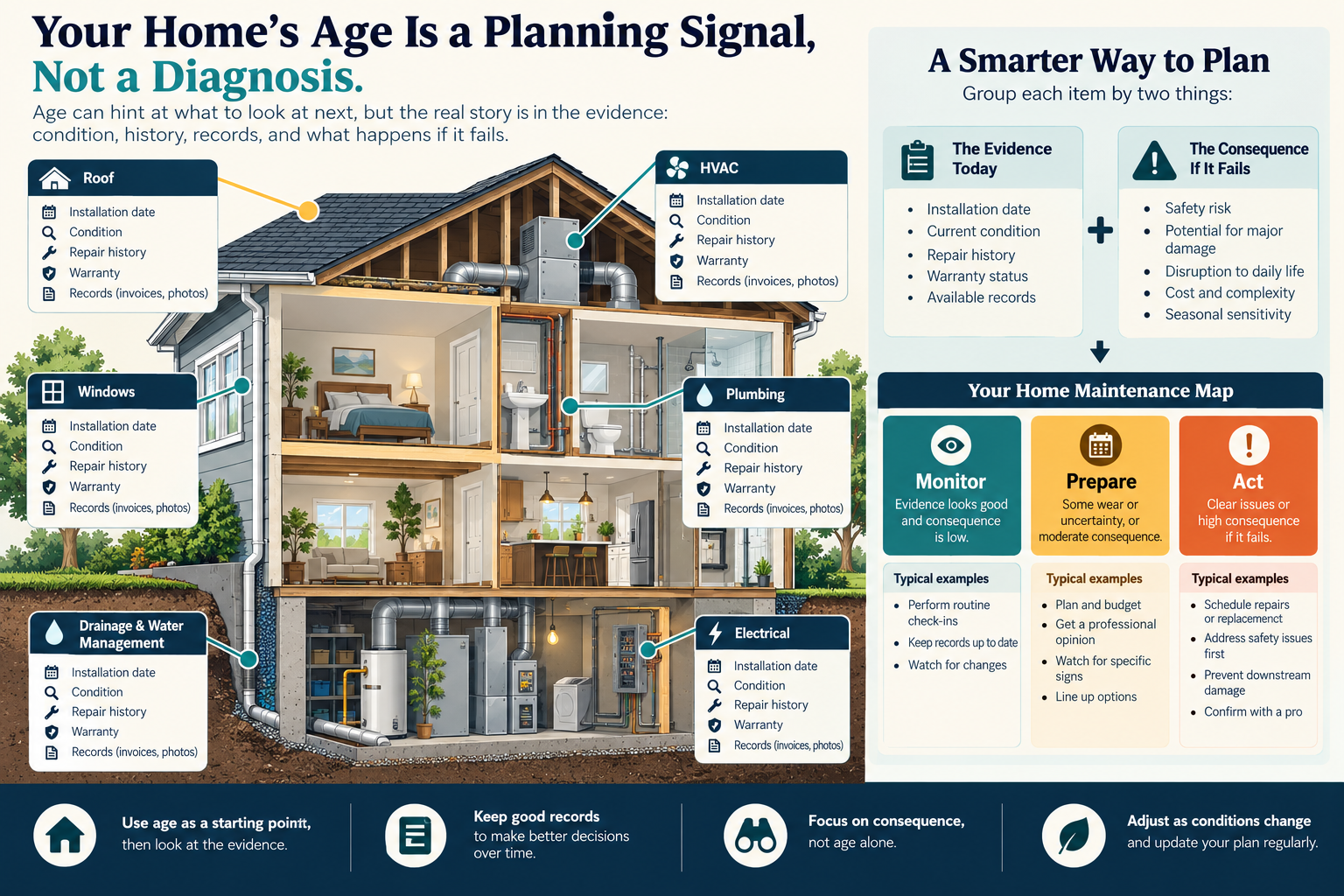
For each major system, record the age if known, current condition, repair history, warranty, likely replacement scope, and consequence of failure. Place the system in a broad planning window: monitor, prepare, or act. Then identify which projects depend on one another.
For example, a planned exterior change may affect windows, cladding, drainage, insulation, or interior restoration. A service upgrade may be needed before electrification. A moisture correction may need to precede finish work. These relationships are more useful than a list sorted only by age.
Use current local quotes for large replacement exposure. Include access, removal, permits, testing, design, related trades, and restoration. Keep U.S. and Canadian pricing separate; do not convert one market’s quote by exchange rate.
Separate legacy-home questions
Some older homes have historic materials, preservation constraints, hazardous materials, or legacy systems that deserve specialist treatment. A general age-and-budget article should flag those possibilities and route them to the relevant assessment. It should not treat every pre-1950 home as a historic property or every old component as hazardous.
If a material or system affects safety, health, structure, electrical, gas, water, or insurance, obtain appropriately qualified advice before disturbing it. The cost of investigation may be part of the age-related budget even when no repair is ultimately required.
Budget for knowledge as well as work
New owners may spend more while they learn the home’s condition, while long-term owners may have records, routines, and trusted providers that reduce surprises. A purchase inspection, specialist report, service history, and warranty file can change the estimate without changing the home’s age.
Keep a separate line for diagnosis and records. Do not classify every inspection recommendation as an immediate repair. Prioritize active hazards, active damage, essential services, and conditions whose delay could compound before funding discretionary improvements.
Review the map annually
Update the plan after a repair, renovation, severe weather event, insurance change, or new inspection. Ask whether a repair solved the cause, whether a system’s remaining exposure changed, and whether several future projects are converging.
An older home can be economical to own when it is well maintained and understood. A newer home can still have a large repair exposure when condition, installation, or documentation is poor. Use age to ask better questions, then let evidence and the property’s actual condition shape the budget.
Why age changes the shape of the budget
Age can affect a budget through overlapping replacement cycles, past alterations, deferred work, discontinued components, and incomplete records. Several systems may have been installed during the same renovation and approach a planning window together. An older property may also contain assemblies that require more careful investigation before a repair is priced.
These are exposure patterns, not diagnoses. A well-maintained older home can have lower near-term needs than a newer home with poor installation, severe weather exposure, or an unknown history. The relevant question is not “How old is the house?” but “Which parts of this property are understood, maintained, and approaching a material decision?”
Build a condition-based age map
Create a table with one row for the roof, drainage, structure, envelope, heating and cooling, plumbing, electrical, appliances, exterior finishes, site work, and other material systems. For each, record installation or renovation date, observed condition, repair history, warranty, expected next review, and the evidence supporting that assessment. Use “unknown” honestly. Unknown age is a reason to investigate, not a reason to assume failure.
Group the rows into:
- work needed now or requiring diagnosis;
- recurring maintenance;
- likely replacement planning;
- systems that are old but currently performing with no known material defect;
- discretionary improvements.
This map avoids the mistake of applying a higher annual percentage to every cost without identifying what the money is meant to accomplish.
Budget for legacy uncertainty without turning it into a stereotype
Older assemblies may contain previous repairs, additions, mixed materials, abandoned components, or construction methods that differ from current practice. These conditions can increase the need for testing, opening, engineering, specialized labor, or finish restoration. They do not prove that a project needs a full modernization.
When a proposal mentions an upgrade, ask whether it is required to correct a verified condition, required by the scope or authority, or simply recommended as an improvement. Separate the minimum safe repair from optional modernization. If the property is historic or has preservation constraints, use the category and professional guidance appropriate to that subject rather than assuming age alone makes preservation work necessary.
Compare new-owner and long-term-owner exposure
A new owner may discover deferred maintenance, missing records, warranties that do not transfer, and systems whose condition was not obvious during a purchase. A long-term owner may have better records but may also have postponed work or become accustomed to gradual deterioration. The first-year budget should therefore emphasize inspection, inventory, liquidity, and triage rather than a fixed age surcharge.
The U.S. housing-age evidence in the research package provides context for spending patterns; it is not a forecasting formula and should not be generalized automatically to Canada. Canadian owners should use local property condition, quotes, housing practices, and market data.
Use an age-and-condition worksheet
For each system, record the home’s construction date, the best-known installation date, renovation history, condition evidence, recent repair history, likely planning window, and the current local replacement scope. Mark which entries are documented and which are estimates. This helps separate an old component that has been maintained and inspected from a newer component with unknown installation quality or hidden damage.
Then group the work by decision horizon:
| Horizon | Planning question |
|---|---|
| Next 12 months | What must be inspected, stabilized, maintained, or priced now? |
| Years 2–5 | Which systems may overlap and require coordinated saving or access? |
| Years 5–10 | Which uncertain items need a planning range rather than a promised date? |
Do not treat this map as a lifespan table. It is a way to identify where missing records or overlapping exposure deserves investigation. If the home is historic or has specialized legacy systems, use the relevant specialist guidance rather than assuming an age-based budget article answers the preservation or compatibility question.
Update the age and condition map after a renovation, severe weather event, inspection, insurance request, major repair, change in occupancy, or purchase. Ask whether the event exposed a related system and whether it changed the order of future work. The best age-based budget is dynamic: age helps identify questions, while documented condition and consequence decide where money goes.
Record the reason behind every age-based line
For each reserve or inspection item, write why it appears: observed wear, incomplete records, manufacturer guidance, exposure, prior repair history, approaching project dependency, or an age-based question that still needs evidence. Do not use age alone to justify a replacement. A well-maintained older component may need only monitoring, while a newer component with an active condition may need immediate attention.
Add the access and coordination assumptions that make the planning amount meaningful. A replacement may require temporary protection, removal of connected materials, an electrical or plumbing adjustment, a permit, testing, disposal, or finish restoration. If those assumptions are unknown, keep them as a range or information task rather than presenting a false precise target.
Refresh the record after a service visit or inspection. Note the professional’s qualifications and limitations, the remaining useful question, and the next review date. The best age-based budget becomes less dependent on age as the homeowner accumulates condition, cost, and maintenance evidence.