
A deposit can help a contractor schedule labor, purchase materials, or reserve capacity. It also creates risk for the homeowner before meaningful work is complete. A safer payment structure connects money to a written scope, identifiable progress, delivered materials, or agreed milestones rather than pressure for a large unexplained advance.
Start with the written contract
Before paying, confirm the contractor’s legal identity, address, license or registration where applicable, insurance, scope, materials, start and completion assumptions, total price or pricing model, payment schedule, warranty, permits, cleanup, subcontractors, and change procedure. The U.S. Federal Trade Commission advises against paying the full project amount up front and recommends retaining final payment until the work is complete and satisfactory.
The contract should state whether a deposit is refundable, what it covers, when it is earned, and what happens if the project is canceled or delayed. “Materials” is not enough if the deposit is large: ask which materials, whether they are ordered, whether they are stored for your project, and how unused or returned items are handled.
Use progress payments carefully
Progress payments can be tied to observable milestones such as completed demolition, delivery and installation of a defined assembly, passed inspection, or substantial completion. The milestone should describe the work, not only a date. Avoid paying for work that is merely promised or for a large percentage of the project while critical scope remains undefined.
Keep a record of invoices, receipts, approved changes, photographs, inspection results, lien or holdback documents where applicable, and payment method. Do not make a cash payment without a traceable receipt. Ask whether subcontractors and suppliers have been paid and what documentation protects you from later disputes; local lien law controls the answer.
The final payment is leverage, not a reason to withhold unfairly
The contract should define substantial completion, punch-list work, commissioning, cleanup, documents, keys, warranties, and the process for correcting defects. A final payment should follow the agreed completion conditions. Do not invent a holdback percentage or withhold an undisputed amount without understanding the contract and local law.
Local rules are not national defaults
Deposit caps, holdbacks, cancellation rights, written-contract thresholds, cooling-off rules, and payment requirements vary by state, province, territory, project type, and how the contract was sold. The jurisdiction-specific examples below illustrate the difference:
- Ontario consumer guidance recommends limiting the down payment and describes an estimate and contract rule for that province.
- California CSLB guidance describes a written-contract threshold and down-payment and change-order requirements for the stated California home-improvement scope.
- Alberta guidance asks homeowners to confirm deposit refund conditions and includes payment schedules and holdback provisions in its contract checklist.
These examples must not be generalized to all of Canada or the United States. Check the authority for the exact location and transaction. If the contract involves a home solicitation, financing, a lien, an estate, or a dispute, obtain local consumer or legal advice.
Warning signs to slow down
Pause when a contractor demands full payment before work, asks for a large unexplained deposit, refuses a written contract, pressures you to sign immediately, changes bank details by an unverified message, will not identify subcontractors, or says permits and insurance are someone else’s problem without clarifying responsibility. A legitimate material need can be documented; urgency is not documentation.
Before authorizing an increase, require the reason, the added or deleted scope, price change, schedule effect, and signatures or approvals required by the contract and law. Paying a deposit is not a substitute for resolving those questions.
Tie payments to a visible project state
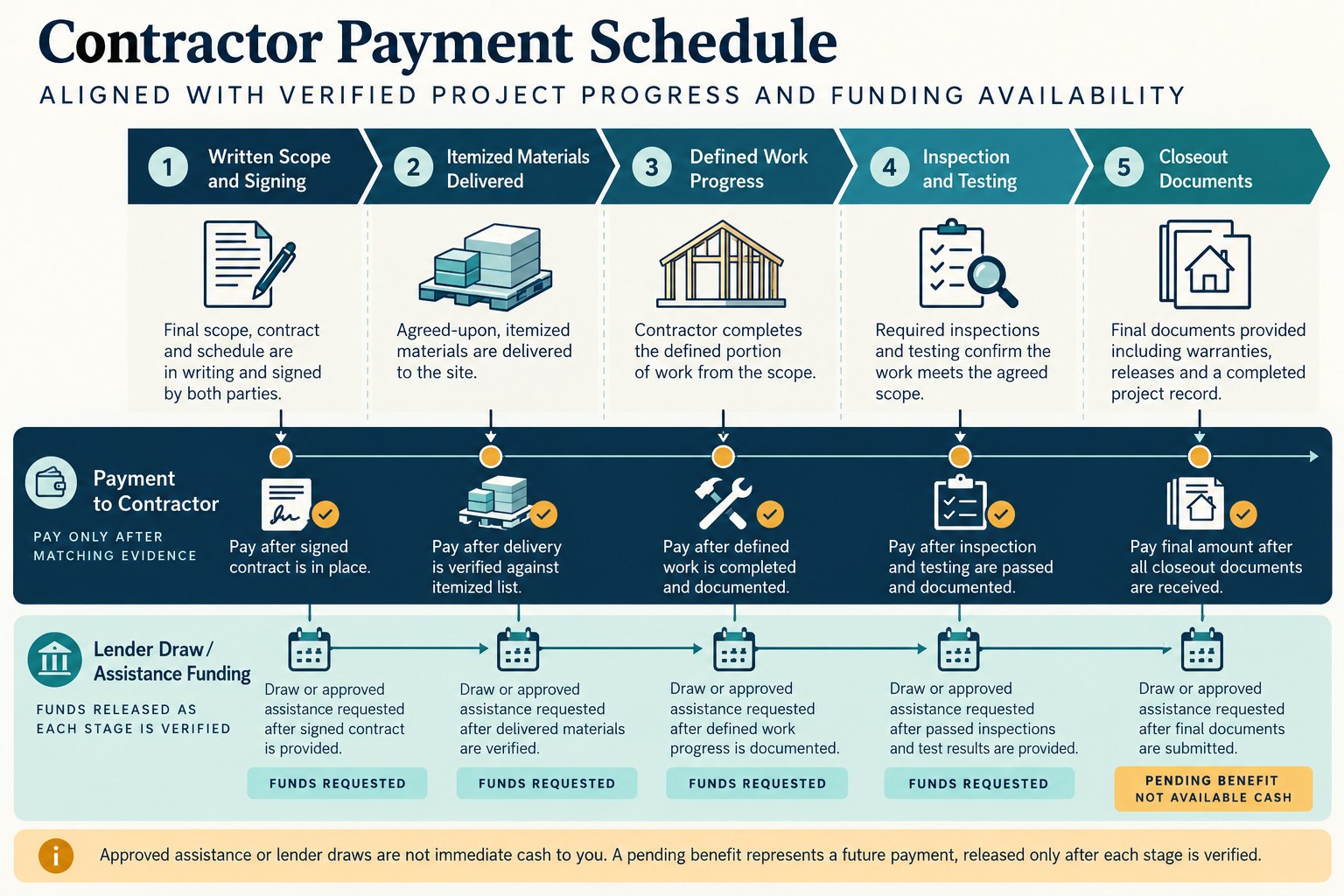
A payment schedule is easier to manage when each installment corresponds to a verifiable milestone rather than an arbitrary date. Depending on the project, milestones might include delivery of approved materials, completion of defined preparation, installation of a measured portion of the work, successful testing, or documented closeout. Avoid paying for a milestone that is described only as “substantially complete” without a way to determine what that means.
For a large project, keep a simple ledger with the contract amount, deposit, approved changes, payments made, credits, retainage or holdback where applicable, and the remaining balance. Match invoices to the schedule and keep receipts, lien or holdback documents, inspection approvals, warranties, and proof of insurance with the contract. The exact documents and rights depend on the jurisdiction and project type.
Materials create a legitimate but specific advance-payment question. A contractor may need money for a special-order item, but ask what was ordered, when it will arrive, who owns it if the project stops, how it is stored, and whether the amount includes delivery or installation. A general request for a large deposit does not become safe merely because materials are mentioned. Require an itemized explanation and confirm whether the item can be returned or transferred.
Use local rules as modules, not defaults
Deposit limits, cooling-off rights, progress-payment rules, lien protection, holdbacks, cancellation rights, licensing, and required contract language vary. Ontario guidance provides one example of deposit and estimate treatment; California provides another set of home-improvement contract requirements; Alberta and British Columbia illustrate different provincial or transaction-specific questions. These examples show why a homeowner must check the state, province, territory, municipality, contract form, and project facts rather than apply a number from another location.
U.S. federal consumer guidance supports avoiding full prepayment and checking local rules. Canadian federal guidance supports written scope, specified products, payment terms, warranties, cleanup, and clear amendments. Neither source creates one nationwide deposit cap or payment schedule. Use a local regulator or qualified legal professional for an actual dispute or high-consequence contract question.
Protect the final payment
Before the final payment, confirm the agreed work is complete, required tests and inspections are finished, debris and temporary protection are addressed, defects are documented, and closeout documents have been delivered. Do not withhold money arbitrarily where the contract or local law provides a different process. If a defect remains, notify the contractor in writing, describe the unfinished item, and follow the contract’s correction or dispute procedure.
Be especially careful when a payment request changes bank details, uses pressure, asks for cash only, or arrives through an unverified message. Verify payment instructions through a known contact. Keep communication records and do not sign a blank change authorization. Payment controls are not a substitute for choosing a qualified contractor, but they reduce the amount of risk committed before the work can be checked.
Build a payment schedule around verifiable progress
For each proposed payment, write the milestone that makes it due and the evidence you will receive. A schedule might distinguish contract signing, delivered and identifiable materials, completed preparation, a finished installation, successful testing, and final closeout. The exact milestones depend on the work; a deposit for a special-order item is not the same as payment for a completed installation.
Before approving a progress payment, check whether the corresponding work is complete, whether materials are on site and intended for your project, whether approved changes are included, and whether another trade or inspection must finish the milestone. Ask for an invoice that shows the original contract amount, approved additions or credits, prior payments, the current request, and the balance to complete.
Do not let a schedule hide an unpriced future obligation. If the contractor needs more money because a concealed condition was found, ask for the scope, supporting observations, price, and approval path. If the request is urgent, authorize the narrow protective step first when possible and document the permanent decision separately.
Local law may require a particular deposit limit, holdback, cancellation notice, or payment treatment. The U.S. FTC advises against full prepayment, while Ontario, California, Alberta, and British Columbia have different examples of consumer or contract rules. Those examples show why the applicable authority and contract—not a generic percentage—must control.
Review a payment request before sending money
Compare the request with the signed scope and your payment ledger. Confirm the amount due, the milestone reached, approved changes, credits, prior payments, taxes, and balance remaining. Ask for photographs, delivery records, inspection results, test results, or other evidence appropriate to that milestone. A receipt proves that money changed hands; it does not prove that the related work or material was supplied.
Use a known phone number or in-person contact to verify a changed bank account or an urgent payment request. Keep the invoice, approval, proof of payment, and communication together. If a milestone is incomplete, identify the missing work in writing and ask whether the contractor proposes a correction, revised date, or properly documented change. Do not approve a broad payment simply because the project has become inconvenient to question.
For a project with multiple trades, confirm who is responsible for the next dependency before releasing the next installment. Payment sequencing should make unfinished work visible, preserve the contract’s correction process, and leave enough information to resolve a dispute without relying on memory.
Make closeout part of the schedule
Define the final milestone before the first payment. It may include completed punch-list work, operating instructions, test results, permits or inspection records where applicable, warranty information, final photographs, cleanup, and confirmation that temporary protections were removed. A project is not financially closed merely because the crew has left.
If the contract uses a holdback or retainage, follow the written terms and applicable local rules. If it does not, still list the closeout items and the correction process in writing. Keep enough time in the schedule to inspect the result in normal use and to report a defect promptly. This gives the last payment a clear purpose without turning it into an arbitrary penalty.
Match the funding calendar to the payment schedule
Put contractor due dates beside any lender draw, approved assistance, or expected rebate. Record whether each funding source is available now, approved but awaiting a condition, or still only an application or estimate. A credit limit, pending award, or later reimbursement does not automatically provide cash for a deposit or progress payment. Confirm draw requirements, eligible invoices, approval steps, and release timing before agreeing to a schedule that depends on them. Keep the amount you must contribute and the funds reserved for other household needs visible. For a specific repair-funding comparison, see savings, borrowing, or a staged project; for delayed incentives, see rebates and tax credits cash flow.