
A replacement reserve is money set aside for a large, foreseeable project before the system fails. It is different from routine maintenance and different from an emergency fund. The purpose is to turn a sudden major bill into a planned decision, even though the exact failure date and final price remain uncertain.
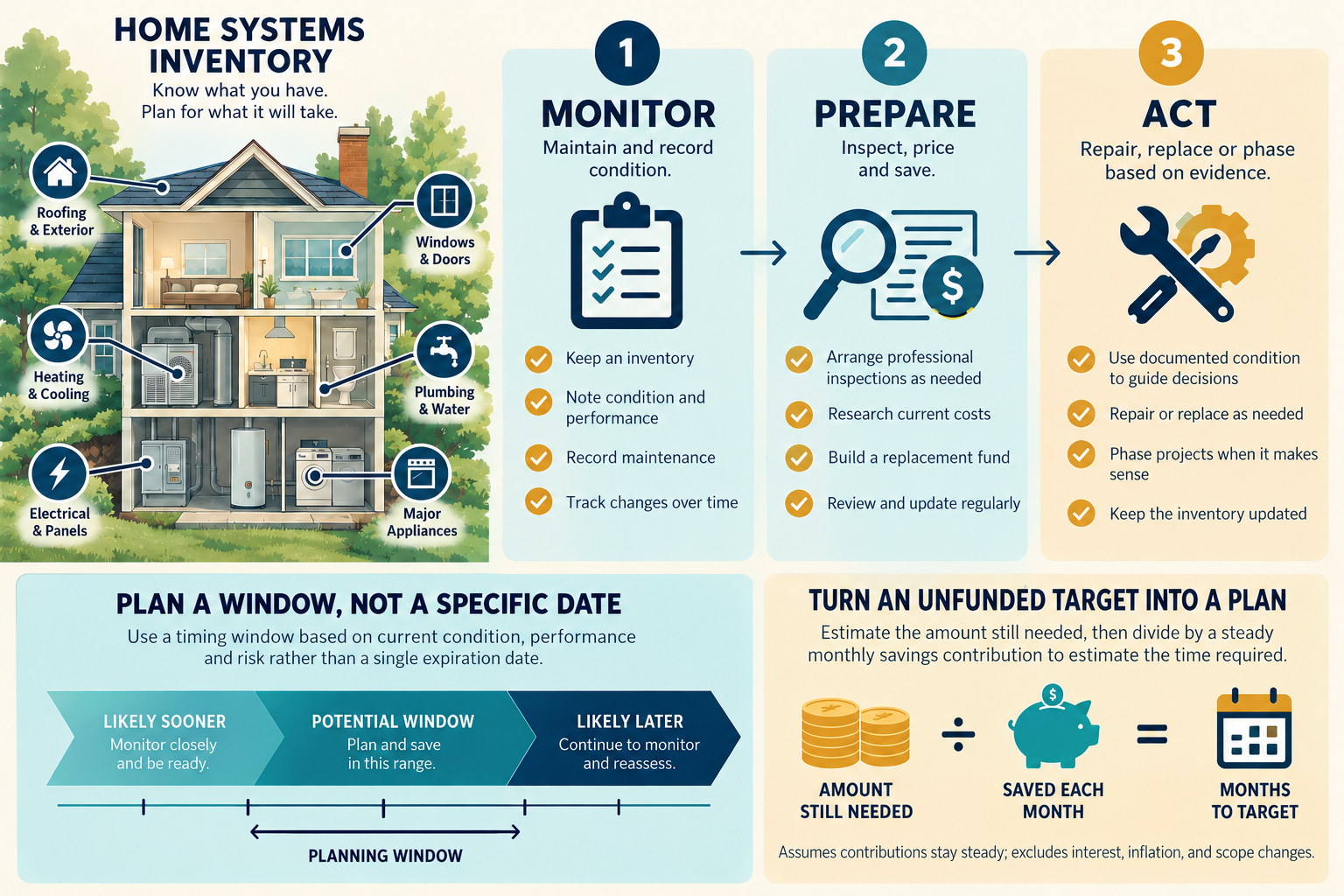
Start with an inventory that can be updated
Record each major system or assembly—for example, the roof, heating and cooling, water heating, electrical service, plumbing, windows, drainage, exterior, private utilities, and property-specific equipment. For each one, note:
- manufacturer, model, capacity, and installation date if known;
- location, access limits, and related systems;
- maintenance and repair history;
- warranty, service agreement, and available records;
- present condition and any unresolved diagnosis;
- likely replacement options and work that each option may trigger;
- a planning window and the date to review it again.
Freddie Mac recommends inventorying home equipment and warranties and noting age and manufacturer recommendations. The inventory is not a promise that a component will last until a particular year. It keeps an approaching cost visible even while the system still works.
Use a planning window, not an expiration date
Service-life ranges are affected by installation quality, maintenance, climate, use, water chemistry, product design, previous repairs, and local conditions. A system that has reached a commonly cited age may still operate, while a newer system may have a condition or compatibility problem. Use three planning windows:
- Monitor: maintain the system and gather records while condition is acceptable.
- Prepare: obtain a current assessment, investigate options, and begin saving more deliberately.
- Act: price repair, replacement, or a temporary solution when condition, reliability, safety, or project timing makes a decision necessary.
Move a system between windows based on evidence, not age alone. Review its window after an inspection, repair, severe weather, renovation, occupancy change, or insurance request.
Estimate the replacement in scenarios
Ask for current local pricing only after defining the likely scope. A replacement quote may include removal, disposal, access, permits, commissioning, controls, connections, finish repair, or upgrades required by the selected option. A low planning number may represent equipment only. A high planning number may include access, related work, and a more complete configuration.
Use at least two scenarios where the choice is material:
| Scenario | Purpose |
|---|---|
| Like-for-like or limited repair | Shows the least disruptive path if compatible and supportable |
| Planned replacement | Shows the complete current installed outcome |
| Expanded or future-ready option | Shows added capacity, efficiency, resilience, or compatibility work |
Do not assume the most expensive option is the most economical. Do not assume like-for-like replacement is possible. System-specific requirements belong in the relevant physical-category guidance and qualified proposal.
Convert exposure into a savings target
If a replacement planning range is $X to $Y and the review window is N years away, a simple planning contribution can be estimated from the amount still needed divided by the remaining period. This is not a financial-return calculation and it does not account for investment performance, inflation, or a changed scope. It is a prompt to ask whether the current contribution is enough and whether a price refresh is needed.
Use current quotes, not an old invoice, when the work becomes nearer. Canadian costs should come from Canadian market evidence and U.S. costs from the relevant U.S. market; currency conversion does not recreate local labor, tax, material, or code conditions. Statistics or price indexes can provide context but do not replace a property-specific scope.
Keep a replacement map that explains the target
For each major system, record the installation date if known, current condition, warranty, recent repairs, likely planning window, current installed-cost range, and work that may accompany replacement. Add a confidence label to the date and condition. “Installed in 2012” is a useful record; it is not an expiration date.
| Inventory field | Why it affects the reserve |
|---|---|
| System and location | Identifies which category-specific scope and access conditions apply |
| Age and evidence | Distinguishes a documented date from an estimate or guess |
| Condition and repair history | Shows whether a repair changed or reduced the exposure |
| Replacement scope | Captures removal, connections, permits, testing, and restoration |
| Planning window | Gives time to investigate and save without promising a failure date |
| Current local range | Avoids relying on an old invoice or a converted foreign-market price |
Divide the unfunded planning amount by the remaining period only as a simple contribution check. Refresh the local quote when the work enters the near-term window. If several systems overlap, prioritize by consequence, access, coordination, and cash flow rather than letting the oldest item automatically win. Keep the reserve distinct from cash for active emergencies. If a system fails early, compare a safe repair, staged replacement, temporary protection, financing cost, and the consequences of delay; do not postpone a serious safety or habitability response to preserve the reserve balance.
Preventive maintenance may extend useful performance or reveal a condition early, but it cannot guarantee a service life. Keep maintenance spending separate from the replacement reserve so that a repair does not make an approaching replacement disappear. After a repair, ask whether it changes the likely timing, compatibility, warranty, or future scope.
Review the reserve after severe weather, a major renovation, an inspection, a change in occupancy, or an insurance request. If several systems reach a planning window together, sequence them by consequence, failure risk, access, and available cash rather than by age alone.
The reserve is successful when it turns a future surprise into a defined next question: inspect, price, repair, replace, phase, or accept the risk for now. It is not successful merely because it contains a fixed percentage or a calendar date.
Separate the reserve target from the funding pace
The target is the current planning range for a defined replacement scope. The funding pace is what the household can set aside after considering active repairs, maintenance, deductibles, and other priorities. Do not reduce the target merely because the current contribution is small; record the shortfall and the date when the plan will be reviewed.
If the scope is not yet defined, fund the information step first. An inspection, equipment inventory, specialist opinion, or comparable local quote may show that the likely replacement is smaller, larger, or dependent on another project. Keep a low, likely, and high case where access, code, permits, related work, or finish restoration are uncertain.
When the reserve is used, document whether the work was a repair, partial replacement, or full replacement and reset the planning window. A new installation can reduce one exposure while adding warranty, service, and maintenance obligations. The map should change with the property rather than remain an untouched savings number.
Record what kind of coverage accompanies the system: manufacturer, builder, or workmanship coverage may differ from an optional paid service contract. Save the actual terms, covered dates, remaining limits, fees, and any steps required before a repair is authorized. Neither a contract limit nor a possible claim is cash in the replacement reserve. For the purchase decision on an optional contract, see home warranty or repair reserve.