
There is no responsible contingency percentage that fits every home project. A contingency is uncommitted money reserved for uncertainty after the known scope has been priced. The appropriate reserve depends on what is still unknown, how costly a surprise would be, how much access you have, and whether you can pause safely if the budget changes.
What contingency is—and is not
Contingency is not contractor markup, overhead, an allowance, or a change order. Markup is part of a selling price. An allowance is a placeholder for a selection or quantity. A change order records an approved change. Contingency is the homeowner’s planning reserve that may fund an approved change or unexpected condition.
Keep these lines separate in your budget. If they are blended, you cannot tell whether the project is uncertain, the selected product is not decided, or the scope is expanding voluntarily.
The uncertainty questions that matter
Increase the reserve or improve the investigation when:
- finishes, walls, roofs, foundations, or soil conceal the work;
- the home’s age or renovation history is poorly documented;
- design, quantities, product selections, or engineering are incomplete;
- several trades must coordinate through the same opening or sequence;
- access is tight, the home remains occupied, or weather protection is difficult;
- permits or inspections can require work not visible in the initial plan;
- the project touches water, structure, electrical, gas, hazards, or drainage;
- the cost of stopping midway would be high.
The reserve can be smaller when the scope is measured, accessible, fully designed, product-selected, and supported by a contractor inspection. A firm quote does not eliminate owner-side risk if exclusions and assumptions remain.
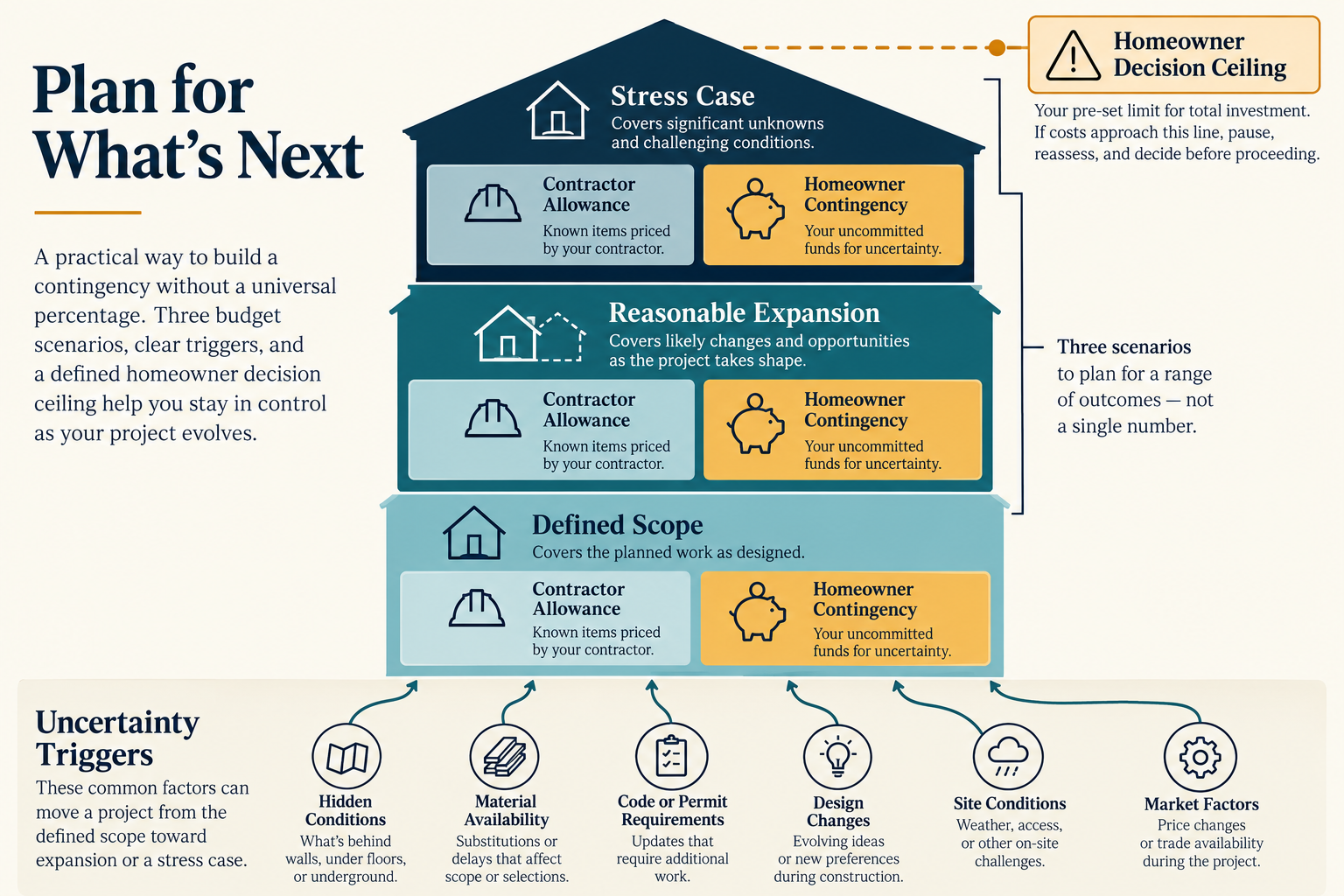
Use scenarios instead of a magic number
Build three versions:
- Defined scope: the work you know must happen, with selected materials and stated exclusions.
- Likely exposure: reasonable work that may be required if an identified assumption fails.
- Decision ceiling: the amount at which you would pause, redesign, phase, or stop.
For each uncertainty, write the trigger, likely response, cost class, and decision maker. A roof replacement might have a defined covering scope, a likely decking allowance, and a decision ceiling that requires a second opinion if structural damage is found. A bathroom remodel might separate the selected fixtures from uncertain subfloor and plumbing work.
This approach is more useful than applying a large percentage without explaining what it is meant to cover. If you cannot fund the ceiling, phase the investigation or work where doing so will not strand an incomplete system.
Do not spend the reserve early
Voluntary upgrades, finish changes, added rooms, and better products can consume contingency even when no surprise occurred. Track them as owner-requested changes. Release unused funds only after concealed conditions are resolved, inspections are complete, and the project is substantially finished.
If the reserve is used, record the reason and remaining balance. A contingency that repeatedly covers scope expansion is not measuring risk; it is masking a changing design.
Market and financial limits
Specialist construction sources discuss contingency and pricing mechanisms, but no reliable universal percentage with consistent definitions exists across U.S. and Canadian residential work. Older homes and budget-constrained owners may face real exposure without being able to hold a large reserve. The practical response may be staged diagnosis, a smaller safe scope, an explicit stop point, or postponing discretionary work.
Do not borrow blindly to fill a reserve. Compare the cost of financing, delay, temporary accommodation, and a smaller intervention. For structural, electrical, gas, health, active-water, or other high-consequence conditions, preserve safety while seeking a qualified scope.
What to ask the contractor
Ask which risks are included in the price, which are excluded, how a concealed condition will be documented, whether work will stop before an overrun, how credits and markups are calculated, and what decisions must be made before the next milestone. A contractor cannot promise that unknown conditions will not exist; a good proposal shows how they will be handled.
Build the reserve from a risk list
Start with the uncertainties that could change the finished cost:
- concealed damage behind a surface or below grade;
- incomplete measurements, design, or engineering;
- uncertain quantities or site access;
- material selection, availability, or escalation;
- coordination between trades and inspections;
- temporary protection, accommodation, storage, or restoration;
- weather, occupancy, or schedule constraints.
For each item, write what is known, what evidence is missing, what event could activate extra work, and how the cost would be priced. A risk list is more useful than a single percentage because it shows whether a reserve is protecting against a real uncertainty or merely repeating a rule of thumb.
Use scenarios instead of false precision
Prepare three planning views when the project is material:
| Scenario | Meaning |
|---|---|
| Defined case | The documented scope proceeds without a material concealed condition |
| Reasonable expansion | One or two known uncertainties require additional work or time |
| Stress case | Several assumptions fail or the project must be paused, redesigned, or phased |
The stress case is not a forecast. It helps you decide whether you can safely start, whether the work should be staged, or whether more investigation is worth paying for first. Do not make the reserve look smaller by placing foreseeable work into an “unexpected” column. A known replacement, owner-selected upgrade, or low allowance should be budgeted separately.
Keep contingency separate from other budget lines
An allowance is a placeholder inside a contractor’s proposal. A change order is an approved scope or price change. Contractor markup may apply to additional work under the agreement. Contingency is money the homeowner has not committed and may never spend. These categories interact, but combining them makes it impossible to tell whether the budget grew because the scope changed, a selection cost more, or an unknown condition appeared.
If a contractor asks to use contingency, record the reason and the new remaining balance. If the request is actually for an owner-selected improvement, decide whether to fund it without disguising it as a project risk. If an allowance is consumed, record the selection and the resulting overage separately.
Set a decision ceiling before work starts
Write the amount at which you would pause, seek a new scope, reduce finishes, phase the work, or stop safely. The ceiling is not a prediction of the final cost and it is not permission for a contractor to spend until the money is gone. It is a household decision boundary that should be communicated before a concealed condition or change creates pressure.
Pair the ceiling with a response plan. If the first uncertainty appears, the next step might be a measured repair. If several assumptions fail, it might be a specialist assessment or a redesigned phase. If the work is active damage or a safety matter, the immediate protective response may take priority while the permanent cost is defined. A reserve is useful when it buys time for a better decision, not when it conceals that the project no longer fits the budget.
Review and release the reserve
Revisit the contingency at defined milestones: after investigation, after opening concealed work, after selections are finalized, after inspections, and before closeout. Release money only when the related uncertainty has passed or when the project is complete. Keep a small amount available for closeout, testing, restoration, and warranty issues until those responsibilities are resolved.
There is no universal defensible contingency percentage for every U.S. or Canadian repair or remodel. Older or poorly documented work may need more investigation than a defined replacement, but the actual reserve depends on scope, condition, access, design completeness, and the consequences of delay. A good contingency plan does not promise a number; it makes the reasons for the number visible and gives the homeowner a safe decision point before committing more money.
Turn the risk list into a starting reserve
For each uncertainty, estimate a conservative planning range only when you can explain the basis. A concealed condition may have a diagnostic cost and a separate repair range. An incomplete selection may have a known allowance overage risk. A schedule delay may create storage or temporary accommodation cost rather than more construction cost. Add the categories that apply, keep each assumption visible, and avoid counting the same risk in both an allowance and contingency.
Then compare the total exposure with your decision ceiling. If the defined work is affordable but the plausible expansion would strand the project, investigate first or phase the work. If the work is safety-critical or active damage is worsening, the decision may be to stabilize now and price the permanent scope later. If the risk is discretionary, you can defer it without representing the choice as a surprise.
At each milestone, reclassify the reserve: unresolved, committed, released, or no longer relevant. A reserve that shrinks because a hidden condition was investigated is different from one that shrinks because optional upgrades consumed it. This record helps you decide whether the project remains affordable and whether the next approval is still justified.