
A home inspection report is a condition report, not a contractor estimate. It may identify a defect, limitation, or recommendation that needs more investigation. To turn it into a repair budget, separate urgency from uncertainty, obtain the right specialist scope, and use ranges instead of treating every observation as an immediate invoice.
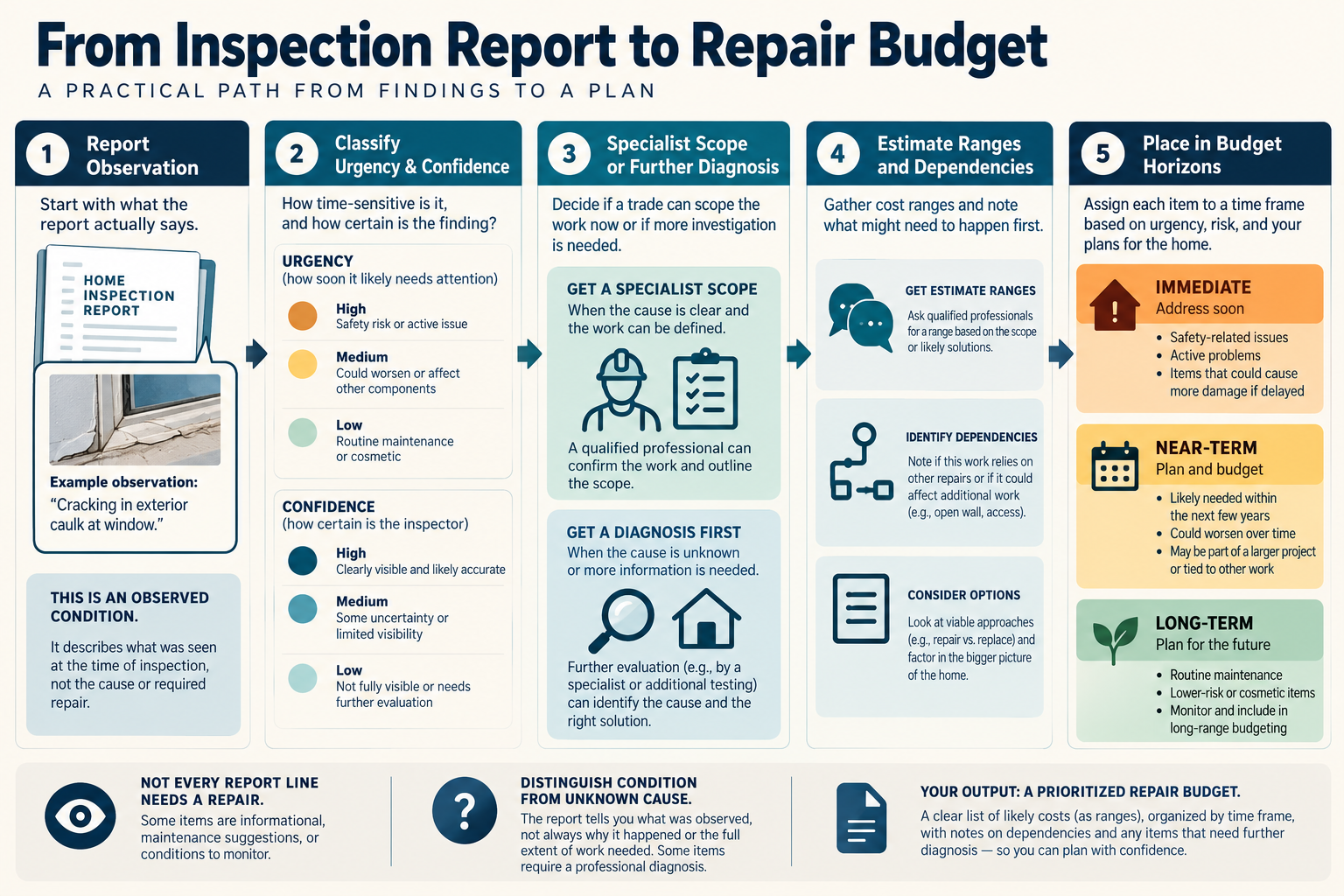
Read the report in two passes
First, read the summary for safety, water, structure, essential systems, and conditions that may affect occupancy or financing. Then read the full report and supporting photographs. The summary is a routing aid; the detailed descriptions and limitations explain what the inspector actually observed.
On the second pass, label each item:
- Immediate protection or specialist assessment: a potentially high-consequence or worsening condition.
- Defined repair candidate: enough information exists to request a trade-specific scope.
- Maintenance: work that should be scheduled but is not necessarily a defect requiring immediate repair.
- Aging or monitoring: a component to inventory and plan for without assuming failure.
- Cosmetic or optional: an improvement that should not be mixed into urgent exposure.
The label should reflect the condition and evidence, not the most alarming wording in the report.
Identify what is still unknown
Ask whether the report establishes the cause, extent, access, repair method, and related work. “Staining,” “old,” “not tested,” and “recommend evaluation” often indicate that a specialist must define the scope.
Create an uncertainty note for each material item:
| Question | Example budget effect |
|---|---|
| What is the likely system or trade? | Determines who should inspect and quote |
| Is the cause known? | May require diagnosis before repair pricing |
| Is the extent visible? | Concealed damage can expand scope |
| Is temporary protection needed? | Adds time, access, or temporary-work cost |
| What other work depends on it? | May change sequencing or restoration |
Do not make a contractor price a broad phrase such as “repair as needed” and treat the result as a complete budget.
Check available repair, permit, inspection, maintenance, and hazard-assessment records against the finding itself. A past inspection, old permit, clearance document, or absence of a record does not establish the home’s current condition or prove that a new concern has the same cause. Keep the record’s date, scope, limits, and property area with the current observation; obtain a specialist assessment when the gap could change a material decision.
Obtain specialist scopes
For material findings, send the relevant report pages and photographs to an appropriately qualified professional. Ask for the condition observed, recommended scope, alternatives, exclusions, urgency, and a price or range with assumptions. Obtain more than one proposal when the work is comparable and time allows.
The Consumer Financial Protection Bureau advises arranging an independent inspection early enough to resolve problems and notes that additional inspections may be needed. Its guidance also distinguishes an inspection from an appraisal and explains that major repairs can affect a buyer’s decision or mortgage process. Contract, lender, and local treatment varies.
Build three budget horizons
Use three totals rather than one false-precision number:
- Before or immediately after closing: safety, active damage, essential services, and work required for a specific transaction or lender condition after verification.
- Near term: repairs and maintenance that should be planned within the first season or year.
- Longer term: aging systems, replacement reserves, and improvements that are not urgent.
For each horizon, show known quotes, estimated ranges, diagnosis costs, contingencies, and items not yet priced. Do not add every recommendation as though it will happen at once.
Separate repair exposure from negotiation choices
The report can help you understand potential cost, but the choice among seller repair, credit, price change, post-closing work, or cancelling under a contract condition is a separate transaction decision. See post-inspection repair options for the economic comparison, and obtain local professional advice for legal, contract, lender, and disclosure questions.
Canadian and U.S. homeowners should use local inspection, contract, and financing requirements. A general article cannot establish that a credit, contingency, or repair standard applies to your purchase.
The budget is ready when every material finding has an owner, a next action, an urgency, a scope confidence, and a visible place in the immediate, near-term, or long-term plan. It is not ready merely because every report line has been assigned a dollar amount.
Build a finding-to-budget table
For each report item, use one row with the observation, category of concern, confidence, next professional, planning cost, likely intervention, and time horizon. A row might say “moisture staining; source not confirmed; roofing or plumbing diagnosis; restoration range not yet known; protect and inspect before finish repair.” Another might say “loose handrail; condition observed; qualified repair scope; near-term.” The table keeps a report’s language from becoming an overconfident construction estimate.
Add the cost of improving information when it could change the decision. A specialist inspection, test, or measured proposal may be a better use of money than collecting several bids against different assumptions. Keep lender, insurer, seller, and contract questions in separate notes. CFPB guidance explains that an inspection is different from an appraisal and that major repairs can affect negotiation or lending conditions, but the actual transaction treatment depends on the contract, lender, program, and location.
Start with the summary, then read the full description, photographs, limitations, and recommendations. Mark each item as an observed condition, a safety or habitability concern, a maintenance recommendation, an aging component, a possible defect, or a question requiring specialist follow-up. Avoid treating the report’s order as a complete economic priority list.
Then build a second table:
| Finding | What is established | What is unknown | Next step |
|---|---|---|---|
| Visible condition | What the inspector observed | Cause, extent, or repair method | Appropriate specialist or monitoring |
| System age | Age or evidence available | Remaining performance and history | Records, service, or planning quote |
| Safety concern | Reported risk or limitation | Exact correction and authority | Qualified assessment and local verification |
| Maintenance item | Recommended upkeep | Consequence and timing | Schedule or defer with review date |
This separation prevents a general inspection from being mistaken for a contractor scope.
Turn findings into cost scenarios
For a defined repair, obtain a local quote. For an uncertain finding, budget the diagnostic first and show the likely repair paths separately. A roof observation may need a roofer to define the area, a plumbing symptom may need source diagnosis, and a structural comment may need an engineer or qualified specialist. Do not assign a precise number merely because a category guide contains an average.
For each material item, include:
- investigation and testing;
- repair or replacement alternatives;
- access, demolition, disposal, and finish restoration;
- permits, design, inspection, or other project prerequisites;
- temporary protection and carrying costs;
- a contingency appropriate to the unresolved scope.
Use immediate, near-term, and long-term columns. The immediate column should contain active hazards, active damage, essential-service problems, and transaction conditions that truly need action. The near-term column contains work that protects the property or avoids compounding exposure. The long-term column contains planned replacement and ordinary maintenance.
Connect the budget to the transaction
Before closing, ask the appropriate real-estate, lender, insurer, and local professional how a material condition affects the contract, financing, insurance, or required documentation. A seller repair, credit, price adjustment, escrow arrangement, or post-closing repair may have different economic and legal effects. Do not assume that an inspection recommendation creates a universal repair obligation.
After closing, keep the report and new specialist findings together. Update the budget when a repair reveals a larger condition or when a proposed solution changes the property’s future maintenance or replacement exposure.
The goal is not to convert every observation into a project. It is to know which facts are established, which require diagnosis, what each path may cost, and which decision must be made next. That is a more honest repair budget than a single total built from unverified assumptions.
Keep the report and the budget synchronized
When a specialist provides a quote or diagnosis, link it to the original finding and record what changed. The specialist may confirm the condition, narrow it, identify a different cause, or add necessary access and restoration. Preserve the report, proposal, photographs, permits, test results, and limitations together so a later decision does not rely on an abbreviated summary.
Review the map after a repair is completed. Mark whether the source was corrected, whether damaged materials were restored, and whether monitoring or follow-up remains. If the work was deferred, keep the reason and trigger visible. If a finding affects insurance, financing, disclosure, or a contract deadline, obtain the requirement from the responsible party rather than inferring it from the inspection language.
The budget is doing its job when it makes uncertainty manageable: urgent items are separated from routine upkeep, unknowns have an information step, and cash can be directed to the next decision that reduces the greatest consequence.
Use confidence to control the next dollar
High-confidence findings can move directly to a defined repair scope when the appropriate professional confirms the work. Medium-confidence findings may need a specialist visit or a targeted test before bids are comparable. Low-confidence findings should remain visible as questions, not become large allowances or replacement assumptions. The confidence label describes the information available; it is not a safety rating.
When two findings share access or a source, note the dependency before requesting proposals. A single visit may be efficient, but a combined scope should still show which work corrects the cause, which restores damage, and which is optional. This keeps the inspection budget useful even when the first diagnosis changes the original plan.