
Do not start by sorting contractor proposals from lowest to highest. First determine whether each proposal prices the same result. A quote that excludes demolition, permits, finish restoration, or a needed specialist can look inexpensive while leaving you with a larger all-in cost.
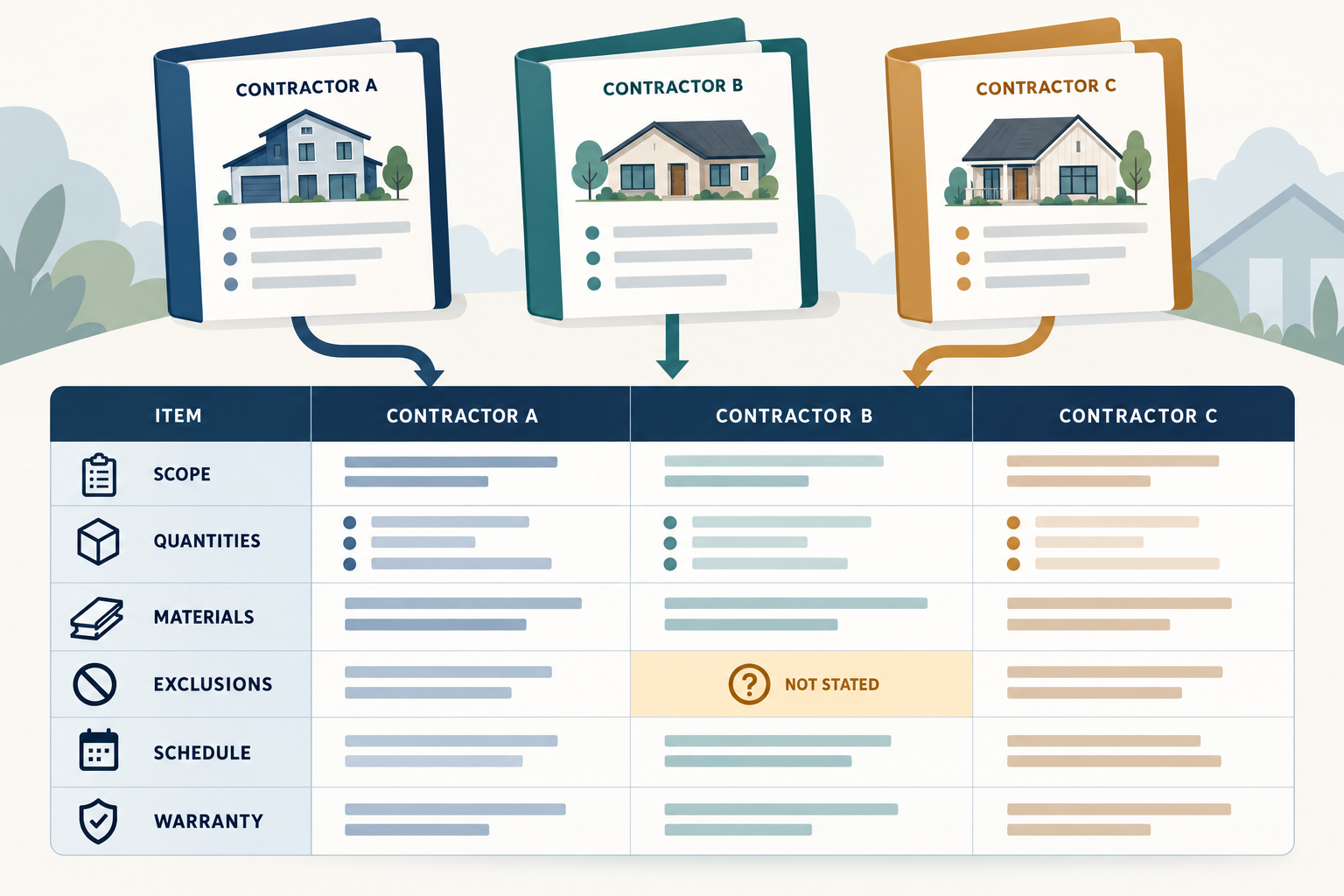
Write the comparison scope first
Create one short project brief before asking contractors to revise their proposals. State the problem or desired outcome, affected areas, approximate quantities, finish level, access limits, occupancy constraints, preferred schedule, and known exclusions. Attach the same drawings, photographs, reports, product specifications, and measurements to every request.
For uncertain work, describe the investigation boundary. For example, ask each bidder to state whether opening a wall, testing a system, or removing a finish is included, excluded, or priced as a unit. This makes uncertainty visible instead of allowing each contractor to make a different private assumption.
Normalize the main cost lines
Use a table with one row per cost class:
| Compare | Questions to ask |
|---|---|
| Core work | Is the same repair, replacement, or finished outcome included? |
| Materials | Are model, grade, quantity, finish, waste, delivery, and substitutions comparable? |
| Preparation | Are demolition, surface preparation, testing, drying, or temporary support included? |
| Access and protection | Are moving, dust control, weather protection, staging, and temporary utilities included? |
| Other trades | Are plumbing, electrical, structural, design, or subcontractor tasks included? |
| Authority costs | Who handles permits, inspections, testing, and required approvals? |
| Closeout | Are cleanup, disposal, commissioning, documentation, and finish restoration included? |
| Commercial terms | Are schedule, payment, warranty, insurance, and change procedures comparable? |
Do not treat an unpriced line as free. Mark it “not stated” and ask for a written answer.
Check quantities and specifications
“Replace the floor” might mean one room, a connected hallway, or the whole level. “Repair the leak” might mean a temporary patch, source correction, removal of damaged material, and restoration—or only the first step. Confirm units, quantities, locations, and how extra quantities will be measured.
Compare named products where the product affects performance, compatibility, warranty, or appearance. If a proposal uses an allowance, record the allowance amount and ask whether it includes tax, delivery, installation labor, trim, accessories, and markup. A lower allowance is not a lower final price; it may simply transfer selection cost to you.
Separate included work from exclusions
Look for “by owner,” “as required,” “allowance,” “provisional,” “not included,” and “unless otherwise noted.” These phrases are not automatically improper, but they identify places where proposals diverge. Ask each contractor to list likely exclusions rather than burying them in boilerplate.
Common omissions include design or engineering, permits, specialist diagnosis, asbestos or lead assessment, demolition, disposal, temporary protection, moving or storage, repairs to concealed damage, painting, trim, taxes, and work by another trade. Detailed fee and logistics decisions may belong to other specialist categories, but they still matter to your total budget.
Compare schedule and disruption
Record the proposed start date, duration, working hours, material lead time, inspection hold points, weather assumptions, and temporary loss of a room or utility. A proposal that finishes sooner may justify a higher price if it reduces accommodation, storage, or business disruption. A low bid with an uncertain start may be less useful when the work must meet a sale, closing, lease, insurance, or seasonal deadline.
Ask what happens if a delivery is late or a concealed condition is found. The answer belongs in the contract or written clarification, not only in a conversation.
Compare warranty and responsibility
Identify who warrants labor, materials, equipment, and subcontracted work; how long each warranty lasts; what is excluded; and how a callback is handled. A manufacturer warranty is not automatically a labor warranty. A contractor’s warranty may not cover a pre-existing condition or an owner-selected product.
Confirm licensing, insurance, subcontracting, permit responsibility, and cleanup obligations as applicable to the project and jurisdiction. U.S. and Canadian consumer guidance supports written estimates and contracts, but the legal requirements differ by state, province, territory, transaction type, and project.
Ask for explanations, not apologies
After normalization, send a focused clarification list:
- “Please confirm whether this line includes demolition, disposal, and finish restoration.”
- “Please identify the product, quantity, and allowance assumptions.”
- “Please price the stated alternate separately.”
- “Please explain what would trigger a change order and how it would be priced.”
- “Please identify permits, inspections, taxes, and subcontractors included.”
- “Please state the expected schedule and what the homeowner must provide.”
The Federal Trade Commission advises asking about large differences rather than assuming that the lowest proposal is the right one. A clear explanation is useful evidence; pressure to sign before the scope is resolved is a risk signal.
Jurisdiction-specific caution
Rules about written estimates, deposits, cancellation, payment, lien protection, holdbacks, licensing, and contract changes are not national defaults. Ontario, California, Alberta, and British Columbia each illustrate different consumer rules. Use the applicable government or regulator source for your location and contract type, and obtain legal advice for a dispute or unusual transaction.
Choose only after the proposals describe the same outcome closely enough to compare. If they cannot, the next useful step may be a better scope, paid diagnosis, design work, or a revised bid—not an arbitrary average of the totals.
Build one comparison worksheet
Give each proposal a column and keep the homeowner’s requested outcome in the first column. Add rows for quantities, materials, preparation, access, other trades, permits, taxes, cleanup, schedule, payment, warranty, and exclusions. Use “not stated” rather than leaving a blank cell. A blank can be mistaken for an included zero-cost item when it actually means that nobody has answered the question.
Separate committed amounts from conditional amounts. A fixed line for removing a known cabinet is different from an allowance for repairing the wall behind it. A unit price for concealed framing is different from an open-ended promise to bill time and materials. Put a note beside every conditional amount explaining what evidence will activate it.
Do not compare totals until you have decided whether the proposals are intended to deliver the same level of finish. “Install a door,” “replace a roof,” and “repair a foundation” can each describe several outcomes. Record the model, grade, dimensions, finish, warranty, and installation method when they affect performance or appearance. If the product is not selected, show the allowance and the assumptions that make it realistic.
Reconcile differences in a deliberate order
Resolve the largest sources of divergence first:
- Outcome and quantity: Confirm the area, number of units, repair boundary, and completion standard.
- Hidden-condition approach: Identify whether investigation, opening, testing, or temporary stabilization is included.
- Materials and labor: Compare the actual product and the expected crew or installation method.
- Project support: Add design, engineering, permits, inspections, access, protection, disposal, and restoration where needed.
- Commercial terms: Compare payment timing, allowances, change procedures, insurance, warranties, and schedule.
This order prevents a homeowner from spending an hour debating a small fixture difference while one proposal excludes the specialist assessment that controls the whole project. It also reduces the chance that a low headline number wins simply because its uncertain work is invisible.
Use a decision matrix when proposals remain different
Sometimes the proposals cannot be made identical because the contractors recommend different solutions. In that case, keep the options separate instead of forcing them into one average. For each option, record:
- initial price and the amount still uncertain;
- expected duration and disruption;
- maintenance, warranty, and follow-up responsibilities;
- likely related work or future replacement;
- the consequence if the assumption is wrong;
- how easily the work can be inspected, repaired, or changed later.
The “best” proposal may be the one with a higher initial price if it solves the source of the problem, includes necessary protection, or leaves fewer unresolved dependencies. A lower price may be appropriate for a limited, well-defined repair. The matrix makes that judgment visible without pretending that a contractor’s recommendation has been proven solely by its total.
Keep revisions attached to the quote
When a contractor answers a question, mark the date and attach the written clarification to the proposal. If the clarification changes scope, price, or schedule, ask for a revised proposal or contract rather than relying on an email thread that cannot be found later. Confirm that all bidders are responding to the same latest information when the project is re-priced.
Rules about estimates, deposits, cancellation, holdbacks, liens, and change orders vary by state, province, territory, project, and transaction. Ontario, California, Alberta, and British Columbia provide useful examples of variation, not a shared national template. Local government or regulator guidance should control high-consequence questions.
Make the final choice with unresolved items visible
After the clarification round, create a short decision summary for each proposal. Record the comparable total, items still outside the price, conditional amounts, expected start and finish, payment schedule, and the person responsible for each unresolved item. This makes a proposal with a lower headline total but several owner-managed exclusions comparable with a higher proposal that includes coordination.
If the bids still describe different outcomes, do not average them. Choose whether to revise the scope, obtain a diagnostic or design package, request a unit price for the uncertain work, or compare limited and complete options separately. A normalized comparison can legitimately end with more than one acceptable choice. The useful result is knowing what each choice buys, what it leaves open, and which event would make you change course.