
The number at the bottom of a contractor proposal may be only one part of the money needed to complete a project. A quote can be accurate for its stated construction scope while leaving the homeowner to arrange design, permits, disposal, restoration, or work by another trade.
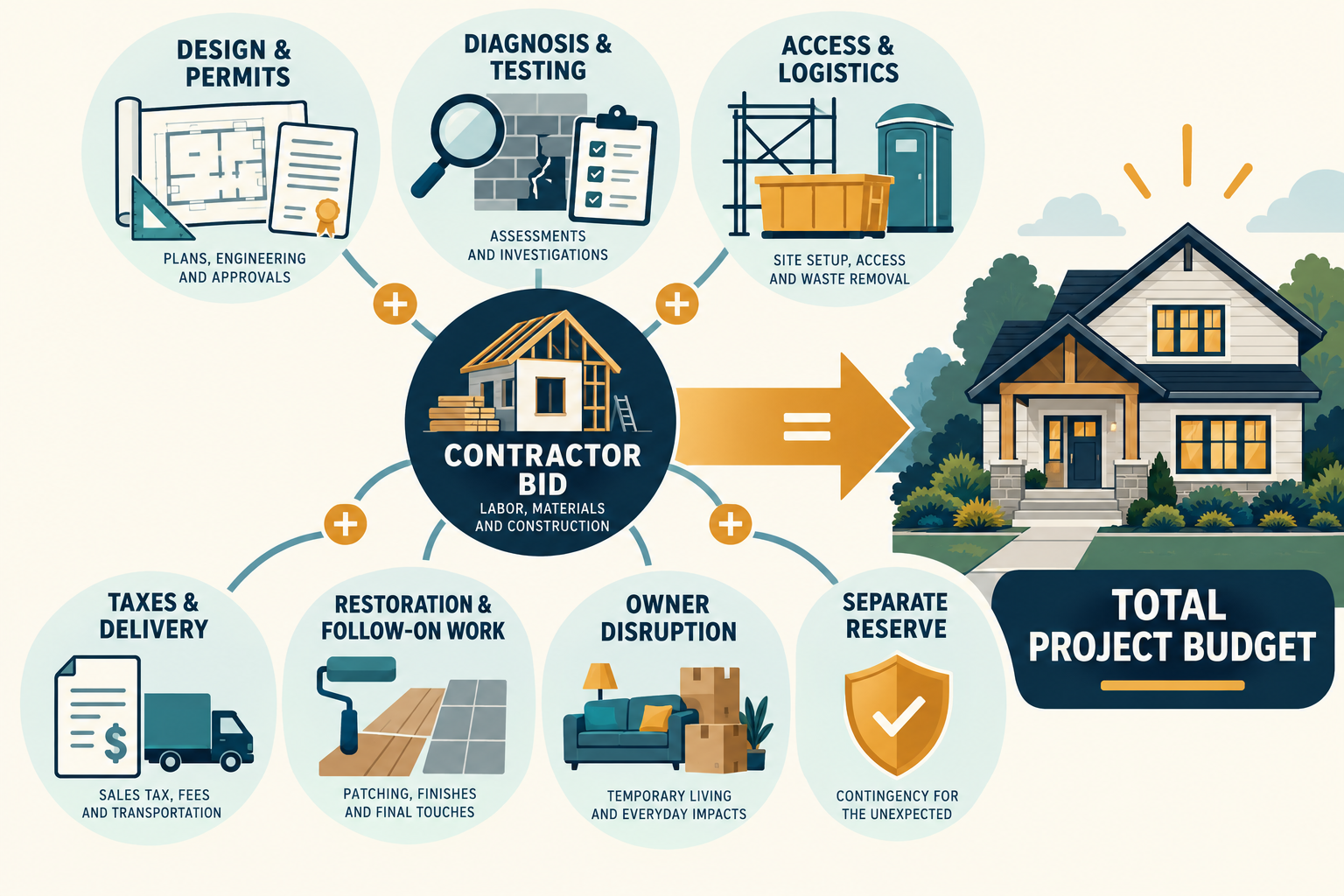
Before deciding that one proposal is affordable, turn it into an all-in budget. Treat every line that says “by owner,” “allowance,” “as required,” “not included,” or “permit responsibility” as a question to resolve rather than as a zero-cost item.
Cost classes to check
| Cost class | Questions to ask |
|---|---|
| Design and engineering | Are drawings, calculations, specifications, or revisions needed before work can start? |
| Inspection and diagnosis | Is a general inspection, specialist assessment, testing, or report separate? |
| Permits and approvals | Who applies, pays, coordinates inspections, and responds to corrections? |
| Demolition and disposal | Does the price include removal, hauling, disposal fees, and protection of what remains? |
| Access and mobilization | Are travel, lifts, scaffolding, staging, parking, or difficult carrying conditions included? |
| Temporary protection | Will the home need weather protection, dust containment, temporary utilities, or security? |
| Materials and delivery | Do the material lines include waste, freight, storage, handling, taxes, and special orders? |
| Restoration and cleanup | Are drywall, paint, trim, flooring, landscaping, or final cleaning included after the main work? |
| Owner-side disruption | Will you pay for moving, storage, temporary accommodation, or lost use of a room? |
| Follow-on work | Does another trade need to reconnect, test, commission, or finish the system? |
The detailed economics of permits, engineering, demolition, access, and disposal belong to their specialist subjects, but they still belong in this project’s budget. A quote comparison is incomplete when those costs appear in only one proposal or in none of them.
Read the exclusions with the same care as the scope
Start with the signed scope, drawings, specifications, allowances, and clarifications. Mark each cost as included, excluded, owner-supplied, provisional, or not stated. “Not stated” is not the same as included. Ask the contractor to answer in writing and attach the answer to the proposal.
Pay attention to items that cross trade boundaries. Replacing a bathroom fixture may require plumbing, electrical, waterproofing, finish repair, and inspection work. A window replacement may include the window but not concealed rot, interior trim, painting, or exterior cladding repair. A new electrical appliance may need a circuit, panel work, or utility coordination outside the appliance quote.
Do not assume that the contractor who owns the main scope also owns every prerequisite. A general contractor may coordinate subcontractors; a specialty contractor may expect the homeowner to arrange design, permits, restoration, or a separate repair.
Build a three-column budget
For each cost class, record:
- the amount already included in the proposal;
- the amount you expect to arrange or pay separately;
- the uncertainty that could change the amount.
Use a range when the scope is not yet defined. For example, a permit may have a known application fee but an unknown design or revision cost. Disposal may be easy for a small accessible project and much more involved when materials require special handling. A temporary move may depend on how long a concealed condition takes to correct.
Keep the homeowner’s contingency separate from contractor allowances and change orders. An allowance is a placeholder inside a proposal. A change order records an approved scope change. Contingency is uncommitted money you reserve for uncertainty. Blending them hides what caused the budget to move.
Check taxes, payment, and closeout
Ask whether taxes are included and whether they apply differently to materials, labor, rentals, or subcontracted work. Confirm delivery, storage, fuel, equipment, and financing charges rather than assuming they disappear into a lump sum. If the budget depends on an eligibility assessment, application fee, or later incentive, list those costs and dates separately; leave an unapproved benefit out of the confirmed funding total. Compare funding choices and benefit timing against the full project budget.
At closeout, check who supplies inspection approvals, warranties, manuals, receipts, lien or holdback documentation where applicable, and evidence of completed work. The cheapest construction bid may not be the cheapest completed and documented project.
Compare the revised totals
Once omissions are identified, compare proposals on the same finished outcome. Ask each contractor to price the same exclusions or state why a line cannot be priced yet. If a cost cannot be known before opening an assembly, define the investigation step, unit price, allowance, or stop point instead of hiding the uncertainty.
For U.S. and Canadian projects, the required contract, permit, tax, and payment treatment depends on the jurisdiction and project facts. Government consumer guidance supports written scope and clear responsibilities, but it does not create one universal all-in bid format. Obtain local advice when the work involves regulated construction, financing, insurance, or a dispute.
The goal is not to force every possible expense into one headline number. It is to know which money is committed, which is conditional, which is outside the contractor’s scope, and what decision will be required if the assumption changes.
Organize costs by who controls them
The homeowner, general contractor, specialty contractor, designer, local authority, insurer, and lender may each control different parts of the budget. Add an owner to every line:
| Cost class | Typical question |
|---|---|
| Design or engineering | Is a professional scope needed before construction can be priced or approved? |
| Permits and inspections | Who applies, pays, schedules, and keeps the approval record? |
| Access and logistics | Are lifting, staging, delivery, storage, travel, or temporary protection separate? |
| Testing and diagnosis | Who defines the condition and who pays if the first test is inconclusive? |
| Main construction | Does the bid include preparation, installation, testing, and closeout? |
| Follow-on restoration | Who repairs finishes, landscaping, paint, insulation, or adjacent systems? |
| Owner-side disruption | Will the home need storage, temporary accommodation, utility changes, or extra travel? |
This ownership view prevents a common mistake: assuming that a cost is included because somebody must eventually pay it. A permit may be required even if the contractor does not include the fee. A designer may specify the work while a separate contractor installs it. A restoration trade may be needed after the system work is complete.
Distinguish prerequisites from consequences
Some costs occur before the main work can start. These may include surveys, measurements, testing, design, engineering, hazardous-material assessment, access planning, or a specialist diagnosis. Other costs appear because the work changes the property: disposal, temporary weatherproofing, finish restoration, commissioning, landscaping repair, or a second inspection.
Ask the contractor to identify both groups. A proposal can reasonably exclude a specialist report if the scope cannot be known until that report exists, but the exclusion should be visible. If a project requires another category of work, use the relevant specialist guide to plan it rather than assuming the main contractor will absorb it.
Estimate owner-side exposure
Make a separate owner-cost page for expenses that do not belong in the construction bid. Include moving furniture, storing belongings, arranging pet care, temporary lodging, additional utility use, parking, travel to a remote property, financing costs, insurance changes, and time-sensitive carrying costs. Not every project needs every line. The purpose is to ask which disruptions are real for your home.
For each line, mark it as known, quoted separately, or uncertain. A temporary hotel stay may depend on schedule and habitability. A storage cost may depend on whether protection can be maintained in place. A financing cost depends on the product and approval, so do not include a projected rate as if it were a committed construction cost.
Close the budget with documents
Before work begins, attach clarifications about permits, taxes, disposal, access, protection, cleanup, testing, warranties, and closeout to the contract. During construction, record changes and owner approvals. At the end, collect permits, inspection records, invoices, product information, warranties, operating instructions, and photographs of concealed work where useful.
The final budget should show the contractor’s completed amount, approved changes, owner-arranged costs, contingency used, and costs still pending. A low headline bid can be the right choice when it is intentionally limited and the homeowner has priced the rest. It is risky when the omitted work is necessary but undiscovered.
Use an all-in budget before approving the headline number
Create one row for the main construction scope and one row for every prerequisite, consequence, or owner-side cost that could affect the decision. A simple budget might look like this:
| Budget layer | Status to record |
|---|---|
| Defined contractor work | Contracted amount, inclusions, and payment schedule |
| Conditional contractor work | Allowances, unit prices, change triggers, and limits |
| Other professionals | Design, engineering, testing, inspection, or diagnosis |
| Site and project logistics | Access, protection, demolition, disposal, delivery, storage, and cleanup |
| Owner-side disruption | Moving, temporary lodging, lost use, travel, utilities, or financing |
| Reserve | Contingency kept outside committed spending |
Do not force uncertain costs into a made-up point estimate. Use “quote needed,” “range,” or “not applicable,” and state what would resolve the uncertainty. The budget is ready for a decision when the remaining unknowns have an owner, a next action, and a stop point. That may lead to choosing a limited bid, paying for more definition, or postponing discretionary work—not necessarily choosing the contractor with the lowest or highest total.