
The cheapest proposal at installation is not necessarily the least expensive way to own a system. A lower-priced option may need more maintenance, use more energy or water, have a shorter planning life, or create a difficult replacement later. A higher-priced option may reduce some of those costs, but it can also fail to pay back if the difference is based on an unsupported assumption.
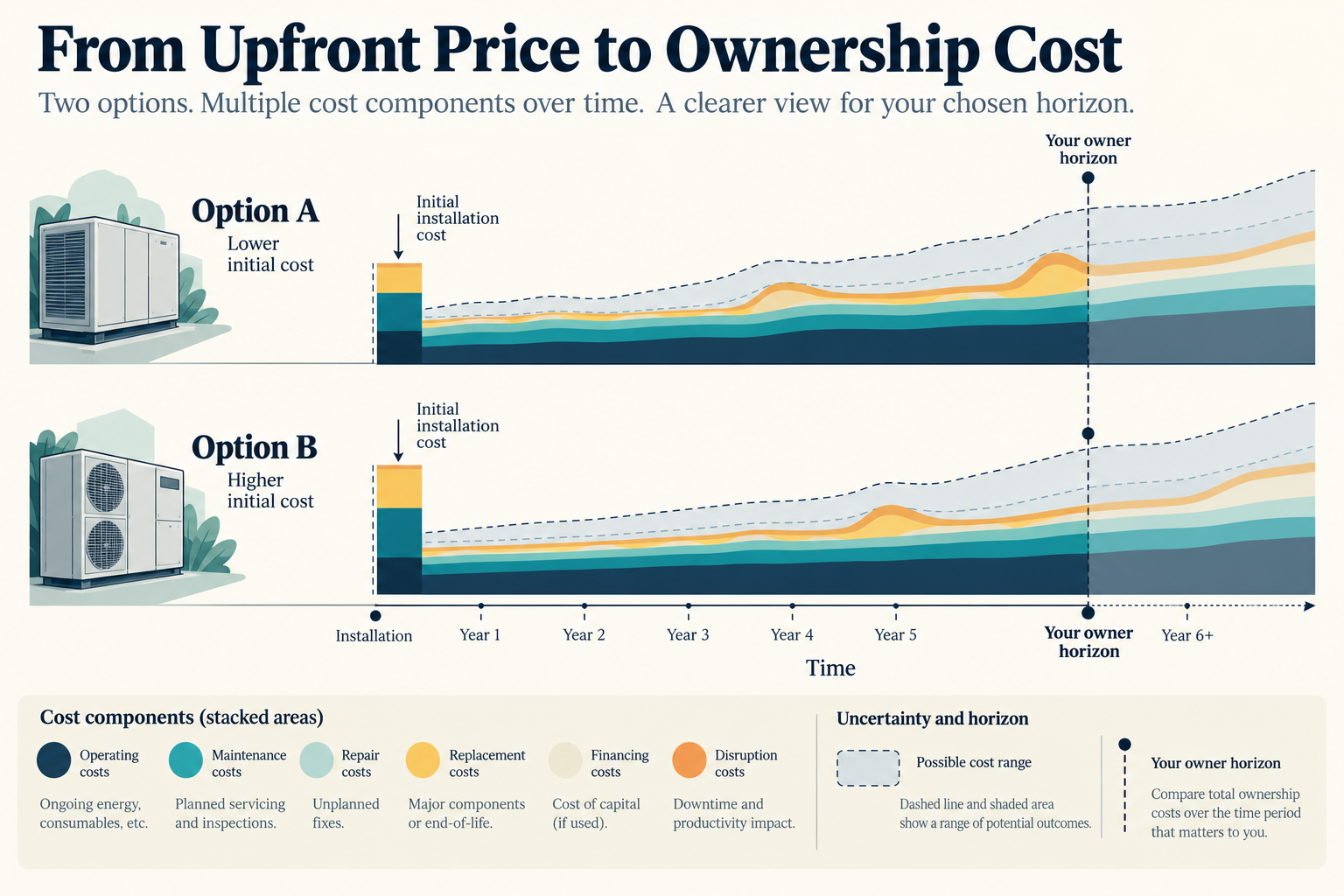
Compare the options over a defined time horizon and show what is known, estimated, and uncertain.
Put all ownership costs in the same frame
| Cost or effect | Questions to include |
|---|---|
| Initial installed cost | Are removal, access, permits, testing, restoration, and closeout included? |
| Maintenance | What recurring service, cleaning, inspection, or consumables are expected? |
| Operating cost | Could energy, water, fuel, or other usage differ, and is there evidence for the estimate? |
| Repairs | What failure modes, parts, labor, and response costs are plausible? |
| Replacement | When might the next major decision occur, and what related work could be needed? |
| Warranty | What is covered, for how long, and who pays for labor or exclusions? |
| Financing | What interest, fees, or cash-flow effect changes the comparison? |
| Disruption | What temporary accommodation, lost use, or follow-on restoration is involved? |
The same categories apply to a repair-versus-replace decision, a material comparison, and a choice between project scopes.
Keep conditional benefits and cash timing visible. A rebate or tax credit may reduce a later net outlay while leaving the full deposit and progress payments due first; include the benefit only in the scenario that satisfies its current eligibility and documentation terms. For an optional service contract, count its contract price and per-use charges alongside the work it excludes or caps, and keep the uncovered exposure visible. See rebates and tax-credit cash flow and home warranty or repair reserve for those specific comparisons.
Choose a realistic time horizon
Use the period that matches the decision: the time you expect to own the home, the length of a warranty, or the point at which a major renovation is likely to change the system. A five-year decision may favor a different option from a twenty-year planning view.
Do not claim that one option “pays for itself” without a supported estimate of future prices, use, maintenance, repair probability, and replacement. A homeowner who may move soon should not automatically fund a long-term upgrade, while a long-term owner may reasonably value reliability and easier maintenance.
Use scenarios, not a single forecast
Create at least three versions:
- Expected case: the stated installed price and ordinary maintenance assumptions.
- Higher-cost case: a plausible repair, access problem, price increase, or lower-than-expected performance.
- Short-horizon case: the cost if you sell, remodel, or replace the system sooner than expected.
Keep future costs as ranges where evidence is weak. A local quote can establish today’s scope, but it cannot guarantee future labor, material, energy, or financing costs.
Check whether the options really deliver the same result
Compare the finished outcome, not only the equipment or material line. A lower bid may omit preparation, protection, testing, controls, disposal, or restoration. A higher bid may include work required for reliable operation or a more complete warranty. Normalize the proposals using this quote comparison checklist.
When a more expensive option depends on a future benefit, ask what must be true for that benefit to occur. For operating-cost claims, record the assumed rates and use. For durability claims, record the maintenance and installation conditions. For compatibility claims, obtain the relevant technical confirmation.
Account for maintenance effort and failure consequence
Some homeowners value predictable service and fewer emergency decisions even when the financial difference is uncertain. Others may rationally choose a simple, lower-cost option for a low-consequence item that is easy to replace. A component that can damage the home, interrupt essential service, or create a safety risk deserves a different analysis from a cosmetic finish.
Freddie Mac recommends planning for known major purchases, keeping equipment and warranty information, and considering cost versus value before remodeling. Those principles support a better comparison; they do not provide a universal service-life table or return threshold.
Decide with visible uncertainty
Write down the upfront difference, the costs it is intended to avoid, the evidence for those costs, and the consequences if the assumption is wrong. Include maintenance, repair, replacement, financing, disruption, and the value of flexibility.
The lowest upfront price is a reasonable choice when it meets the needed outcome, its future exposure is acceptable, and the higher-priced alternative has no reliable advantage for your horizon. The higher initial cost can be rational when it addresses a documented condition, reduces a meaningful risk, or avoids a likely second project. The comparison is useful when it makes that reasoning explicit rather than pretending future ownership costs are certain.
Define the alternatives at the same level
Write a complete scope for each option before comparing numbers. Include purchase or material cost, installation, removal, disposal, access, permits, testing, commissioning, finish restoration, and any work required to make the option compatible with the property. An option that is described only as “replace the unit” is not comparable with one that includes controls, electrical work, or related repairs.
Then list the ownership costs that could differ:
| Cost over time | Question |
|---|---|
| Routine maintenance | What service, cleaning, testing, or consumables are expected? |
| Repair exposure | What parts fail, how often, and how easily can they be obtained? |
| Operating cost | Does energy or water use materially affect the decision for this property? |
| Replacement timing | Is a second replacement likely within the ownership horizon? |
| Disruption | Will access, noise, downtime, or future work add a real cost? |
| End of life | Are removal, disposal, recycling, or restoration different? |
Do not fill unknown cells with optimistic assumptions. Use a range, a planning note, or a task to investigate.
Compare over the time you actually care about
A long-term owner may value lower maintenance, better reliability, or fewer future disruptions. A homeowner planning to move soon may value a lower committed cost and a solution that is credible and documented. Neither horizon makes the other choice irrational. The important point is to avoid using a 20-year benefit to justify a premium that the owner will not experience, or ignoring a likely near-term failure because a long-term calculation looks attractive.
Use a simple scenario table rather than a false precise present-value calculation when the inputs are weak. For each option, show the initial cost, likely annual costs, a possible major repair, replacement timing, and the remaining value or flexibility at the end of the horizon. State which assumptions drive the result. If energy prices, service life, repair frequency, or future regulation are unknown, show how the decision changes under a lower and higher case.
Treat future savings as conditional
Claims about efficiency, comfort, durability, resale, or reduced repairs should be tied to the property and the evidence available. A more efficient system may not produce the expected operating savings if it is oversized, poorly controlled, used differently, or installed in a property with another limiting condition. A durable material may still require costly preparation or replacement of adjacent work.
Ask what must be true for the higher-priced option to earn back its difference. Then ask what happens if that condition is not met. This turns a sales promise into a decision boundary. A warranty can reduce a particular repair exposure, but it has terms, exclusions, labor limits, and a duration; it is not the same as guaranteed ownership cost.
Show the comparison with a simple worksheet
For each option, write the initial installed cost and the likely costs over the chosen period. A useful worksheet has rows for maintenance, operating use, repairs, replacement, financing, disruption, and end-of-life work. Mark each row as quoted, observed, modeled, or unknown. Sum ranges rather than hiding uncertain rows behind a single average.
For example, a $3,000 initial difference is meaningful only if the higher-priced option has a credible way to avoid or reduce costs that matter within your horizon. If the benefit arrives after a likely move, depends on a usage pattern you do not have, or requires unpriced supporting work, treat it as conditional. If the lower-priced option creates a likely second installation or a high-consequence failure exposure, show that in its scenario rather than declaring it the winner because of the first invoice.
Review the comparison when you receive a better scope, a current local quote, an inspection, or actual operating data. A transparent rough comparison is more useful than a precise-looking payback calculation built on unsupported service life, energy savings, inflation, or repair probabilities.
Record the options, complete installed price, planning horizon, major cost drivers, uncertainties, and the reason for the choice. Revisit the comparison when a quote, inspection, design, or operating record changes. The lowest upfront price is often sensible when it delivers the needed outcome and the future exposure is acceptable. A higher upfront price is sensible when it buys a documented benefit that matters to this property and this owner—not merely because “cheaper is false economy” is a familiar phrase.
State what the calculation leaves out
Put a short limitations note beside the comparison. Identify whether the figures exclude financing, taxes, rebates, inflation, disposal, access, replacement of connected materials, owner labor, or a future change in use. If one option has a different comfort, reliability, safety, or disruption outcome, do not hide that difference inside a dollar total.
Then identify the most sensitive assumption. It may be service life, energy use, maintenance frequency, repair availability, the price of a future component, or how long the owner will remain in the home. Test that assumption with a conservative case. If the decision changes easily, the next step may be a better quote, inspection, manufacturer document, or professional assessment rather than a confident calculation.
Keep the worksheet with the proposal and update it when the scope changes. A transparent rough comparison is more useful than a detailed model whose inputs no longer describe the two options being considered.