
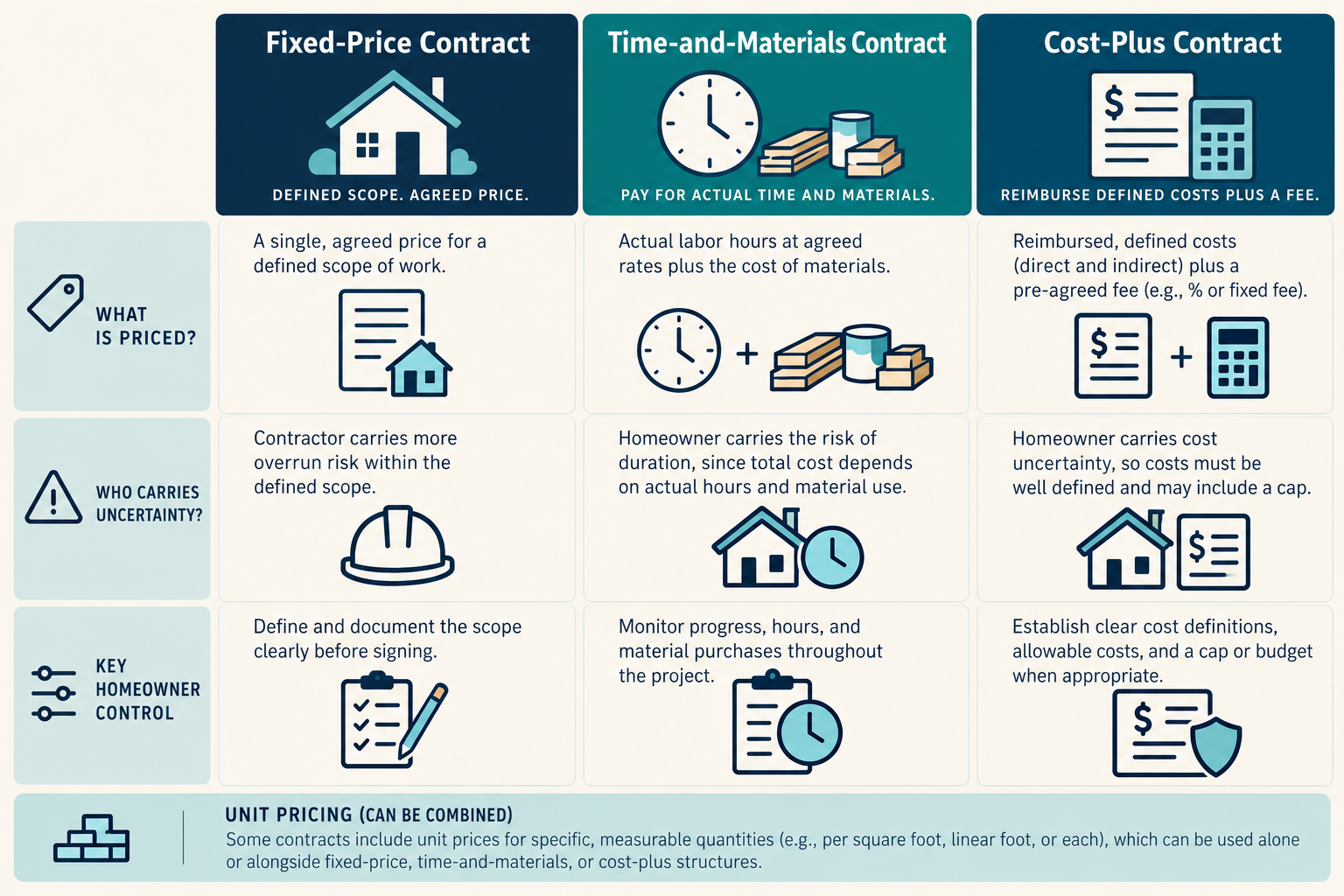
The pricing model is a way of allocating uncertainty between the homeowner and contractor. It should match how well the work is defined. A fixed-price contract can provide budget clarity for a known scope. Time-and-materials can be practical when investigation is unavoidable. Cost-plus can make the contractor’s cost visible while leaving more total-cost risk with the homeowner. The labels are used differently, so read the actual terms rather than relying on the name.
Fixed or lump-sum pricing
A fixed price states a defined amount for a defined scope. It works best when quantities, products, access, design, and existing conditions are sufficiently known. The contractor normally carries more risk that the stated work will take longer or cost more than expected, so the price may include a risk allowance.
Fixed price does not mean every possible condition is included. Concealed damage, owner-requested changes, allowances, material substitutions, and work specifically excluded from the scope can still change the total. Read the definition of completion, exclusions, allowances, and change-order procedure.
Time-and-materials pricing
Time-and-materials billing usually charges for labor time and materials used, sometimes with a service charge, markup, or not-to-exceed limit. It can fit exploratory repair, emergency stabilization, or work where opening an assembly is necessary before the full scope is known.
The homeowner carries more quantity and duration risk. Ask how time is recorded, whether travel and supervision are billable, how material markup is calculated, when updates are provided, and whether the contractor must obtain approval before exceeding a threshold. A written ceiling can improve control, but its exclusions and assumptions matter.
Cost-plus arrangements
Cost-plus pricing reimburses defined project costs and adds a fee, markup, or fixed amount for the contractor’s services. It can be useful when the owner wants open-book visibility or when the scope is too uncertain for a reliable fixed price. It also places more risk on the homeowner unless the contract includes a cap, guaranteed maximum, shared-savings rule, or approval thresholds.
Define “cost” carefully. Does it include subcontractors, labor burdens, equipment, delivery, taxes, rework, project management, and financing? Is the fee a fixed amount, a percentage, or a combination? Can the same overhead be marked up at several levels?
Unit pricing and allowances
Unit pricing sets a price per square foot, linear foot, fixture, opening, load, or other measurable unit. It can help when the unit is clear but the quantity is uncertain. Require a method for measuring actual quantities and identifying what is included in each unit.
An allowance is a budget placeholder for a selection or incompletely defined item. It is not the same as contingency. A low allowance can make a fixed-price bid look lower while leaving the final selection cost unresolved.
Which model fits which condition?
| Project condition | Model that may fit | Risk to control |
|---|---|---|
| Clear scope and known quantities | Fixed price | Exclusions and change-order triggers |
| Hidden conditions or exploratory work | Time-and-materials or staged pricing | Duration, documentation, and approval limits |
| Design still developing | Allowances, unit prices, or phased contracts | Selection and quantity changes |
| Owner wants cost transparency | Cost-plus or open-book pricing | Definition of reimbursable cost and total cap |
| Repetitive measurable work | Unit pricing | Measurement, access, mobilization, and minimums |
These are starting points, not recommendations that override the project facts. A project can use more than one model: fixed price for the defined work, unit pricing for quantities, and time-and-materials for investigation.
Questions before signing
Ask who carries the risk of concealed conditions, price increases, delays, waste, and rework. Confirm how scope changes are requested, priced, scheduled, and approved. Require regular cost-to-complete updates when the final amount is uncertain. Ask whether the contractor can provide invoices, time records, material receipts, and subcontractor documentation appropriate to the model.
Contract terminology and legal effect vary by jurisdiction. Canadian federal guidance emphasizes a signed contract, clear products, warranties, cleanup, and amendments. State and provincial rules may impose additional requirements for contracts, deposits, estimates, cancellation, or payment. The model name is not a substitute for local review.
Select the structure that makes the important uncertainty visible and manageable. A contract that appears firm but hides large exclusions can be less predictable than a well-documented time-and-materials arrangement with a clear limit.
Match the model to what is known
| Pricing structure | Often useful when | Main question for the homeowner |
|---|---|---|
| Fixed price or lump sum | Scope, quantities, products, and access are well defined | What is excluded, and what event permits a change? |
| Time and materials | Work is exploratory or the final quantity cannot yet be known | How are hours, materials, travel, markup, and approval limits controlled? |
| Cost plus | The owner needs an open-book arrangement and accepts more cost exposure | Which costs are reimbursable, and what fee or markup applies to each? |
| Unit pricing | Quantities are uncertain but units can be measured | How are units counted, and what mobilization or minimums sit outside the unit rate? |
These are economic descriptions, not legal classifications. A proposal can combine them: fixed price for known demolition, unit prices for concealed framing, and time-and-materials for investigation. Read the actual contract rather than assuming the title determines the risk.
Not-to-exceed limits need operating rules
A not-to-exceed amount or guaranteed maximum can improve visibility, but only if the contract says what is inside the limit and how changes are handled. Ask whether taxes, permits, allowances, owner-requested changes, escalation, and concealed conditions are included. Ask whether the contractor must stop before reaching the limit and obtain written approval, and whether work can continue if an immediate safety or weather-protection action is needed.
An upper limit is not necessarily a guaranteed finished price. It may exclude work that was not in the defined scope. Conversely, a fixed price is not necessarily a complete project price if large allowances, owner responsibilities, or exclusions remain. Put a simple budget table beside the contract showing committed, conditional, and owner-arranged costs.
See how changes interact with the model
Pricing structure becomes most important when the project changes. Under a fixed price, an owner-requested different product may require a priced change. Under time-and-materials, the extra hours may occur without a formal change unless the agreement requires approval. Under cost-plus, a small scope expansion can increase both reimbursable cost and the fee or markup. Under unit pricing, the total may rise because the measured quantity is larger even though the rate is unchanged.
Before work begins, ask for the change procedure, required notice, supporting records, and effect on schedule. Clarify whether unused allowances return to the owner, whether credits receive the same markup treatment as additions, and whether emergency stabilization can proceed before a final price is known.
Choose based on the project stage
If the problem is still being diagnosed, pay for a defined investigation or use a limited diagnostic phase before committing to a construction price. If design and quantities are complete, a fixed-price proposal may be easier to compare. If the work must open an uncertain assembly, a hybrid approach may be more honest than a forced fixed number. If the project has many owner selections, resolve the most expensive or schedule-sensitive choices before signing.
The model should answer three practical questions: who carries the risk of unknown conditions, who can authorize additional spending, and what records will show how the final amount was reached. If a contractor cannot explain those points, the label on the proposal does not create predictability.
Compare the control rules, not only the labels
Before signing, put the pricing model beside its operating rules:
| Control point | Fixed price | Time and materials or cost-plus |
|---|---|---|
| Known scope | Must be described precisely or exclusions become important | Can accommodate discovery, but the owner carries more uncertainty |
| Extra work | Usually requires a documented change or other contract mechanism | Still needs a trigger, records, and an approval limit |
| Materials | Usually specified or included in a stated allowance | Purchases, handling, and markup should be defined |
| Budget control | Contract total may be easier to plan | Not-to-exceed, phase limits, or frequent reporting may be needed |
| Best next question | What exactly is included? | What evidence and approval are required before spending grows? |
Some projects use a hybrid: a fixed price for known work, unit prices for measured quantities, and time-and-materials for a limited investigation. That can be more honest than forcing unknown work into an apparently firm total. Whatever structure is chosen, keep the assumptions, records, approval point, and remaining uncertainty together with the contract. The pricing label cannot protect a homeowner from an undefined scope.