
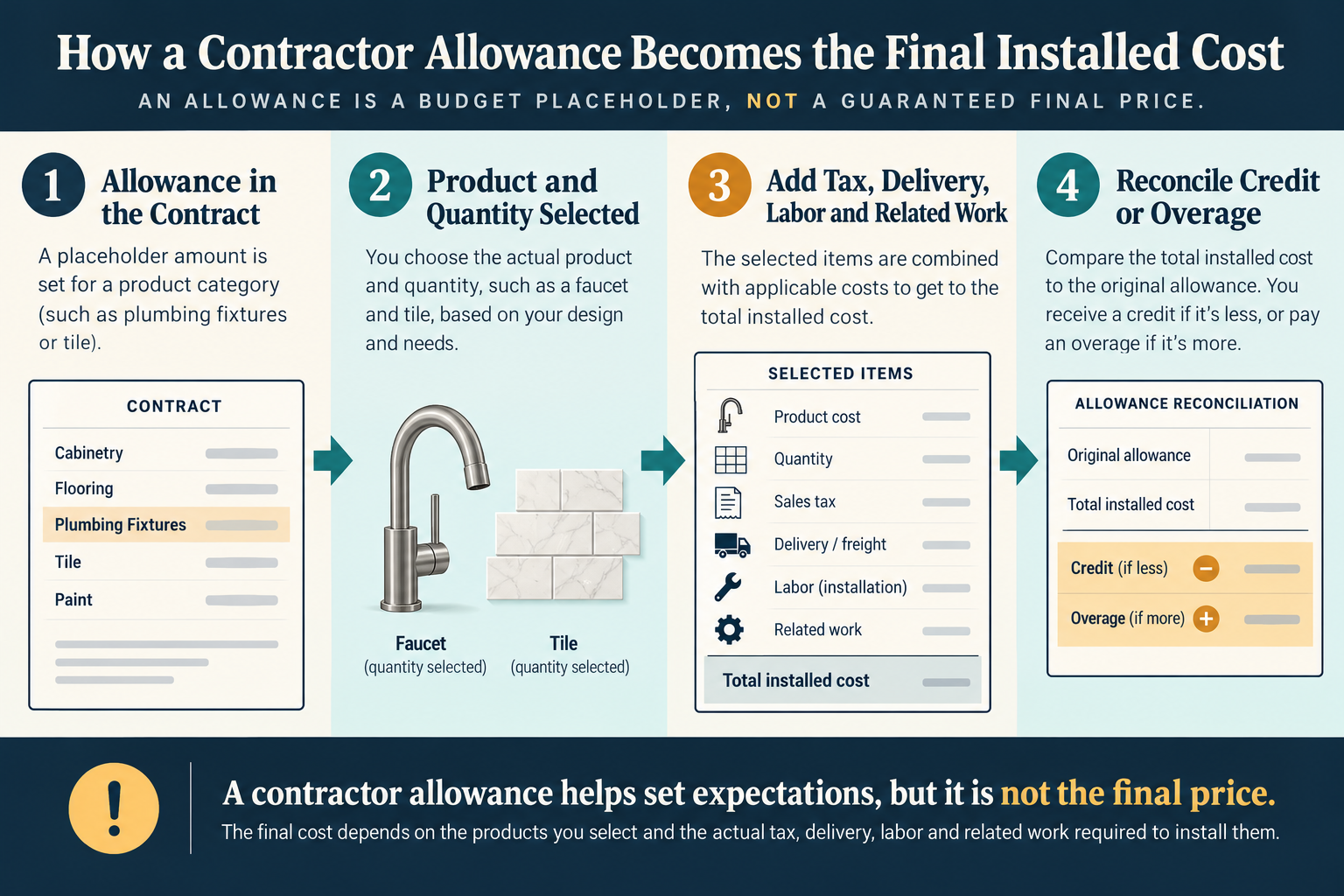
An allowance is a budget placeholder for a product, fixture, finish, quantity, or part of the work that has not been fully selected or defined. It can keep a project moving while decisions remain open. It can also make one proposal appear cheaper when the allowance is too small, excludes installation, or does not cover tax and delivery.
What the allowance actually represents
Read the line with four questions:
- What item or work is included?
- What quantity or unit is assumed?
- Is the amount for the product only or for the complete installed result?
- What happens when the actual cost is higher or lower?
For a bathroom fixture, an allowance might cover the fixture but not trim, valves, delivery, installation, electrical work, or wall repair. For flooring, it might be a material price per square foot while labor, waste, transitions, subfloor preparation, and disposal remain elsewhere.
Allowance versus contingency, alternate, and change order
These terms overlap in everyday proposals but solve different problems. An allowance usually addresses a selection or quantity that is not final. A contingency is an owner-side reserve for uncertainty such as concealed damage. An alternate is a separately priced option. A change order documents an agreed change to the contracted work, including its price or credit and often its schedule effect.
Do not use contingency to hide an allowance that was obviously unrealistic. Do not call a voluntary upgrade a concealed-condition change. The contract should preserve the distinction so you can see what caused the budget to move.
How an allowance changes the final cost
Suppose a proposal includes a low material allowance. When the selected item costs more, the difference may be added to the contract. The contractor may also apply markup, tax, delivery, installation changes, or a revised quantity. Ask whether the contractor’s markup applies only to the difference or to the full installed package, and require the calculation in writing.
If the selection costs less, ask whether the credit is passed through fully and whether associated labor changes. A cheaper faucet may not reduce installation time. A smaller tile may increase labor. The effect of a selection is not always equal to its shelf price.
Build an allowance schedule
Make a separate schedule with the item, assumed quantity, included unit, selected specification, allowance amount, excluded costs, decision deadline, and adjustment method. Keep it with the quote and contract. Ask for samples, model numbers, performance requirements, and lead times before the work reaches the point of no return.
When comparing bids, replace the allowances with the same selections where practical. If the selections are not ready, increase visibility rather than pretending the totals are comparable. A proposal with a higher but realistic allowance may be safer than one with a low placeholder.
When allowances are useful
Allowances can be reasonable when a homeowner wants flexibility, a product has not been chosen, quantities depend on opening an assembly, or design is still being completed. They are less helpful when the item is central to the result, readily specified, or used to conceal a broad scope gap.
Ask whether the allowance is fixed, who chooses the final product, how substitutions are approved, and what happens if the selected product is unavailable. A named allowance should not silently become an owner obligation to research every technical compatibility question.
Protect the budget
Resolve the most expensive or schedule-sensitive selections first. Keep a list of selected items and approvals. Do not authorize an overage from a phone call alone; ask for the revised price, tax, delivery, labor, schedule, and warranty effect. If you change the selection after work begins, it may be a change order rather than an allowance adjustment.
Contract treatment varies by contractor and jurisdiction. Canadian consumer guidance recommends specified products, clear contract terms, warranties, and written amendments. It does not create one universal allowance rule. The actual proposal and local consumer law control.
Trace an allowance from selection to installed cost
An allowance is useful only when you can tell what its amount represents. Ask whether it covers the item alone or also tax, delivery, storage, installation labor, trim, accessories, disposal, and contractor markup. A $2,000 fixture allowance can become a much larger installed cost if the selection requires a different rough opening, electrical circuit, plumbing connection, special delivery, or finish work.
Use a selection schedule with these columns:
| Item | Allowance basis | Selection deadline | Actual cost | Other cost affected |
|---|---|---|---|---|
| Fixture or material | Model, unit, quantity, and inclusions | Date needed for ordering | Approved price | Labor, tax, delivery, warranty |
The schedule should also say how a credit or overage is calculated. If a selection costs less than the allowance, does the contract credit the difference? If it costs more, is the owner charged only the difference or the difference plus a markup, tax, delivery, and changed installation labor? The answer should not be left to a verbal promise.
Distinguish types of uncertainty
Not every placeholder is the same. A selection allowance covers an item the homeowner has not chosen. A provisional or unit-price amount may cover work whose quantity or condition is not known. An alternate is a separately priced option. Contingency is the homeowner’s uncommitted reserve. A change order records an approved change to the contracted scope. The contract may use different terms, so read the definition supplied by the contractor.
Selection uncertainty can often be reduced before work starts. Choose high-cost, long-lead, and schedule-critical items first. Confirm dimensions, compatibility, finish, delivery, and return rules. A lower allowance is not a saving if the products that meet the intended result cost more or if choosing them late causes storage, rework, or schedule charges.
Compare proposals using the same selections
When comparing bids, ask each contractor to price the same specified product or to use the same allowance assumptions. If one contractor prices a basic fixture and another assumes a higher-performance model, the difference is not contractor markup alone. If the selection cannot yet be made, compare the allowance amount, included labor, installation assumptions, and overage formula rather than comparing the headline total.
An allowance can also hide quantity uncertainty. “Tile allowance” may cover the tile but not extra substrate repair, layout changes, waste, trim, grout, waterproofing, or labor to install a more complex pattern. Ask what happens if the measured area changes and who verifies the quantity before ordering.
Control selections without losing flexibility
Do not choose a product only to protect the allowance if it is unsuitable, unavailable, unsafe, or incompatible with the existing assembly. Ask for a revised price and schedule effect before approving a substitution. Keep the written selection approval with the contract and update the budget immediately.
Allowances are a way to keep a project moving while some decisions remain open. They are not permission to hide an incomplete scope. A well-managed allowance tells you what is known, what is still a choice, how the final amount will be calculated, and which deadline protects the work from avoidable reordering or delay.
Use an allowance schedule that can be reconciled
For every allowance, record the item, quantity, assumed unit cost, included installation, tax, delivery, accessories, waste, markup, selection deadline, and the rule for an overage or credit. Then compare that schedule across proposals. Two bids with the same headline total can carry very different exposure if one allowance includes installation and the other covers only the product.
Suppose a quote carries a $2,000 fixture allowance. Before treating it as a $2,000 budget, ask whether the amount includes the fixture, freight, tax, trim, valves, installation changes, and the contractor’s handling charge. If the selected item costs more, the increase may be only the difference in product cost—or it may also change labor and supporting work. The contract should explain the calculation.
Choose high-cost or schedule-critical selections early enough to reduce uncertainty, but do not select an unsuitable product merely to remain under an allowance. If a choice changes the scope, obtain the revised price and schedule before ordering. The allowance is doing its job when it keeps a genuine decision visible; it is failing when it makes a proposal look complete while leaving the final outcome undefined.
Decide when to remove an allowance
An allowance is most useful early, when the homeowner needs a budget before every finish is chosen. It becomes less useful as the project approaches ordering, installation, or a schedule-critical inspection. At that point, convert important allowances into selected products, measured quantities, or explicit unit prices wherever practical. Ask for a written update showing how the conversion changes the contract total and remaining reserve.
Keep the original allowance in the record even after it is replaced. The difference between the allowance and the selected amount explains why the budget moved and makes later change orders easier to understand. If the item cannot be selected yet, record the latest market check, the acceptable range, the selection deadline, and what work can proceed without creating rework.