
When a quote is higher than the visible cost of materials and direct labor, the difference is not automatically “the contractor’s profit.” A business must recover direct job costs, indirect operating costs, risk, warranty obligations, and profit. The contractor may display those components separately or embed them in labor, material, subcontractor, or project lines.
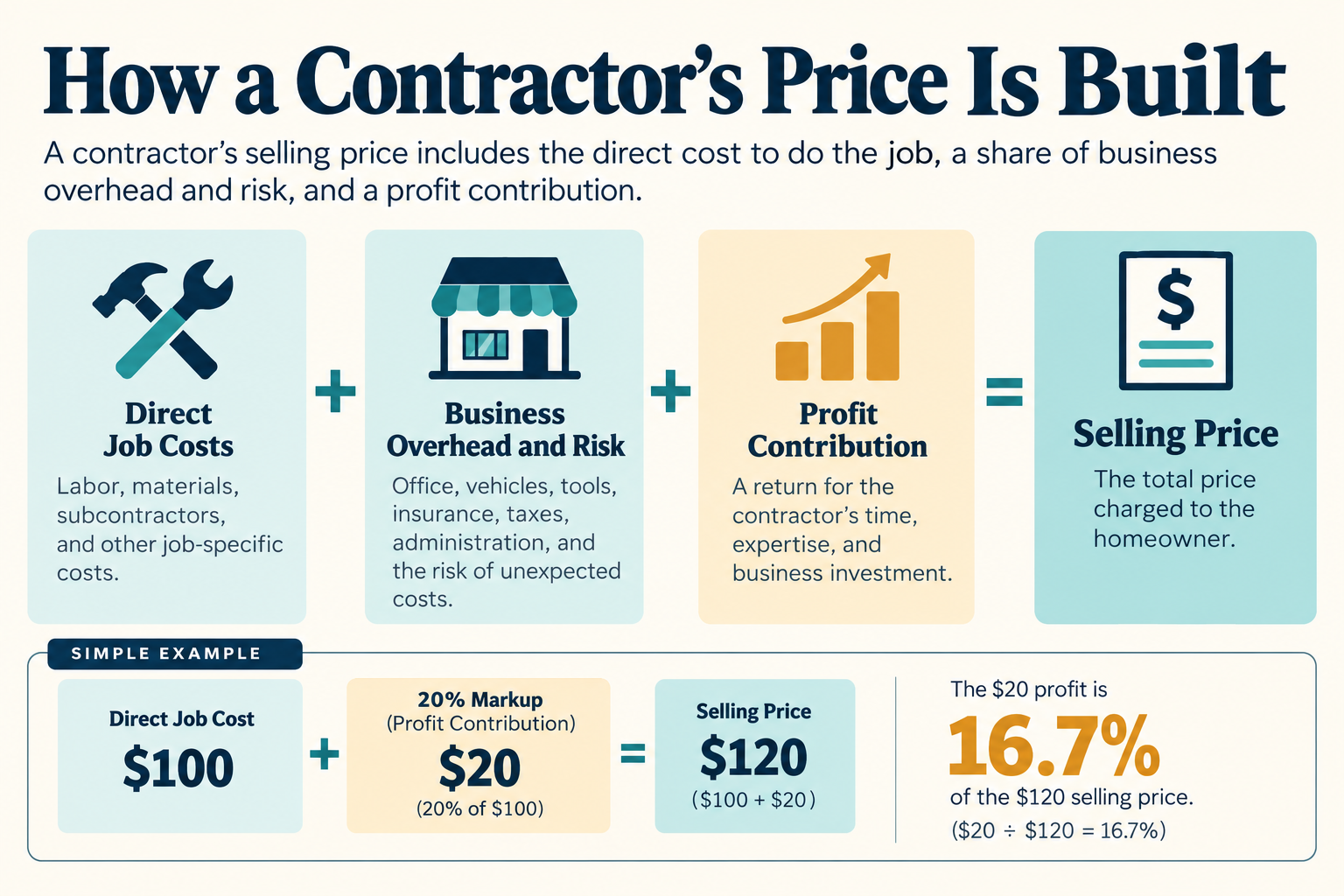
Direct cost is only the starting point
Direct costs are expenses that can be tied closely to your job: the workers on site, materials installed, equipment rented for the job, and sometimes subcontractors. Indirect costs support the business across many jobs: vehicles, insurance, office staff, estimating, scheduling, software, training, licenses, storage, supervision, financing, and time spent handling callbacks.
Overhead is not an optional add-on just because it is not physically left in the house. Without it, the contractor may be unable to answer calls, carry insurance, manage employees, or return to correct a defect.
Markup and margin are different
Markup is commonly calculated by adding an amount to cost to reach a selling price. Gross margin expresses gross profit as a share of the selling price. Because they use different bases, a 20% markup is not a 20% margin. A homeowner does not need to perform the accounting to compare bids, but confusing the terms can make a percentage appear more informative than it is.
Markup can cover overhead and profit together. Net profit is what remains after the business pays its operating costs and other obligations. For example, adding a 20% markup to $100 of cost produces a $120 selling price. The $20 difference is 16.7% of that selling price, so 20% markup is not a 20% gross margin. Neither figure is automatically net profit.
Material handling has a cost
The purchase price of a component is not always the contractor’s complete material cost. Someone must specify, order, receive, inspect, store, transport, protect, and sometimes return it. The contractor may also assume warranty coordination, waste, damaged deliveries, or a substitution when a product is unavailable. Material markup can recover those activities and the risk attached to them.
That does not mean every material charge is reasonable. Compare the stated product, quantity, delivery, tax, waste, and handling assumptions across bids. Ask for an explanation when a material line differs substantially, especially if the product is owner-supplied or already purchased.
Subcontractor management affects the price
A general contractor may hire and coordinate plumbers, electricians, designers, engineers, or specialty installers. The selling price can include subcontractor cost plus the coordination, scheduling, quality control, insurance, and warranty responsibility carried by the general contractor. A direct-to-trade quote may look lower because the homeowner is taking on that coordination.
If subcontractors are involved, ask who contracts with them, who pulls permits, who resolves conflicts, and who returns if their work affects another part of the project. These responsibilities have economic value even when there is no separate “management” line.
What counts as a warning sign?
Markup itself is not a warning sign. Look instead for an unclear scope, unexplained product substitutions, a large unexplained difference from comparable bids, pressure to pay the entire amount up front, refusal to provide a written contract, or a proposal that shifts every foreseeable cost to the homeowner without a clear process.
Specialist sources sometimes publish illustrative U.S. ranges for total or material markup. Those observations are not a national standard, a Canadian rate, a legal limit, or a fairness test. Markup varies with trade, region, project size, business model, risk, and level of service.
Compare value rather than one percentage
Ask each contractor to make the same scope, materials, exclusions, schedule, payment terms, and warranty clear. A contractor who embeds markup may still be cheaper overall than one who shows a lower percentage but excludes disposal, protection, supervision, or follow-up work. A high percentage on a small job may also produce a lower total than a low percentage on a larger or less complete scope.
Useful questions include:
- What does this markup or management amount cover?
- Are overhead, insurance, supervision, and warranty service already included elsewhere?
- Is subcontractor markup included, and can it be charged again on changes?
- Are owner-supplied materials excluded from warranty or installation responsibility?
- Which costs are fixed, and which can change if quantities or conditions differ?
The goal is not to force a contractor’s internal accounting into your preferred format. It is to understand what you are buying and compare the complete installed result.
Read the cost structure in context
Ask what the proposal’s price includes:
- direct labor and materials;
- subcontractor coordination and their markup;
- estimating, design, engineering, or project management;
- insurance, licensing, permits, and compliance work;
- delivery, storage, equipment, access, protection, and cleanup;
- warranty, callback, and closeout responsibility;
- the contractor’s contingency or treatment of unknown conditions.
A separate markup line is not proof of overcharging, and an absent line is not proof that markup is absent. The relevant question is whether the completed scope, risk allocation, and service are clear enough to compare with other options.
When a markup deserves a closer question
Ask for clarification when a markup applies to a cost that was not explained, when the same subcontractor or material appears to be marked up more than once without an agreed structure, when the proposal changes the base on which markup is calculated, or when the markup appears on work the contractor does not coordinate. The goal is not to demand private financial records. It is to identify what the line means and whether it is applied consistently.
Also ask what happens if the quantity changes. A percentage applied to a larger material order may be ordinary if procurement, handling, and warranty responsibility increase. It may need explanation if the base changes because a small owner-requested change is being treated as a new project with unrelated fees. Put the answer in the contract or written clarification.
An unusually high total deserves a scope and risk comparison, not an automatic accusation. An unusually low total deserves the same scrutiny because omitted preparation, protection, warranty, or follow-on work can reappear later as an owner cost. The fair question is whether the complete price is understandable for the result and responsibilities described.