
A change order is a written adjustment to the agreed work. It can add or delete scope, change a product, respond to a concealed condition, or record a schedule effect. A change is not automatically evidence that the original contractor priced badly, but undocumented changes make it difficult to know what you approved or why the budget moved.
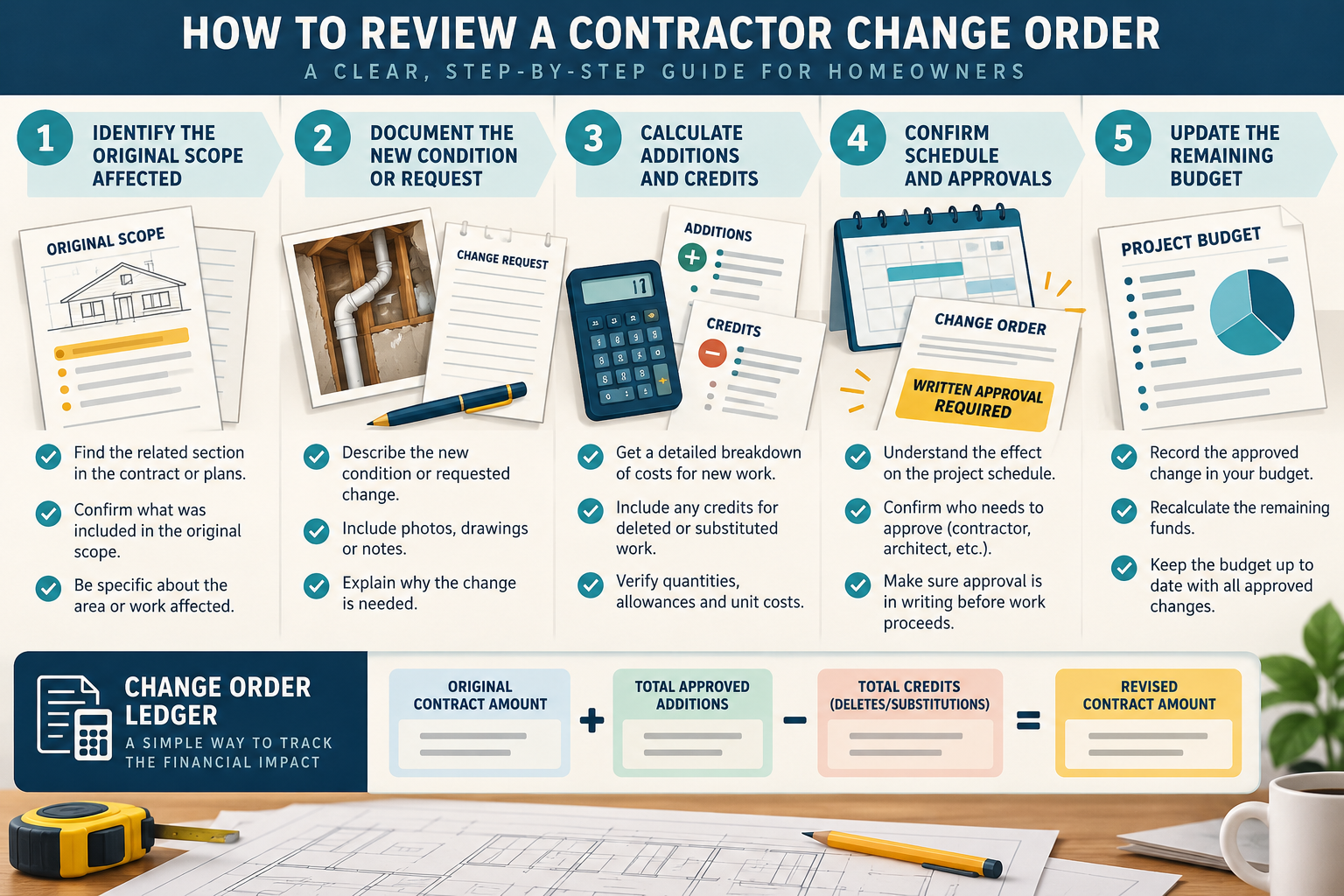
Start with the original scope
Keep the signed contract, drawings, specifications, allowances, exclusions, and clarifications together. When a change is proposed, identify the exact original line it affects. The question is whether the new work was already included, expressly excluded, covered by an allowance, or genuinely outside the known scope.
Examples of possible changes include an owner requesting a different finish, a material becoming unavailable, a hidden damaged assembly being discovered, a required correction identified during permitted work, or a quantity changing after measurement. The contract and facts determine who bears the cost.
What a useful change order states
Before approving, ask for:
- added and deleted work in plain language;
- material, labor, equipment, subcontractor, tax, and markup effects;
- the net price increase or credit and how it was calculated;
- schedule, access, inspection, occupancy, and completion effects;
- any new allowance, warranty, or maintenance assumption;
- photographs, test results, or other evidence for concealed conditions;
- the signatures or approvals required by the contract and local law.
Do not approve a new total without knowing whether it includes a credit for deleted work. A change can add cost in one line and reduce it in another.
Change order versus allowance overage
If you select a product above an allowance, the adjustment may be an allowance reconciliation rather than a new scope change. If the selection changes the installation method, quantity, schedule, or supporting work, a broader change may be needed. The paperwork should say which assumption changed.
Contingency is different again. It is money you reserve before work for uncertain conditions. It is not a contractor charge and is not permission to add voluntary upgrades without approval. Paying an approved change from contingency does not make the change free.
Approve before the work where possible
Written approval before work protects both sides. It gives you a chance to compare an alternative, obtain a second opinion, or decide that the added work is not worth the cost. Some urgent conditions require temporary action before paperwork can be completed; document the authorization, emergency scope, and expected next decision as soon as practical.
Do not let a contractor close a wall, pour concrete, remove a structural support, or discard evidence before you understand a material change unless delay would create a greater risk. For structural, electrical, gas, fire, environmental, or water-damage conditions, use an appropriately qualified professional and follow local requirements.
Rules vary by location
Official consumer guidance in Ontario, California, and Alberta each illustrates the importance of written changes, but their legal details are not interchangeable. California CSLB guidance describes written, signed change orders for the stated California home-improvement scope. Ontario guidance describes an estimate and contract treatment for that province. Alberta guidance asks for written approval and a signed statement showing the increase or reduction. None is a national rule.
If the change involves a deposit, lien or holdback, financing, permit, insurance requirement, home sale, or dispute, verify the applicable state, provincial, territorial, municipal, and contract rules before relying on a general article.
Track cumulative changes
Maintain a simple running table with the original contract, approved additions, approved credits, pending changes, contingency used, and revised amount to complete. Ask for an updated schedule of values when several changes accumulate. A small change can be affordable alone but alter the total when combined with allowances, taxes, and follow-on work.
The goal is not to prevent every change. It is to make the decision visible while there is still time to choose, price, sequence, or stop.
Classify the reason for the change
The financial response is easier to understand when the trigger is named. Common categories include:
- an owner-requested addition or deletion;
- a selection that differs from the allowance;
- a concealed condition not reasonably visible when the scope was written;
- a design correction or incomplete drawing;
- a material substitution caused by availability;
- a required safety, code, or inspection correction;
- a contractor error or rework issue.
The label does not decide who is legally responsible, but it prevents every overrun from being treated as the same event. A changed finish selected by the owner is different from a hidden condition found behind a wall. A correction caused by defective workmanship may be different from both. The contract, evidence, and local law control the result.
Require a usable change document
Before approving non-emergency additional work, ask for a document that states:
- the original scope or line being changed;
- the added, deleted, or substituted work;
- labor, materials, subcontractors, taxes, and markup;
- the net price increase or credit;
- the effect on the schedule and other trades;
- assumptions, allowances, and remaining uncertainty;
- who must approve it and when the approval is effective.
The change should be linked to the latest drawings, selection schedule, photographs, or inspection information when those records explain the reason. “Proceed and we will price it later” can be unavoidable for immediate stabilization, but it should be limited to the safe necessary step and documented as soon as practical.
Watch the cumulative budget
A series of small changes can be more damaging than one large, visible change. Maintain a running total of additions, credits, allowance overages, contingency used, taxes, and follow-on costs. Recalculate the remaining amount to complete, not just the size of the latest change. If the project now approaches a different financing, insurance, permit, or occupancy threshold, ask the relevant professional before approving more work.
Changes can affect more than price. A heavier material may require structural review. A revised fixture may change plumbing or electrical work. A delayed selection may create storage or temporary accommodation costs. A removed item may leave a surface unfinished or make another trade’s work impossible. Ask the contractor to identify those interactions rather than approving the line item in isolation.
Know when to stop and re-scope
If repeated changes show that the original scope was incomplete, pause for a revised plan. More change orders may be less useful than a defined phase with new drawings, a specialist assessment, or a revised fixed price. The purpose is not to punish a contractor for finding an unknown condition; it is to keep the homeowner from authorizing a project whose final cost and outcome are no longer understood.
Written-change requirements differ by jurisdiction. California, Ontario, Alberta, and other locations provide specific examples, but no one example should be treated as a national rule. Follow the contract and local authority guidance, and obtain legal advice for a dispute. A clear change process protects both parties by showing what was known, what changed, and what the owner actually approved.
Use a change-order review sequence
When a change is proposed, move through the same sequence each time:
- Identify the original scope, drawing, allowance, or exclusion affected.
- Ask what was discovered or requested and whether the condition was reasonably visible before work began.
- Request the added work, deleted work, materials, labor, subcontractors, taxes, markup, and schedule effect in writing.
- Ask what happens if the change is declined, delayed, or replaced by a smaller alternative.
- Confirm the approval method and the new amount remaining before authorizing it.
- Update the project budget, payment schedule, drawings, selections, and warranty notes.
This sequence separates a real scope change from a contractor correcting its own work, an allowance reconciliation, or a voluntary upgrade. It does not decide legal responsibility. It gives the homeowner enough information to decide whether to proceed, seek another price, phase the work, or stop and re-scope.
For example, opening a wall may reveal damaged framing. The immediate safe action may be to protect the opening and document the condition. The permanent repair can then be priced with photographs, measurements, and any required specialist input. If a contractor says work must proceed before a price is available, limit the authorization to the necessary stabilization when safe and require a defined next approval point.
Separate approval from payment
Signing a change does not necessarily mean the added work is complete or that the new amount is immediately due. Keep the approved change with the payment schedule and verify the milestone that supports the next invoice. If the change deletes work, confirm the credit and whether the deletion affects warranties, permits, finish quality, or another trade’s sequence.
If several changes are pending, request one current schedule of values rather than approving isolated requests without seeing the revised amount to complete. A project can remain within a contractor’s stated change-order price while exceeding the homeowner’s available cash because allowances, taxes, temporary costs, or owner-purchased items moved at the same time. The decision should be based on the full remaining exposure.