
Replacing a furnace and central AC together can share access, labor, controls, and some indoor equipment, but it is not automatically the economical choice. The furnace may have useful remaining life, while the AC needs replacement, or both may be aging and no longer a confident match. Compare the complete one-at-a-time and coordinated scopes over the period you expect to own the home.
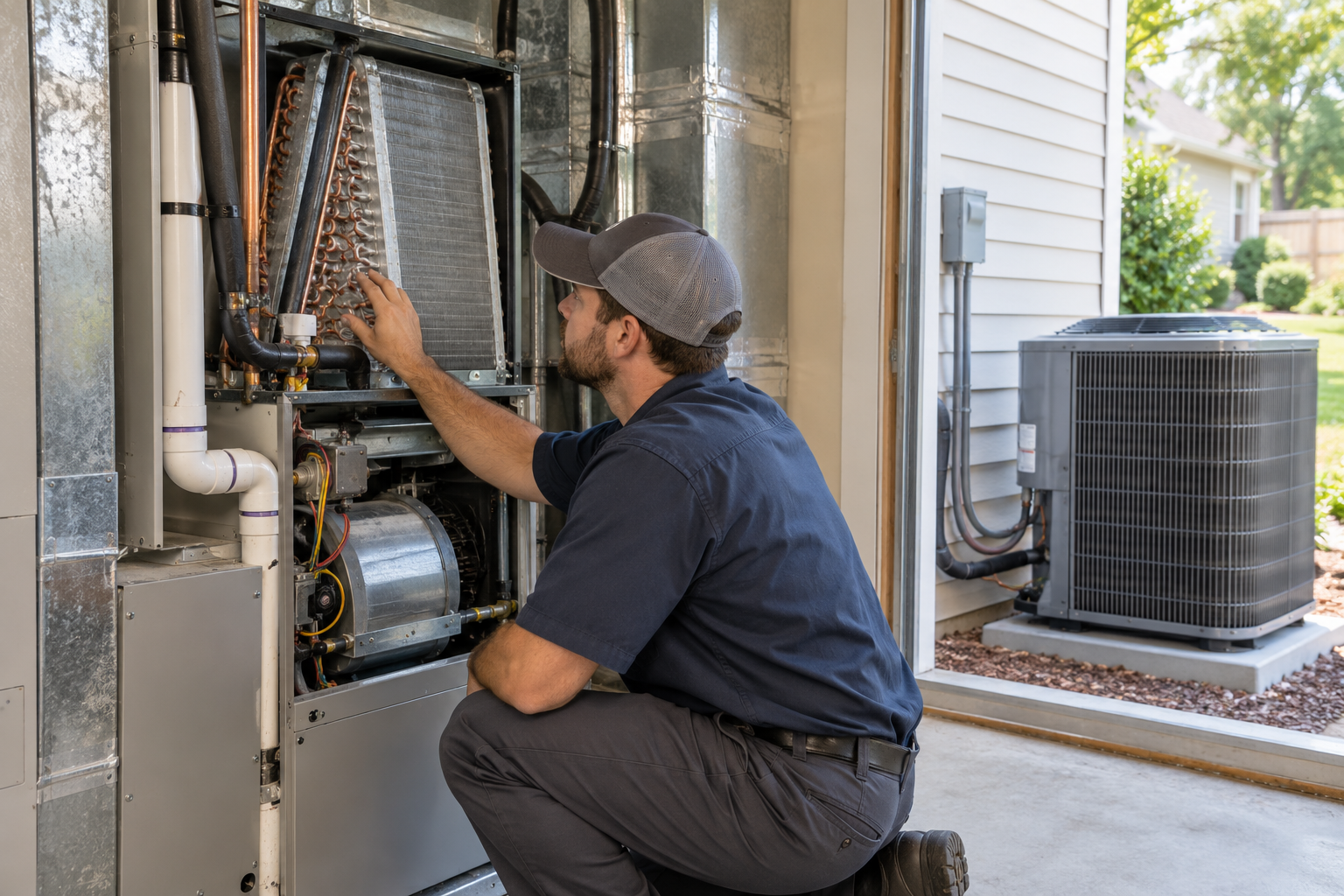
Illustrative planning scenario (CAD, September 2026)
This is a transparent comparison using a specialist Canadian paired-system example: a gas furnace plus central AC with existing ducts is reported at CAD $6,500–$12,500. Treat that as a bounded market observation, not a quote; compare it with the separate furnace-only, AC-only, access, controls, removal, and future-mobilization costs.
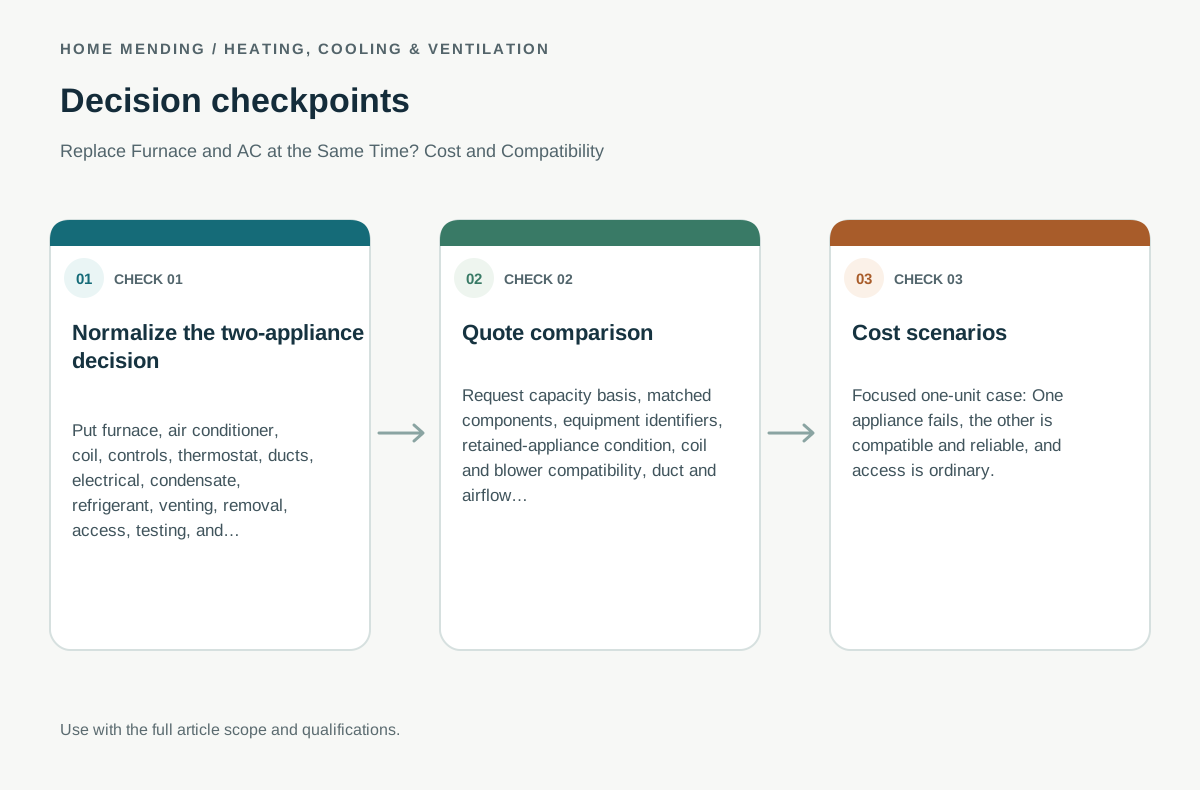
Normalize the two-appliance decision
Put furnace, air conditioner, coil, controls, thermostat, ducts, electrical, condensate, refrigerant, venting, removal, access, testing, and commissioning into separate lines. Then identify what is reusable and what would be replaced later. Coordinating work can reduce duplicate labor, but it can also accelerate spending on a component that still has useful life.
Ask how a staged plan would affect future matching, warranty, access, and disruption. If a heat pump or dual-fuel plan is under consideration, price that complete alternative with backup and operating assumptions. The best decision is the path that resolves the next real system need without paying twice for adjacent work.
Compare staged and coordinated work
Replacing both appliances together can reduce duplicate access, equipment-matching uncertainty, and later disruption. Staging can preserve cash and avoid replacing a reliable component. Ask what condition, age, compatibility, and future service assumptions support each path. If one appliance is likely to be replaced soon, show the cost of doing the associated coil, controls, electrical, condensate, removal, and commissioning work once rather than twice.
If a heat pump is a genuine future option, include its distribution, backup, electrical, controls, low-temperature capacity, and operating assumptions. Do not make a paired furnace-and-AC replacement the default when the homeowner is actually choosing a different system strategy.
The furnace or air handler may contain the blower and share the evaporator coil, cabinet, thermostat, duct transitions, controls, condensate, and access. A new outdoor AC unit may not be compatible with the existing coil or control architecture. Conversely, replacing a working furnace only to obtain a package discount can destroy remaining value.
ENERGY STAR recommends evaluating ducts, airflow, installation quality, comfort, bills, age, and repeated repairs. The paired decision should start with condition and compatibility, not a contractor’s claim that both boxes must always be replaced.
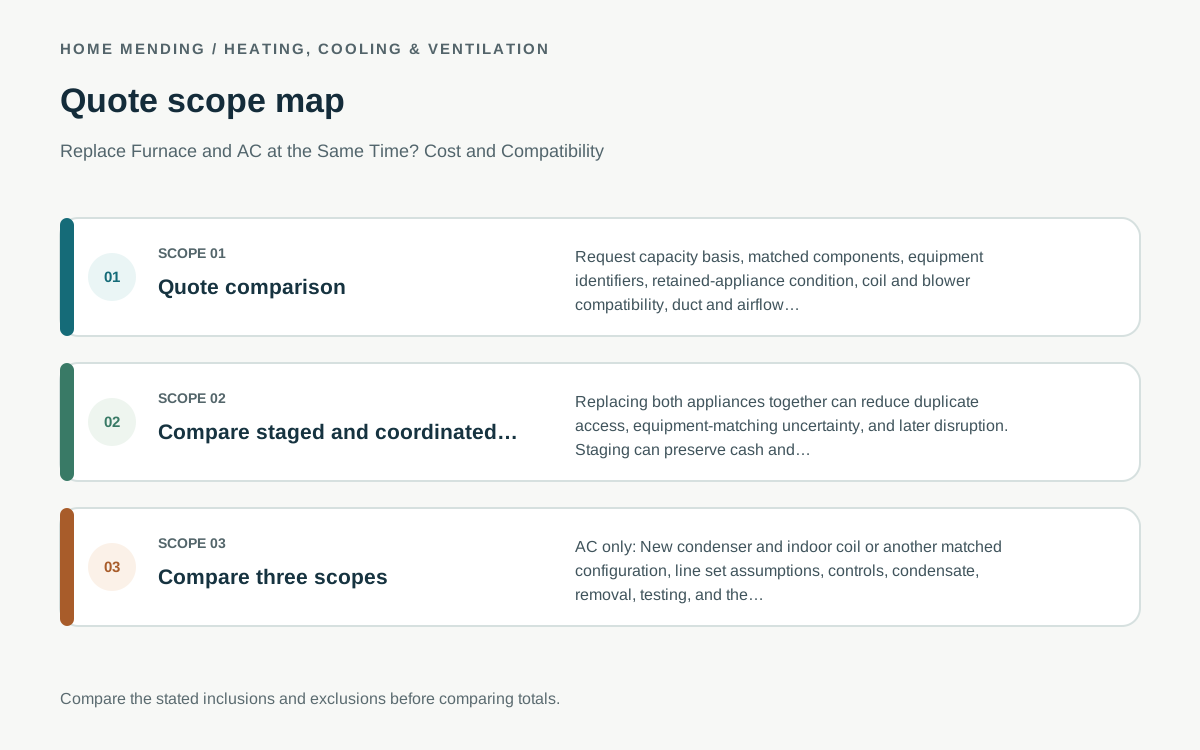
Compare three scopes
AC only: New condenser and indoor coil or another matched configuration, line set assumptions, controls, condensate, removal, testing, and the existing furnace retained.
Furnace only: New furnace, blower, controls, venting or condensate as applicable, removal, testing, and the existing AC evaluated for compatibility.
Coordinated replacement: New heating and cooling equipment, matched coil and condenser, controls, ducts and airflow, removal, electrical or venting, condensate, testing, and one access setup.
When replacing both is stronger
The coordinated case gains weight when both appliances are near the end of their useful service horizon, share difficult access, use incompatible controls or coil, have repeated repairs, or would otherwise require two disruptive mobilizations. Include the value of one schedule and one commissioning process, but do not call labor “free”; quantify the actual overlap.
When replacing one is stronger
Single replacement can preserve a reliable furnace or AC, limit upfront cost, and defer a system that is not yet a problem. It is stronger when compatibility is documented, the retained appliance has good history and warranty, and future access will not create a disproportionate second project.
Ask what condition and compatibility the contractor is assuming. A retained furnace with poor airflow or a failing blower can undermine a new AC; a new furnace attached to deficient ducts can preserve comfort problems.
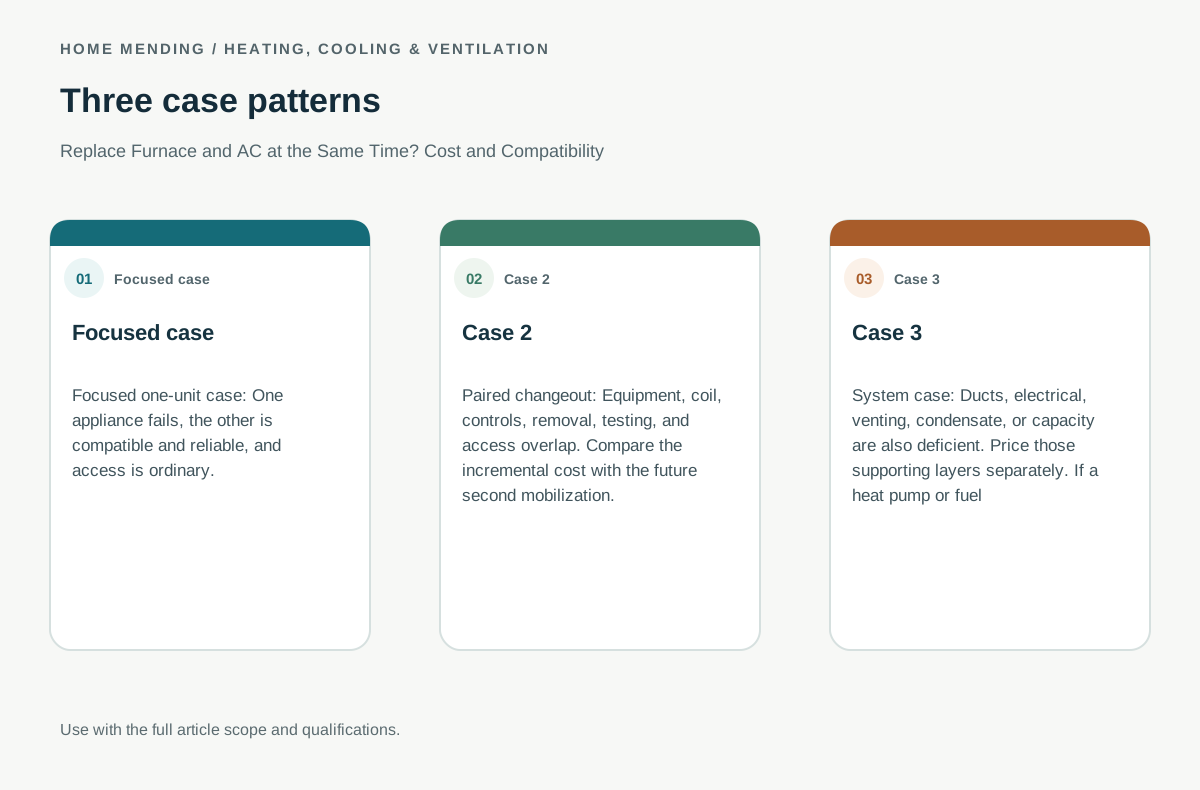
Cost scenarios
Focused one-unit case: One appliance fails, the other is compatible and reliable, and access is ordinary.
Paired changeout: Equipment, coil, controls, removal, testing, and access overlap. Compare the incremental cost with the future second mobilization.
System case: Ducts, electrical, venting, condensate, or capacity are also deficient. Price those supporting layers separately. If a heat pump or fuel conversion is the real strategy, use the broader equipment or electrification comparison.
Quote comparison
Request capacity basis, matched components, equipment identifiers, retained-appliance condition, coil and blower compatibility, duct and airflow evaluation, controls, refrigerant, removal, access, electrical or venting, condensate, testing, warranty, and exclusions. U.S. and Canadian market observations are planning context only and should not be converted across currencies.
Choose both when the system-level scope, labor overlap, compatibility, and ownership horizon justify it. Choose one when the retained equipment is sound and the future project remains manageable. The decision is resolved by the condition after each option, not by a package discount alone.
Quantify labor overlap
Ask what access, removal, controls, coil, blower, duct transition, condensate, testing, and commissioning work is shared. A coordinated project may avoid reopening a difficult closet or attic, but the contractor should show the actual incremental cost rather than call the second appliance free. Include the future cost of a separate mobilization if only one unit is replaced.
Protect compatibility
If one appliance is retained, request the equipment match, coil, blower, thermostat, refrigerant, venting, and control assumptions in writing. A new AC can inherit a failing blower or poor airflow; a new furnace can inherit a mismatched coil or deficient duct system. Ask which performance checks are included after either option.
Compare staged total cost
Request the price of AC-only, furnace-only, and combined work with identical access, removal, controls, testing, and warranty assumptions. Then add the likely cost of the second mobilization if work is split. A package discount is meaningful only after you know what is actually shared.
If the retained appliance has poor airflow, a failing blower, a mismatched coil, or a near-term warranty issue, single replacement may not be a durable saving. If it is reliable and compatible, replacing it early can waste remaining value. Ask for a condition statement rather than relying on age alone.
For a short horizon, retaining a reliable appliance may preserve cash. For a long horizon, coordinating two near-end-of-life appliances may reduce disruption and duplicate access. If a heat pump is the future strategy, compare that complete system rather than automatically installing another furnace and AC pair.
Make system matching part of the price
Replacing the furnace and AC together can coordinate indoor and outdoor equipment, controls, coil, airflow, refrigerant work, removal, and commissioning. It does not automatically mean every adjacent problem is included. Ask whether ducts, returns, electrical capacity, condensate, line sets, thermostat, pad, disconnect, and finish restoration are reused or changed.
The low-cost case is a compatible pair in an accessible location with sound distribution. A typical case includes removal, equipment match, controls, testing, and some related corrections. A difficult case includes poor ducts, concealed access, electrical work, refrigerant or coil uncertainty, or a change to a heat pump. Compare the combined project with staged replacement and with a complete alternative system using the same rooms, comfort objective, and ownership horizon.