
Illustrative planning scenario (U.S. dollars, September 2026)
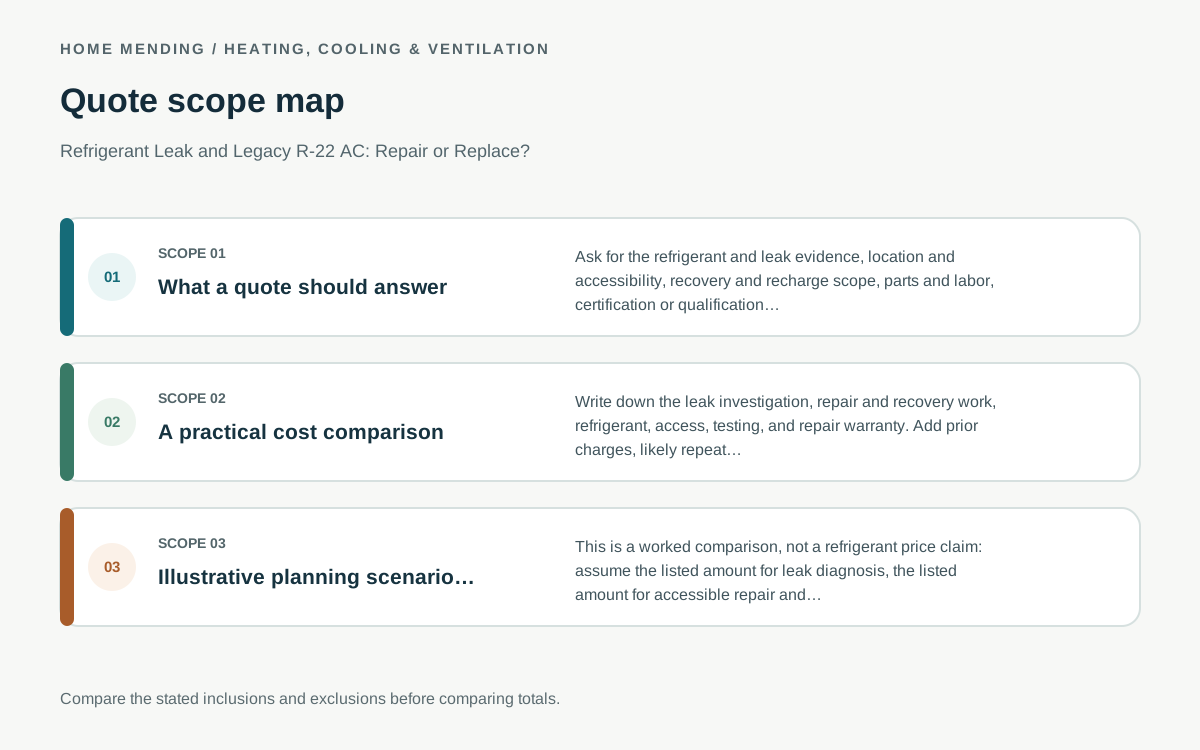
This is a worked comparison, not a refrigerant price claim: assume $450 for leak diagnosis, $650 for accessible repair and evacuation, and $350 for a refrigerant-related allowance. The repair case is $1,450 before tax; compare that bounded intervention with replacement when the leak is concealed, repeated, or tied to obsolete equipment.
Ask what the leak means for the equipment
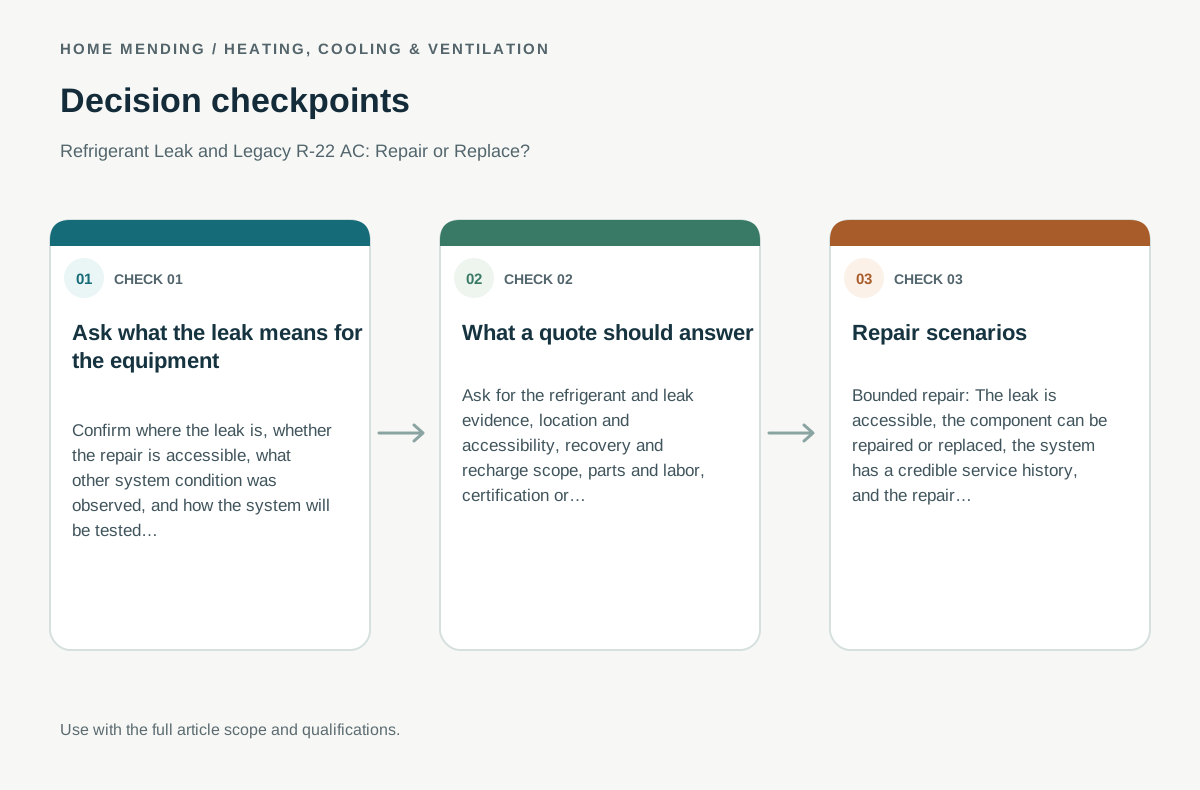
Confirm where the leak is, whether the repair is accessible, what other system condition was observed, and how the system will be tested afterward. EPA states that an existing R-22 system is not required to be replaced solely because R-22 is no longer produced; recycled, reclaimed, or previously produced refrigerant may be used by appropriately qualified technicians under applicable requirements. Retrofit is not a simple drop-in conversion.
Repair is stronger when the leak is bounded, the equipment and coil are otherwise credible, and the owner accepts future service uncertainty. Replacement is stronger when leaks recur, the coil or compressor is also declining, access is difficult, or a complete system change better fits the ownership horizon. Compare repair, refrigerant and testing, replacement, electrical, indoor coil, line set, controls, removal, and commissioning without treating one regulatory fact as a universal economic answer.
Separate leak investigation, repair, recovery, refrigerant, access, testing, and warranty from the cost of another service call. Then price a matched replacement with coil, condenser, line-set assumptions, controls, removal, electrical, condensate, and commissioning. The first recharge is not the relevant comparison if the system has leaked repeatedly.
Ask what fact would change the recommendation: a located accessible leak, an unavailable component, a second leak, a failed compressor, or a current local rule. This keeps regulatory uncertainty and economic uncertainty visible without treating either as a universal answer.
A leaking R-22 air conditioner creates a repair-versus-replace decision, not an automatic replacement order. In the U.S., EPA states that existing R-22 equipment may continue to be serviced with recycled, reclaimed, or previously produced refrigerant and that homeowners are not required to replace or convert a unit solely because it uses R-22. That does not make every leak repair economical. Availability, leak location, system age, repeated service, and the complete replacement scope still matter.
Find the leak before discussing a top-off
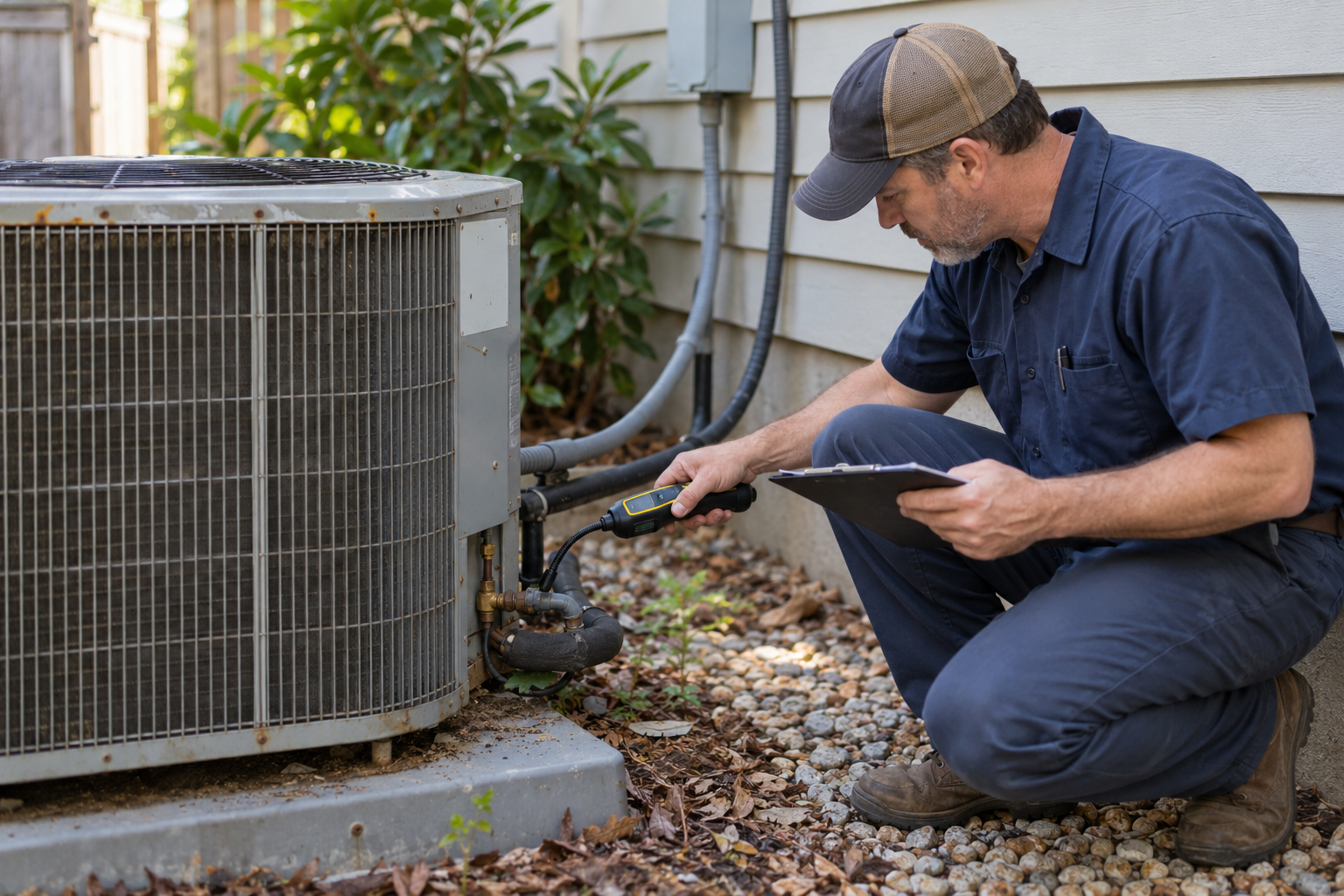
Adding refrigerant may restore operation temporarily, but it does not establish the source or durability of the repair. Ask whether the technician is proposing leak detection, access to the leaking component, repair, recovery, evacuation, recharge, and performance testing. A quote should say what happens if the leak cannot be located or if another leak is found.
Do not perform refrigerant work yourself. EPA recommends technicians with applicable Section 608 certification in the U.S. Canadian requirements depend on the federal, provincial, or territorial rules applicable to the property and system.
Why R-22 changes the economics
Legacy refrigerant availability and service cost can add uncertainty. The system may also have aging coils, compressor, controls, insulation, or airflow problems. A low initial charge can become an expensive repeated mobilization when the underlying leak remains.
EPA distinguishes repairing an existing system from installing a new system. It also warns that an alternative refrigerant is not a simple drop-in substitution; components may need changes for a retrofit to work properly. A proposal that says “convert to another refrigerant” should explain the equipment-specific procedure, compatibility basis, and warranty implications.
U.S. and Canadian boundaries
EPA’s U.S. federal guidance and technology-transition FAQ are not Canadian law. In the U.S., current requirements for new split systems and refrigerant handling must be checked against the scope and current version of the applicable rule. Existing-system repair remains a distinct category from installing a new system.
In Canada, ECCC describes a federal halocarbon regulation with a limited scope, including specified systems on federal or Indigenous lands or connected with federal ownership or works. Provincial and territorial legislation applies in other contexts and may address installation, servicing, leak repair, recovery, training, and restrictions on recharging leaking equipment. Verify the rule for the actual province or territory and system; do not generalize the federal page nationwide.
Repair scenarios
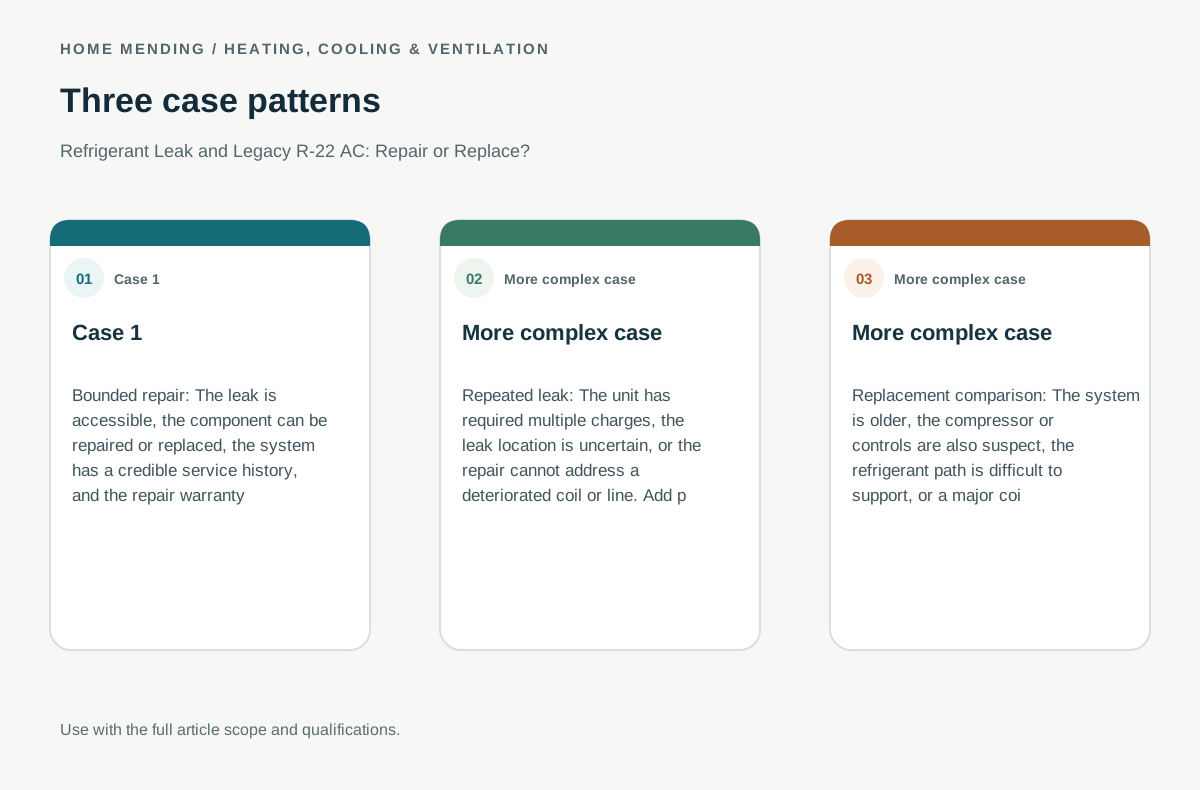
Bounded repair: The leak is accessible, the component can be repaired or replaced, the system has a credible service history, and the repair warranty is clear. Repair may be sensible when it restores a useful remaining horizon.
Repeated leak: The unit has required multiple charges, the leak location is uncertain, or the repair cannot address a deteriorated coil or line. Add prior service costs and likely future mobilization to the repair total.
Replacement comparison: The system is older, the compressor or controls are also suspect, the refrigerant path is difficult to support, or a major coil repair is required. Price a new matched system with indoor coil, outdoor unit, line-set assumptions, controls, removal, electrical, condensate, and commissioning.
What a quote should answer
Ask for the refrigerant and leak evidence, location and accessibility, recovery and recharge scope, parts and labor, certification or qualification relevant to the jurisdiction, repair warranty, remaining system condition, and replacement alternative. Request that optional efficiency or thermostat upgrades be separated from work required to restore operation.
Do not compare a refrigerant charge with a replacement system. Compare a durable leak repair plus residual risk with a complete replacement plus its installation and supporting work.
When replacement wins
Replacement is more persuasive when the leak is one symptom of a failing system, repairs repeat, the repair warranty is weak, component availability is uncertain, or the repair would leave a large future decision immediately ahead. Repair is more persuasive when the fault is isolated, the equipment is otherwise sound, the cost and outcome are clear, and ownership horizon supports keeping it.
No universal rule decides the choice. The responsible budget states what is known, what is still uncertain, which local refrigerant rules apply, and what condition the system will have after each option.
A practical cost comparison
Write down the leak investigation, repair and recovery work, refrigerant, access, testing, and repair warranty. Add prior charges, likely repeat service, and the chance of another leak. Then obtain a replacement scope with matched indoor and outdoor equipment, line-set assumptions, controls, removal, electrical, condensate, testing, and commissioning.
The comparison is strongest when the leak location is known and the repair has a credible service horizon. It is weaker when the contractor cannot locate the leak, the system has multiple aging components, or each visit only restores cooling temporarily. A lower first invoice can still be the more expensive ownership path.
Keep rule questions separate from economics
Ask the technician or authority which current refrigerant-handling, certification, recovery, installation, and disposal requirements apply. EPA’s U.S. guidance and ECCC’s Canadian pages establish different scopes; neither replaces province-, territory-, state-, or local verification. A contractor should identify whether the proposal repairs an existing system or installs a new one.
Do not accept “R-22 is banned” or “replacement is required” without the jurisdiction, system, and current rule. Equally, do not accept a cheap recharge as proof that the system is a good long-term repair candidate.