
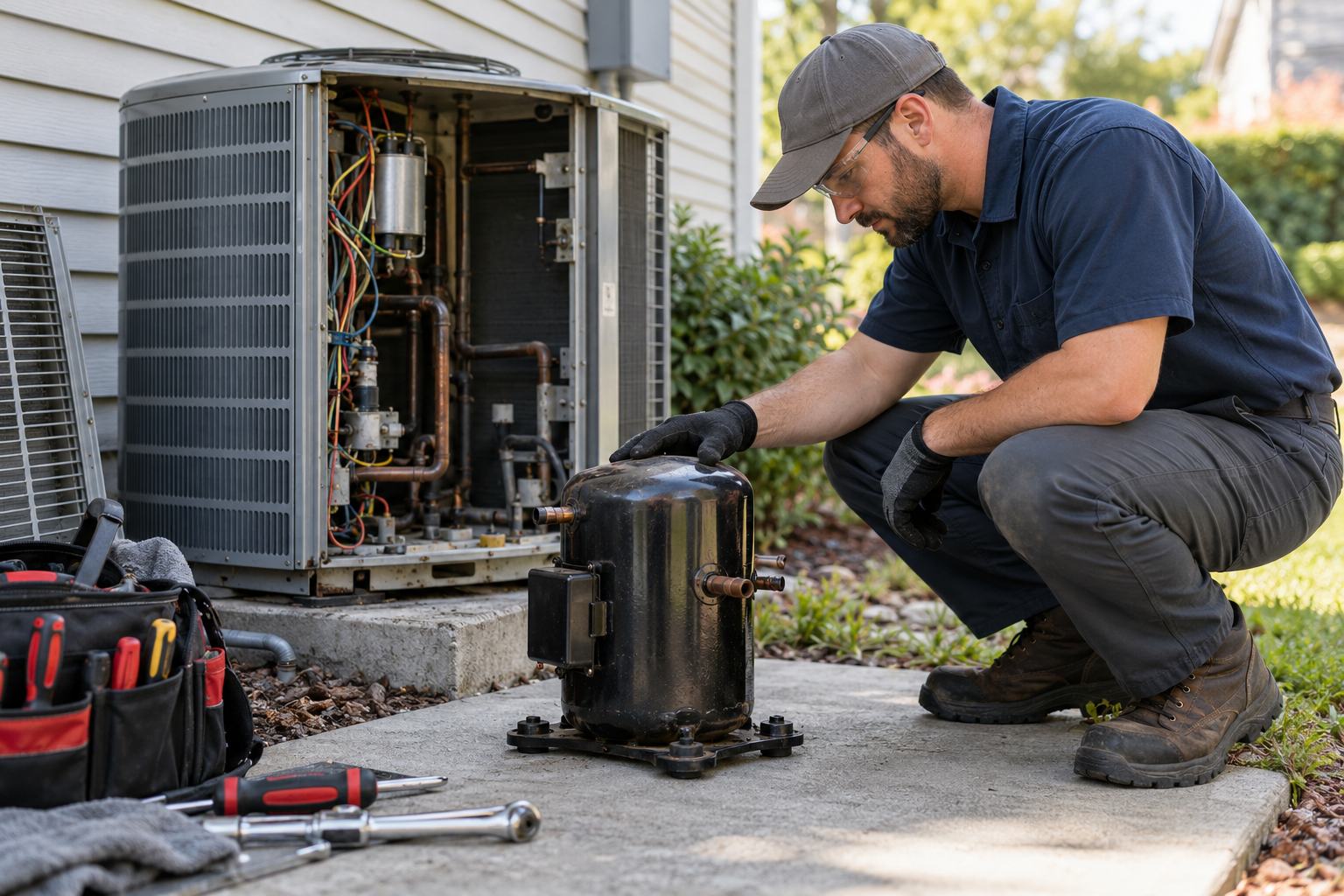
A compressor replacement is one of the more consequential central-AC repairs because the compressor sits inside the refrigerant circuit and the work can involve recovery, opening the circuit, evacuation, recharge, testing, and diagnosis of why the compressor failed. There is no reliable universal compressor price in the active market evidence. Treat any number as a local, equipment-specific quote rather than a standard line item.
Illustrative planning scenario (U.S. dollars, September 2026)
This is a transparent comparison, not a market quote: assume $1,400 for compressor labor and refrigerant-related service, $400 for diagnosis and cleanup, and $1,000 for a related electrical or access allowance. The repair budget would be $2,800 before tax; compare it with the complete matched-system replacement scope rather than the compressor alone.
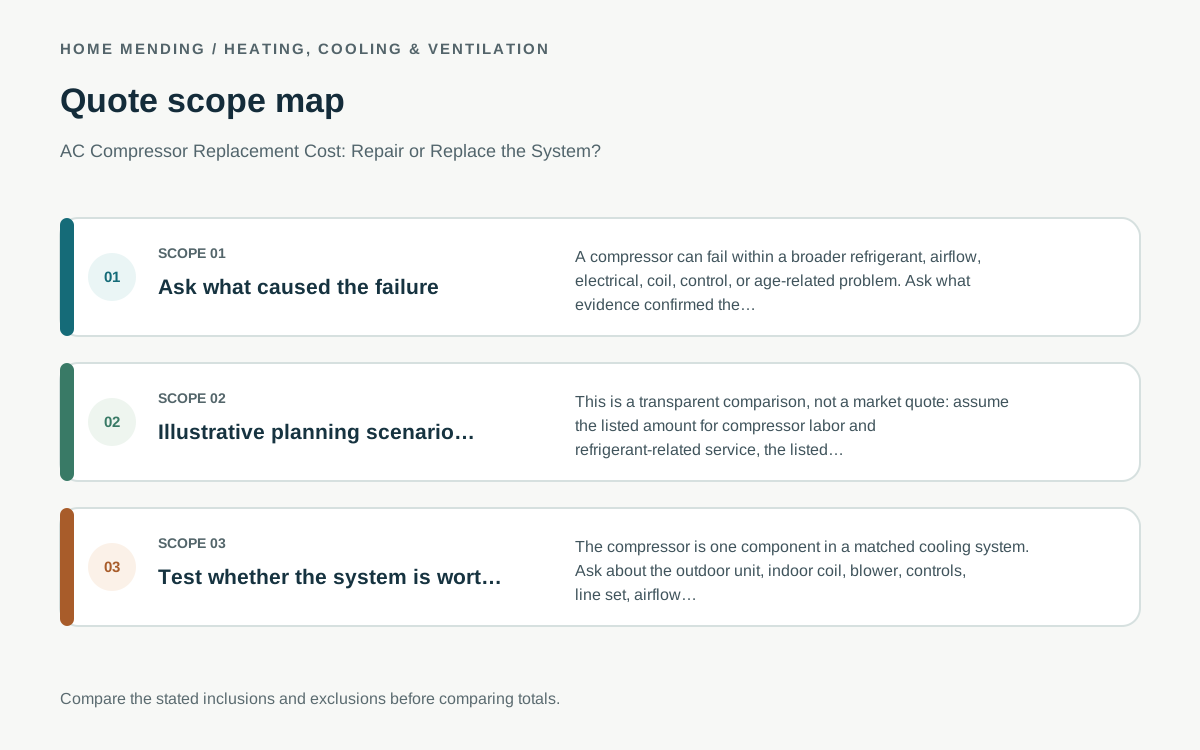
Ask what caused the failure
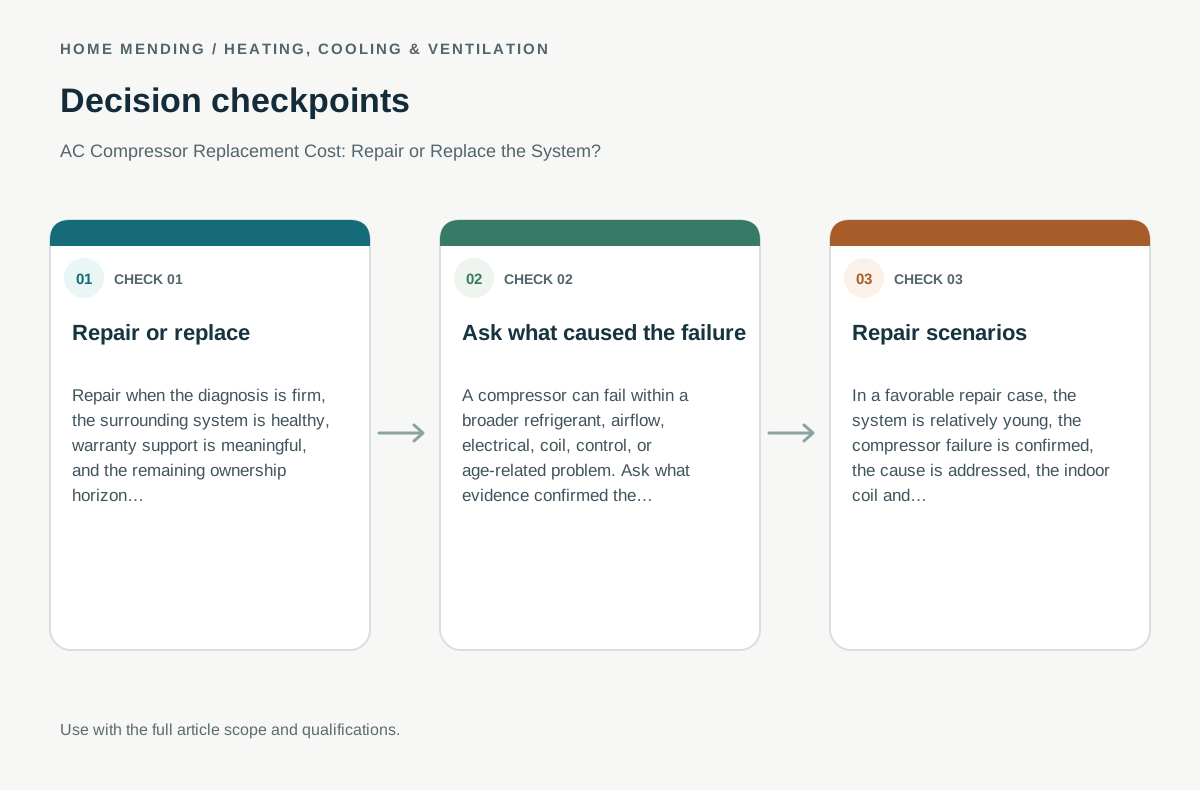
A compressor can fail within a broader refrigerant, airflow, electrical, coil, control, or age-related problem. Ask what evidence confirmed the failure and whether the underlying condition was investigated. If the cause is unresolved, the repair risk includes more than the labor to install the replacement part.
Compare the complete repair with an AC replacement when the system has repeated leaks, a failing coil, corrosion, difficult access, or an adjacent air handler or furnace near replacement. Include recovery, cleanup or protection, testing, warranty, removal, line-set assumptions, electrical, condensate, controls, and commissioning. A running system is not necessarily a sound long-term system.
Test whether the system is worth preserving
The compressor is one component in a matched cooling system. Ask about the outdoor unit, indoor coil, blower, controls, line set, airflow, refrigerant condition, access, and likely remaining service life. If the failure cause is not understood, a new compressor may be exposed to the same condition.
Compare a focused repair with full AC replacement when age, corrosion, repeated leaks, coil condition, or a near-end-of-life air handler changes the risk. Make recovery, replacement, cleanup or protection measures, testing, warranty, removal, electrical, condensate, controls, and commissioning visible. “Running after repair” is a test result, not a long-term value conclusion.
The contractor must first establish that the compressor—not a control, capacitor, wiring issue, fan, coil, airflow problem, or refrigerant condition—is the cause. The repair may then require access to the outdoor unit, refrigerant handling, replacement labor and materials, circuit cleanup or filtering depending on the failure, commissioning, and a repair warranty.
The failed compressor may also be a symptom of another condition. Poor airflow, incorrect charge, electrical problems, contamination, or inadequate installation can affect the new component. Ask what evidence was found and what corrective work is included to protect the repair.
Warranty changes the economics
Some equipment warranties cover a compressor part while leaving labor, refrigerant, access, and related materials to the homeowner. Others may have registration, installer, or system-specific conditions. Ask for the written warranty terms and an itemized out-of-pocket total. “Compressor covered” does not mean “the repair is free.”
If the system is out of warranty, compare the complete repair with a matched AC replacement. A replacement quote should include indoor coil, condenser, line set assumptions, controls, removal, disposal, electrical, condensate, and commissioning—not just a new outdoor box.
Repair scenarios
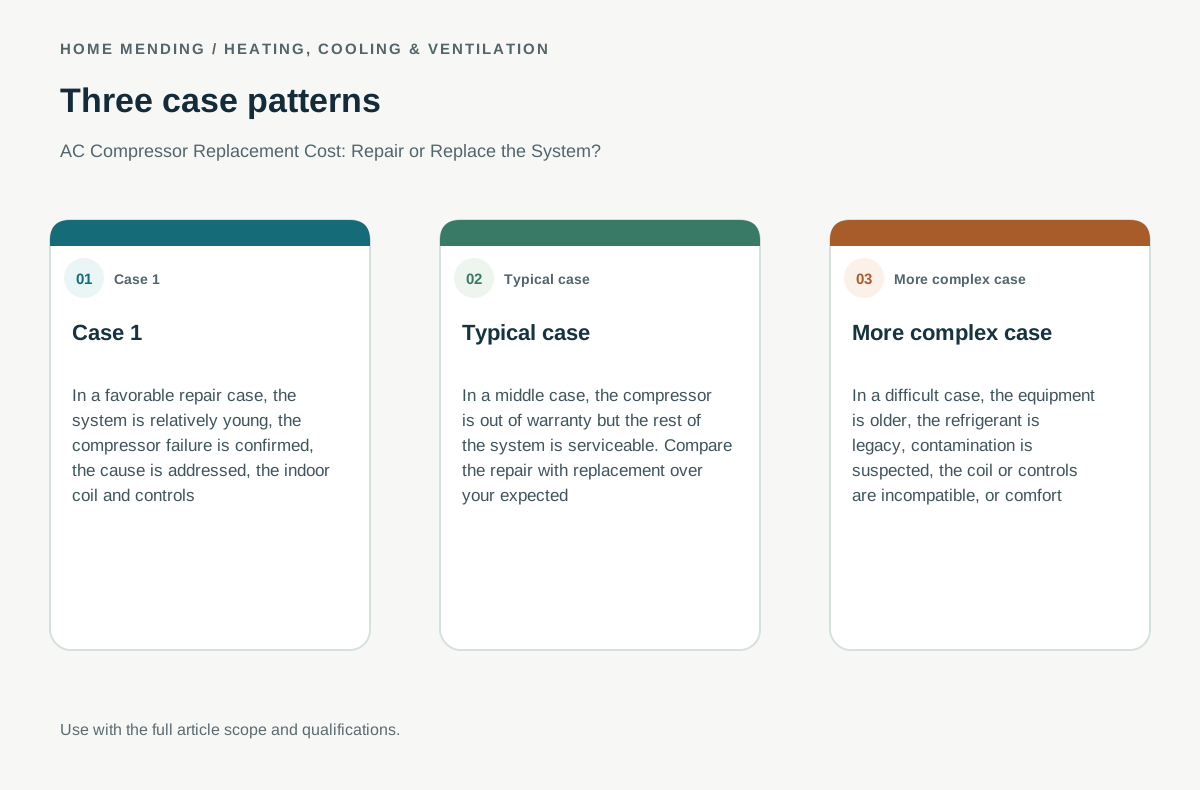
In a favorable repair case, the system is relatively young, the compressor failure is confirmed, the cause is addressed, the indoor coil and controls remain compatible, and warranty coverage reduces the part cost. Repair may preserve the value of the remaining system.
In a middle case, the compressor is out of warranty but the rest of the system is serviceable. Compare the repair with replacement over your expected ownership period, including the chance of another coil, control, or fan failure.
In a difficult case, the equipment is older, the refrigerant is legacy, contamination is suspected, the coil or controls are incompatible, or comfort problems existed before the failure. A compressor repair can restore cooling without resolving those risks. Replacement may be more predictable even when the compressor repair has a lower initial total.
Refrigerant and compatibility boundaries
EPA states that U.S. technicians handling refrigerant should have applicable Section 608 certification. EPA also distinguishes repairing an existing system from installing a new system and warns that an alternative refrigerant is not a drop-in retrofit without component changes. Canadian refrigerant requirements vary by applicable federal, provincial, or territorial scope.
These rules do not decide the economic choice. They tell you to ask whether the proposed work is a repair to the existing system, a component change that affects the match, or a new-system installation with different requirements.
Questions for the contractor
Ask:
- What tests confirmed compressor failure?
- What evidence suggests the cause will not damage the replacement?
- Is the compressor part covered, and what labor, refrigerant, and materials remain?
- Is cleanup or circuit treatment included if contamination is found?
- Are the indoor coil, line set, controls, and condenser a verified match?
- What warranty applies to the repair?
- What is the all-in replacement alternative using comparable scope?
The answers should be specific enough to distinguish a repair from a guess.
Repair or replace
Repair when the diagnosis is firm, the surrounding system is healthy, warranty support is meaningful, and the remaining ownership horizon justifies the risk. Replace when the compressor is one of several aging failures, the system is poorly matched or difficult to support, the repair leaves a known refrigerant or comfort problem, or the replacement quote is close enough that predictable service matters more than preserving the old assembly.
Do not decide from compressor price alone. Decide from the condition of the whole refrigerant and air-distribution system after the proposed work.
Separate failure cause from failure component
Ask whether the compressor failure was confirmed as electrical, mechanical, refrigerant-related, airflow-related, or another documented cause. The homeowner does not need a textbook diagnosis, but the quote should explain what corrective work addresses the risk. If the cause is unresolved, the apparent compressor price understates the repair risk.
For a short ownership horizon, a warranted repair on otherwise sound equipment may preserve cash. For a longer horizon, include the chance of a coil, fan, control, or line-set problem and compare that with a new matched system’s installation, warranty, operating assumptions, and service availability.
Close out the repair properly
Request the system identifiers, confirmed failure, cause or remaining uncertainty, refrigerant work, cleanup or protection measures if applicable, testing, repair warranty, and recommendations for airflow or controls. A compressor replacement should end with a system-condition statement, not only an invoice marked “running.”
Compare a compressor repair with the system’s future
The repair case is stronger when the failure is confirmed, the coil, outdoor unit, indoor coil, controls, and refrigerant circuit are otherwise credible, and the equipment is worth keeping. It is weaker when the system is old, the cause of failure is uncertain, the coil or refrigerant circuit is also compromised, or a second major component is likely to require work. A compressor is not an economical repair merely because it is replaceable.
Ask whether the quote includes recovery, replacement, cleanup or protection measures, evacuation and charging as applicable, electrical checks, startup, cooling performance, and warranty. Compare that complete scope with an AC replacement that includes indoor coil, outdoor unit, line set assumptions, electrical, condensate, controls, removal, and commissioning. If an adjacent furnace or air handler is near replacement, show staged and combined options without treating either as mandatory.