
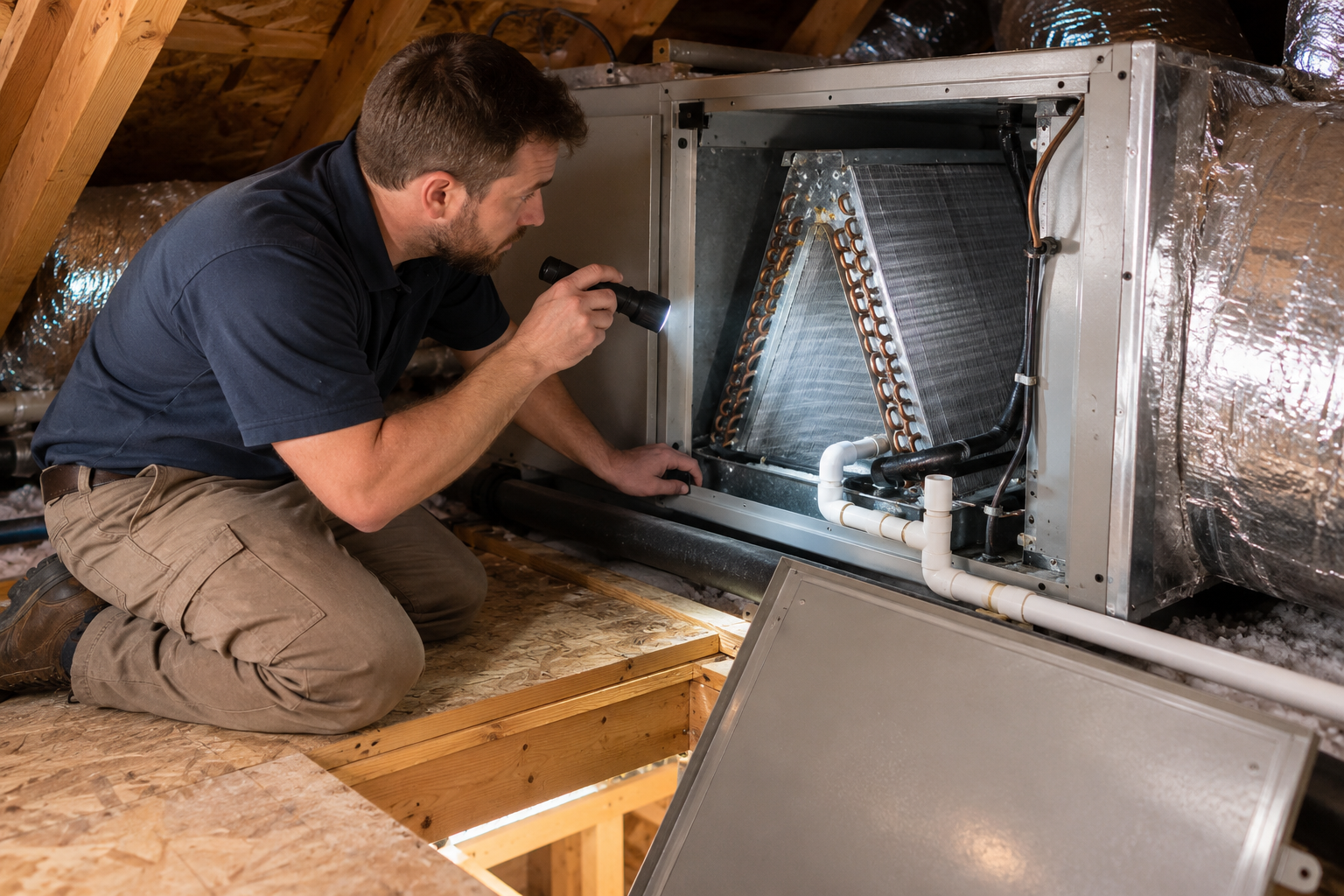
An evaporator coil sits in the indoor side of a split AC or heat-pump system. Replacing it can be a contained major repair, but the cost is rarely just the coil. The quote may include cabinet access, refrigerant recovery and recharge, labor, a drain pan or condensate correction, transitions, testing, and compatibility checks with the outdoor unit, furnace, or air handler. The active evidence does not support a universal coil price, so the useful budget is a defined local scope rather than a precise national average.
Illustrative planning scenario (U.S. dollars, September 2026)
This is a scope-bounded example, not a market average: assume $900 for the coil, $850 for labor and access, and $350 for refrigerant recovery, testing, and startup. The illustrative total is $2,100 before tax and finish work; a concealed coil or mismatched replacement can change the scope substantially.
Ask what the coil repair preserves
Confirm whether the outdoor unit, indoor cabinet, blower, line set, controls, condensate, and duct system are expected to remain serviceable. A coil replacement can restore cooling while leaving a near-end-of-life matched component or an airflow problem that shortens the repair’s value. If refrigerant or compatibility questions remain, price diagnosis and replacement boundaries explicitly.
Use a repair when the failure is confirmed and adjacent equipment is credible. Compare full system replacement when the coil repair joins age, repeat failure, corrosion, access difficulty, or a likely second major repair. Include testing and warranty in both options; “cold air after startup” is not a complete ownership forecast.
Compare coil work with the matched system
An evaporator coil quote should identify the indoor equipment, coil match, refrigerant-circuit work, access, condensate, removal, testing, and warranty. A coil can be replaceable while the surrounding cabinet, blower, controls, line set, outdoor unit, or duct system is near the end of its useful service. Ask whether the repair preserves a credible matched system.
The focused case is a confirmed coil failure with accessible equipment and sound adjacent components. A difficult case adds concealed access, cabinet corrosion, condensate correction, refrigerant uncertainty, or a near-end-of-life outdoor unit. Compare the complete coil scope with indoor or full system replacement and include removal, electrical, controls, line-set assumptions, commissioning, and future service. A low part price is not a low project price.
Loss of cooling, icing, water around the indoor unit, and low system performance can have several causes. A leaking coil is one possibility; restricted airflow, a dirty filter, a drain problem, controls, refrigerant charge, or a duct issue can produce overlapping symptoms. ENERGY STAR’s quality-installation guidance treats airflow and refrigerant charge as whole-system performance matters.
Ask what test or observation established a leak or coil failure. “Needs refrigerant” does not by itself identify the leak location or prove that coil replacement is required.
What a replacement quote should show
Request separate or clearly described lines for:
- coil model, dimensions, and compatibility;
- access, cabinet modification, or removal of adjacent equipment;
- refrigerant recovery, circuit opening, evacuation, and charge;
- drain pan, condensate line, pump, and cleanup;
- transitions, insulation, and duct connections;
- labor, testing, and repair warranty;
- any furnace, air-handler, control, or outdoor-unit work;
- removal and disposal.
The contractor should identify what is retained and how the indoor coil will match the outdoor equipment. Compatibility is product-specific; a coil that fits physically may not create the intended system match or efficiency.
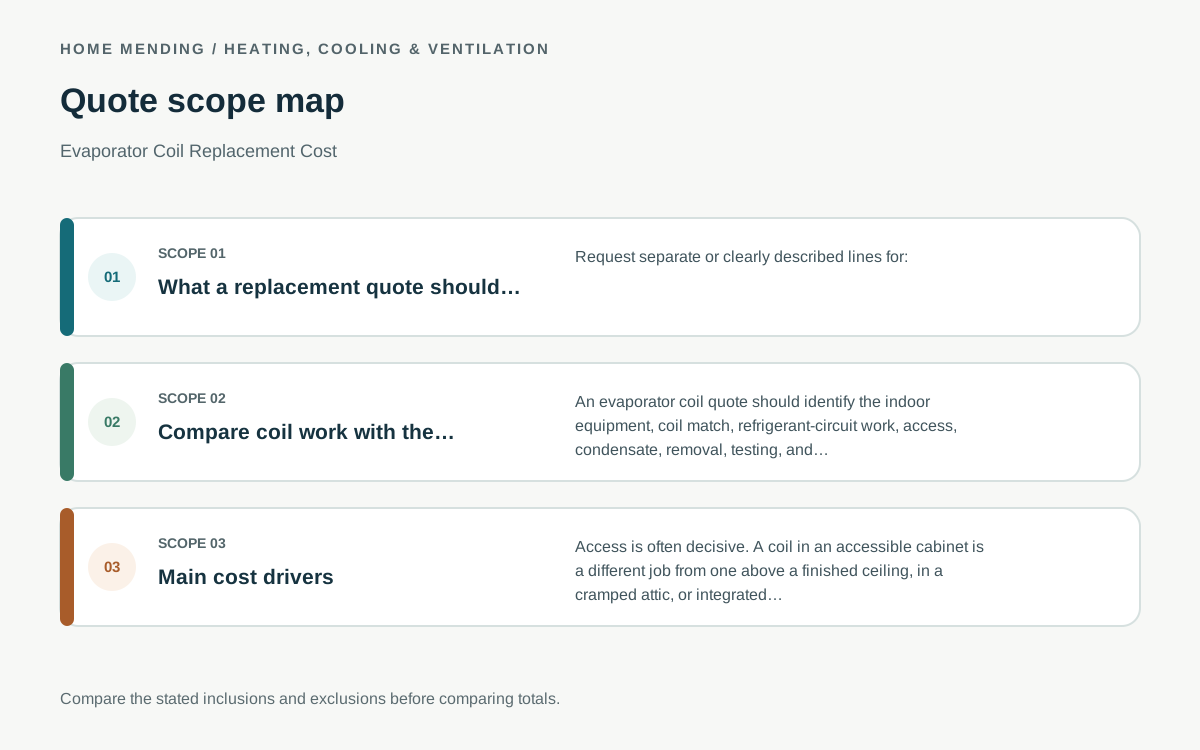
Main cost drivers
Access is often decisive. A coil in an accessible cabinet is a different job from one above a finished ceiling, in a cramped attic, or integrated with equipment that must be moved. Coil configuration and availability affect both price and schedule. Refrigerant type, charge, and local handling requirements affect the circuit work.
The surrounding air path also matters. If the duct transition is damaged, the return is restricted, or the coil cabinet has moisture damage, a coil-only quote may not restore performance. Ask whether airflow and condensate conditions were evaluated.
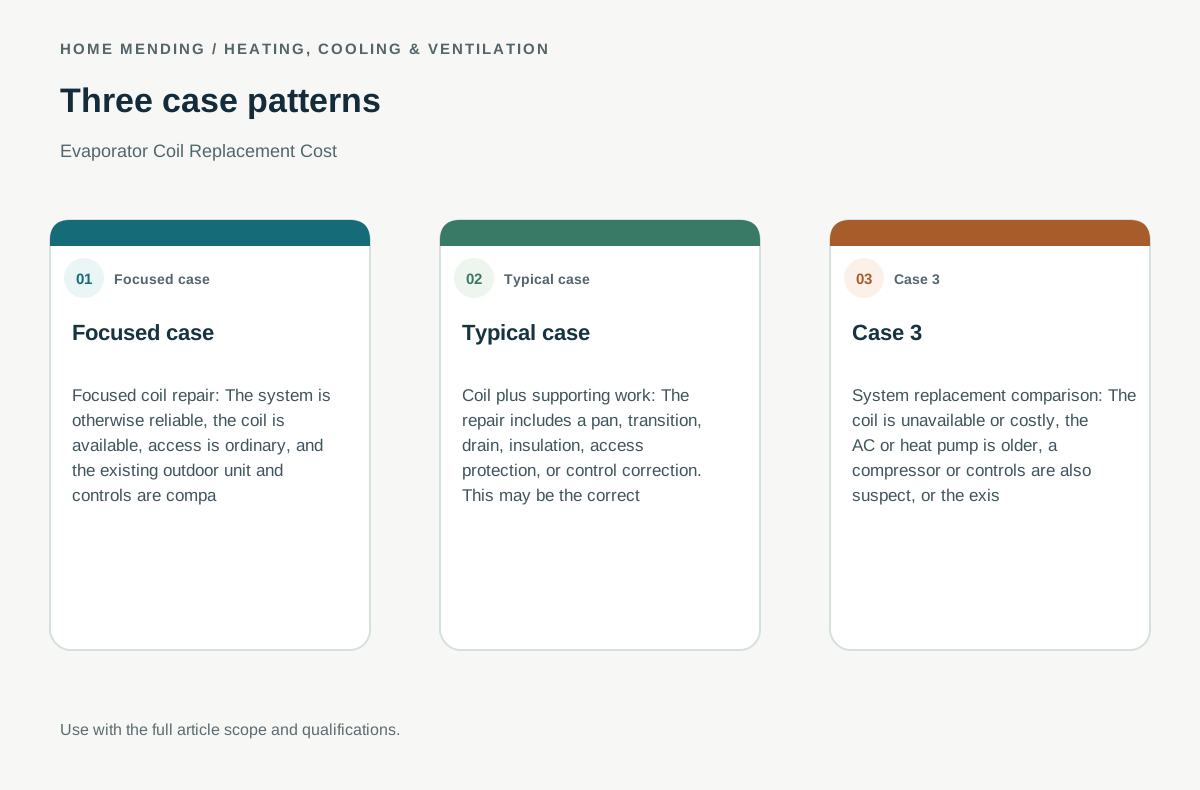
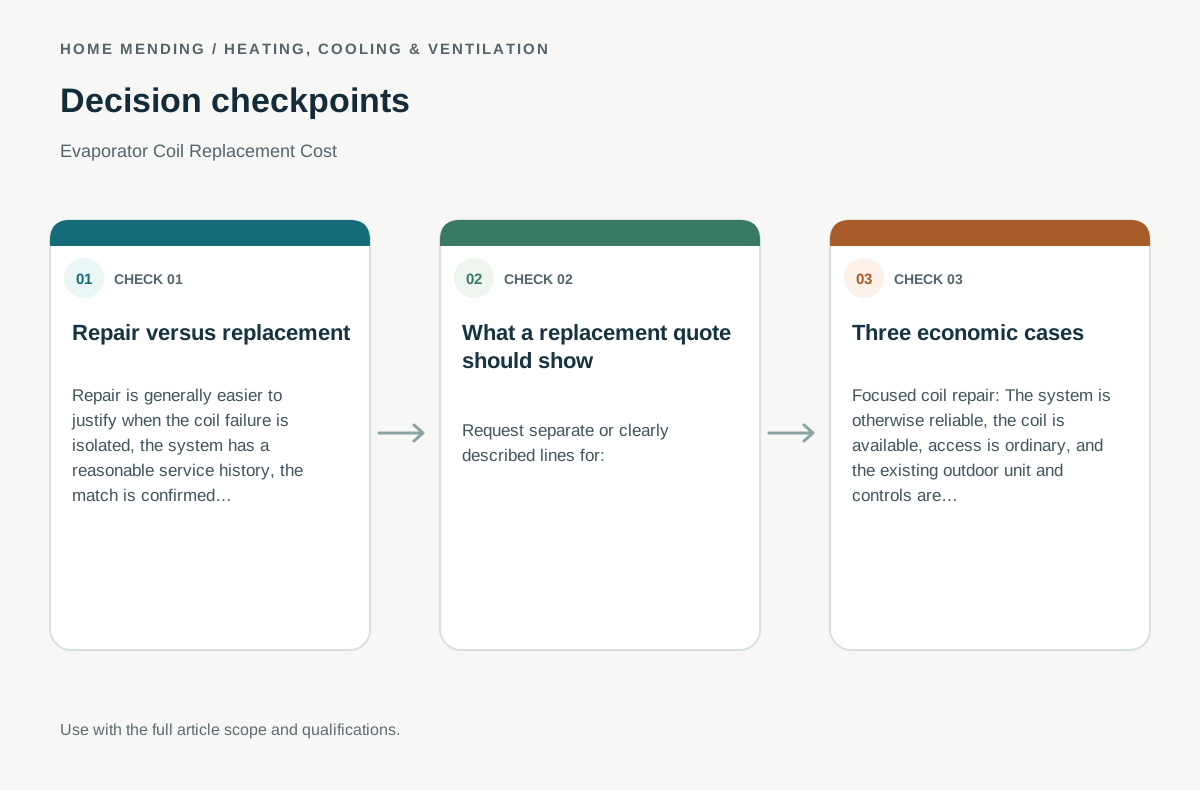
Three economic cases
Focused coil repair: The system is otherwise reliable, the coil is available, access is ordinary, and the existing outdoor unit and controls are compatible. Repair can preserve useful life.
Coil plus supporting work: The repair includes a pan, transition, drain, insulation, access protection, or control correction. This may be the correct complete scope, even if it makes the quote larger than expected.
System replacement comparison: The coil is unavailable or costly, the AC or heat pump is older, a compressor or controls are also suspect, or the existing indoor/outdoor combination is obsolete. Obtain a full replacement alternative rather than comparing a coil-only number with a box-only replacement.
Warranty and refrigerant questions
The part warranty may not cover labor, refrigerant, access, or related materials. Ask what is covered and for how long. U.S. EPA guidance recommends appropriately certified technicians for refrigerant handling; Canadian certification and handling requirements depend on the applicable jurisdiction and system.
If a legacy refrigerant or retrofit is involved, do not assume a substitute can simply be charged into the old system. EPA states that retrofit may require component changes. Ask whether the proposed work is a repair of the existing system or a new matched-system installation.
Repair versus replacement
Repair is generally easier to justify when the coil failure is isolated, the system has a reasonable service history, the match is confirmed, and the repair warranty is meaningful. Replacement deserves more weight when the coil is one of several failures, the system has repeated leaks, comfort was poor before the failure, parts are uncertain, or the repair would leave an aging compressor and controls in service.
There is no universal age or repair-percentage cutoff. Compare the full repair total, expected repeat work, remaining performance, and ownership horizon with a complete replacement scope. The key question is what condition the home will have after the work—not merely what part is being installed.
Coil-only, coil-plus, or system replacement
A coil-only repair is strongest when the leak is isolated, the outdoor equipment and controls are compatible, access is manageable, and the rest of the system has a credible service history. Coil-plus work may include a pan, drain, transition, insulation, or cabinet correction; those items can be required for a durable installation rather than optional extras.
System replacement deserves a real quote when the coil is one of several failures, the compressor or controls are also aging, the match is uncertain, or the equipment performed poorly before the leak. Include indoor and outdoor equipment, line set, controls, condensate, ducts, removal, testing, and commissioning in that comparison.
Protect against scope surprises
Ask what access method is assumed and how finished surfaces will be protected. If the coil is concealed, request a unit price for access or restoration rather than an unlimited allowance. Confirm whether refrigerant recovery, recharge, leak testing, disposal, and labor warranty are included. A part warranty may not cover those services.