
“Chimney repair” covers very different projects. A cap or small joint repair is not the same decision as a liner, above-roof rebuild, or appliance compatibility problem. A factory-built insulated metal chimney has its own replacement decision; see factory-built metal chimney replacement cost rather than treating it as masonry rebuilding or a metal liner.
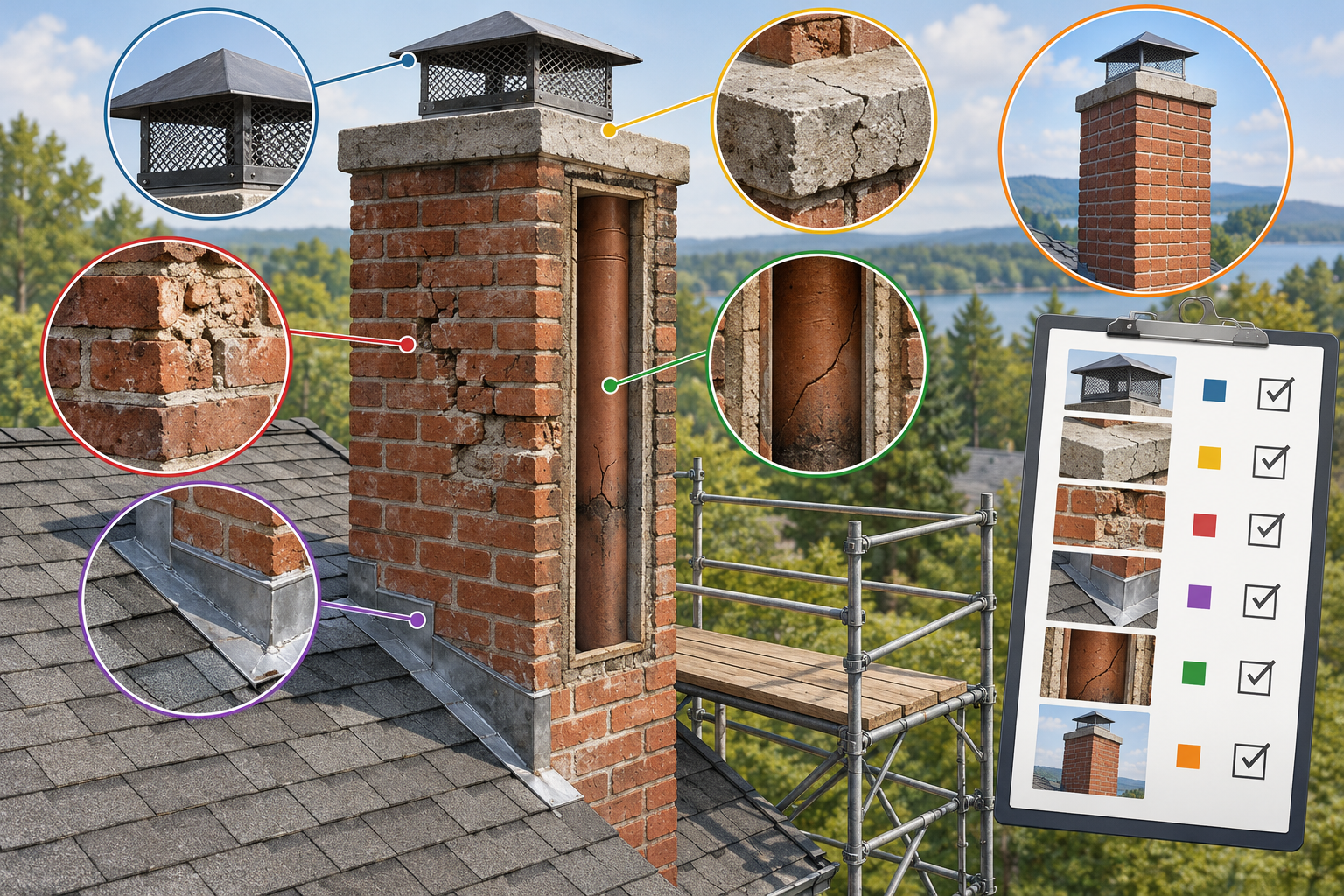
| Scope | What the quote may include |
|---|---|
| Inspection | Structure, flue, access, appliances, roof and attic interfaces, and a report. |
| Masonry | Repointing, brick replacement, crack assessment, and above-roof work. |
| Crown or cap | Water-shedding repair and rain or debris protection. |
| Flashing | Diagnosis and repair at the roof-to-chimney intersection. |
| Liner | Inspection, relining, or replacement selected for the appliance and flue. |
| Rebuild | Partial or larger masonry reconstruction. |
| Removal | Stack, roof closure, interior patching, disposal, and appliance review. |
Access, roof pitch, height, multiple flues, staging, weather protection, and masonry matching recur across the scopes. A leak near the chimney does not identify which component failed.
CSIA guidance says local code matters and describes inspection of connected appliances, flues, clearances, crown, flashing, and accessible attic areas in its Level 2 context. Appliance manuals and current local requirements control liner, venting, and clearances. U.S. terminology is not automatically a Canadian framework.
Angi’s 2026 U.S.-oriented guide reports $160–$750 for basic chimney repairs, with a stated average of $455; it also describes complex work such as repointing, liner repair, or rebuilding reaching $15,000. These are the publisher’s broad, overlapping categories, not a single comparable repair budget or Canadian benchmark. Ask what was observed, what is assumed, what access is included, and what triggers extra work. Start with chimney inspection cost when the component is unknown.
Use inspection findings to define the repair
“Chimney repair” can mean a small cap or flashing correction, repointing, crown work, liner repair, or substantial masonry reconstruction. Ask for each observed defect to be tied to a proposed task, location, and photograph. If the recommendation is based on an inspection, request the relevant report and ask which finding makes the repair necessary. A broad repair allowance is difficult to evaluate when it does not state what will be opened or replaced.
Separate immediate water or safety protection from longer-term restoration. If an active leak is damaging interior finishes, identify the temporary measure and permanent source correction separately. If the flue or appliance is involved, use a qualified chimney professional and confirm compatibility with the appliance manufacturer’s instructions and local requirements. Masonry work does not establish that a venting system is safe, and an appliance change does not by itself define chimney repair scope.
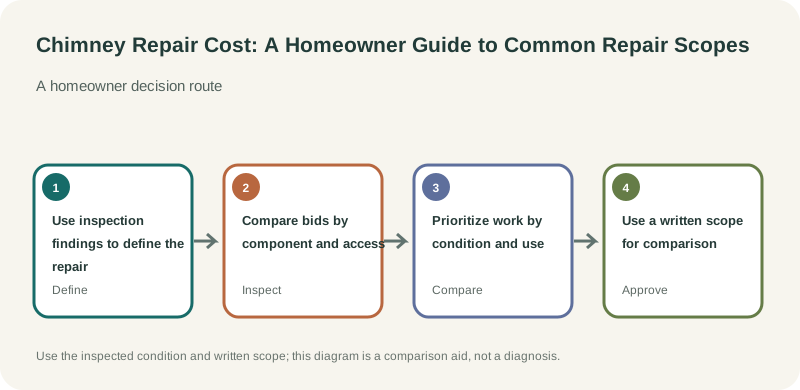
Compare bids by component and access
Ask whether the price includes roof access, scaffold, lifting materials, weather protection, demolition, disposal, matching brick, mortar, liner materials, flashing, and cleanup. Confirm whether each flue, roof intersection, or stack is included. Tall or steep roofs and difficult staging can materially affect setup and labor; the estimate should state the access assumptions. If concealed damage is possible, agree on photographs, unit prices, and approval before scope expands.
When extensive deterioration is present, compare a component repair with partial rebuild or full reconstruction only after the structural and flue condition is understood. Keep inspection, masonry, liner, roofing, and appliance scopes distinct unless one written proposal explicitly coordinates them.
Prioritize work by condition and use
If several defects are listed, ask which one presents an immediate water or operating concern and which can be scheduled. A contractor should explain the consequence of deferring each item without overstating certainty. Do not use this guide to decide whether an appliance may be operated; follow qualified, case-specific advice when a flue defect or damage event raises a safety concern.
For an unused chimney, clarify whether it remains connected to another appliance, whether it needs a cap or closure, and what maintenance is still required. For an active chimney, include the appliance and fuel information in any inspection and repair scope. A masonry repair estimate alone cannot establish venting compatibility or safe operation.
Use a written scope for comparison
Ask for separate options if a contractor recommends both necessary repair and elective restoration. Require line items for each component, quantity, access, materials, inspection, permits if applicable, and closeout. If a bid includes several trades, ask who is responsible for the roof interface, liner, appliance reconnection, and interior restoration. Keep warranties and exclusions by component so a future leak or performance concern can be directed to the right contractor.
Separate emergency work from planned restoration
A damaged cap, active leak, unstable masonry, or suspected flue defect can carry different urgency. Ask the professional to identify any temporary protective action and the condition that makes permanent work necessary. A repair estimate should not imply that temporary covering, diagnostic testing, and long-term reconstruction are the same service. Price each stage separately where the condition allows.
If multiple contractors are needed, request a sequence that states when the chimney may be used, when the roof or flue is exposed, and who restores each interface. This is especially useful where roofing, masonry, and appliance work overlap. Keep permits, inspection reports, and final photographs together for future maintenance and sale records.
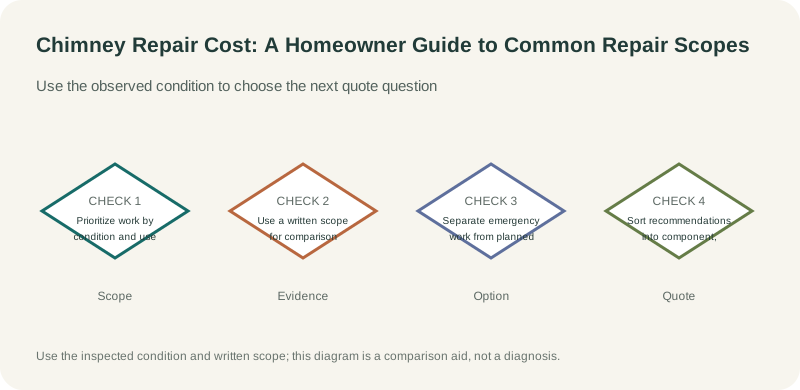
Sort recommendations into component, system, and access work
A repair estimate is easier to understand when its lines are grouped by function. Component work changes one visible part, such as a cap, crown, flashing, joint, or liner. System work addresses a failure spanning multiple parts, such as water entry across the roof intersection or a flue compatibility problem. Access work includes scaffold, lift, roof protection, and setup; it can be a major cost even when the repair itself is small. Ask the contractor to show those groups separately.
The inspection report should connect each repair to an observation. A cracked crown may support crown work; an interior stain alone does not prove the crown is the source. Ask which areas were inspected, which were inaccessible, and whether additional testing is recommended. If a repair is proposed without an inspection, ask what can be concluded from the observed condition and what uncertainty remains.
Compare the repair path with reconstruction
A component repair may preserve a serviceable chimney. Partial rebuilding can be appropriate when masonry damage is concentrated above the roof, while extensive displacement or a failing flue may require a larger project. Removal is relevant only after confirming whether any appliance relies on the chimney and deciding what roof and interior restoration are included. These options should be priced against the same intended outcome and active-system assumptions.
If several defects are present, ask which should be corrected first and whether combining work saves a separate mobilization. Keep optional upgrades separate from necessary repairs. A contractor may recommend cap, crown, flashing, and repointing together because access overlaps; you still need an explanation for each line and a clear consequence of deferring it.
Read the estimate for a complete result
Check whether the quote includes demolition, material, temporary protection, debris handling, roof restoration, liner or appliance coordination, inspection, permits if applicable, and closeout documentation. Identify which trade is responsible at each interface. A proposal that stops at masonry may not include roofing or appliance reconnection. Ask for a change-order process for concealed conditions and written approval before extra work whenever the building can safely remain protected.
No dependable national or Canadian price range is established by the available evidence. A local inspection and itemized bid are necessary because height, pitch, flue count, access, materials, and defect extent vary substantially. Use the component guides linked in this category to define the scope, then compare local estimates for the same work.
Start with a report and a scope map
For an uncertain defect, ask for an inspection that identifies the flue or masonry component, location, severity, and access limitations. The report should include photographs and distinguish observed damage from recommended follow-up. If several issues are reported, ask the contractor to mark them on a simple chimney sketch or roof photograph. This makes it easier to obtain a second estimate and to avoid paying for overlapping work.
The inspection should be appropriate to the purpose and system. A routine visual look, an event-related inspection, liner evaluation, and appliance compatibility assessment answer different questions. Canadian WETT terminology applies to its solid-fuel program; U.S. CSIA terms are a separate framework. The required scope depends on fuel, appliance, history, property, and local acceptance. Do not choose the lowest-fee visit when the concern requires broader evaluation.
Separate immediate risk from planned work
If a qualified professional identifies an unsafe condition or active water exposure, ask what use restrictions or temporary protection apply and how the permanent repair will be scheduled. Separate that response from elective restoration, appearance improvement, or future maintenance. For an unused chimney, verify all connected appliances and vents before capping, removing, or changing the structure.
Keep final inspection, permits, appliance reconnection, roof repair, and interior restoration in the total project cost. A masonry contractor’s subtotal may not include the entire return-to-service process. Ask for each trade’s role and closeout document before comparing bids.
Keep the final report and invoices with appliance records so future inspection can see which components were repaired and which were not evaluated.
For work at the roofline, confirm how the chimney and roof are left weather-tight at the end of each day and who checks the final closure.