
Water near a chimney does not identify the failed component. Crown, cap, flashing, masonry, roof intersection, wall transition, or more than one defect can contribute. Price diagnosis before choosing a component repair.
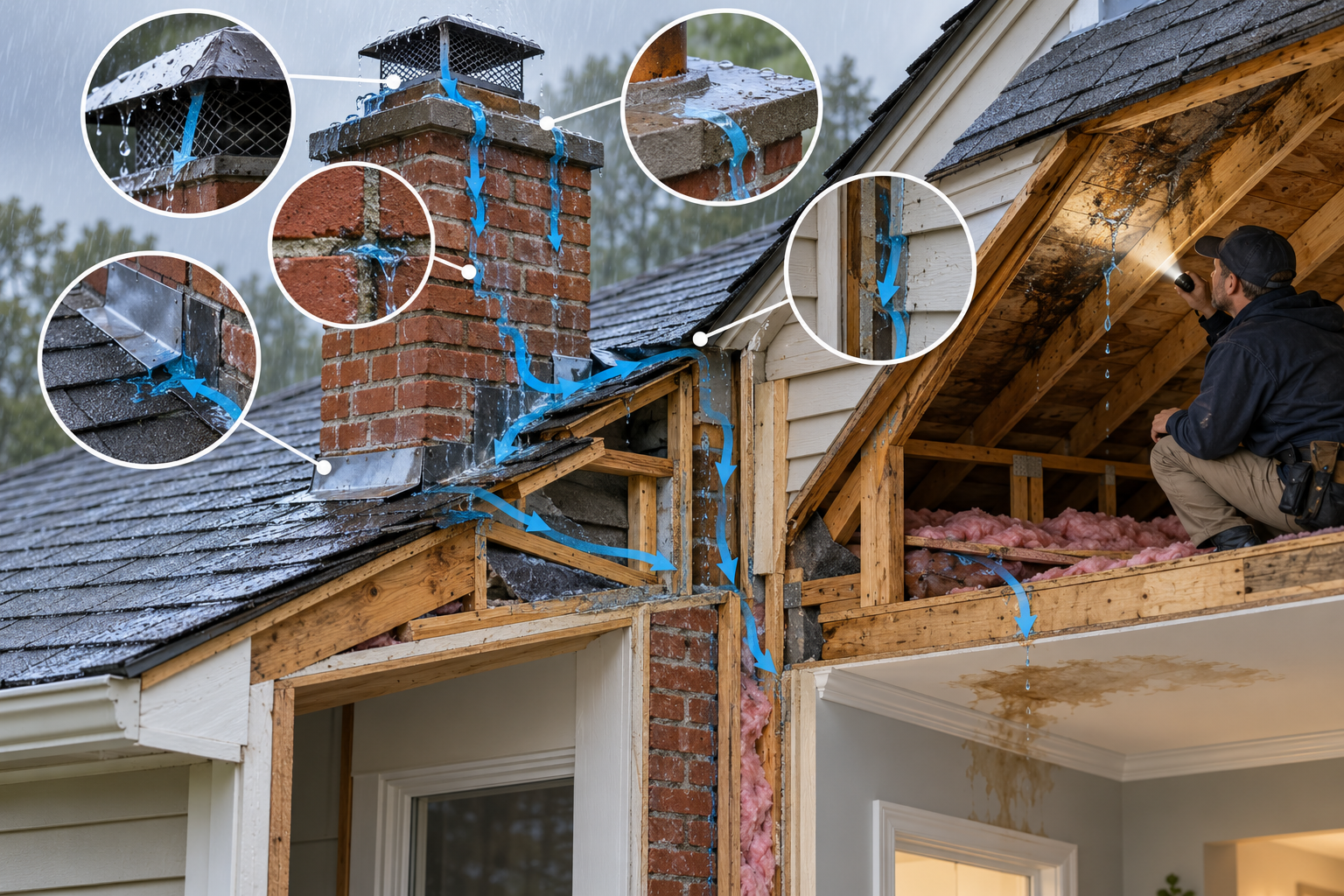
Water can pass the exterior surface and travel behind cladding, through joints, or along framing before appearing indoors. A stain location is not proof of the exterior entry point. The chimney connects roof, wall, attic, and sometimes an appliance or flue.
CSIA inspection guidance includes accessible attic areas, chimney and flue, crown, flashing, cap, termination, and visible water entry in its Level 2 context. Building-science guidance treats flashing and drainage layers as connected parts of water management.
A quote may include inspection, moisture diagnosis, crown repair, cap, masonry or repointing, flashing, roof or cricket work, targeted opening, concealed repair, drying, and interior restoration. These are different services. The evidence does not establish a reliable national or Canadian leak-repair price.
Ask for the observed defect, proposed test, access, repair boundary, and change-order rules. A sealant-only proposal should explain why the joint—not the flashing or drainage system—is the failure. If roof or broad wall work dominates, use that scope. If flue safety is involved, use qualified chimney and appliance professionals.
Build a diagnosis before buying a repair
Ask the inspector or contractor to trace the water path from the attic and roof toward the visible stain, rather than assuming that the nearest exterior component is responsible. Useful documentation includes photographs, the conditions present, recent weather, and whether the leak is intermittent. A roof inspection may need to include the cap, crown, flashing, masonry, cricket, nearby wall transition, and accessible attic. No single observation proves the whole path when water can travel behind finishes.
A diagnostic visit, moisture assessment, and repair quote may be separate services. Ask what the initial fee includes, whether it is credited toward work, and whether invasive testing or interior opening is extra. If the source remains uncertain after a visual inspection, do not treat an unverified sealant application as a guaranteed permanent fix.
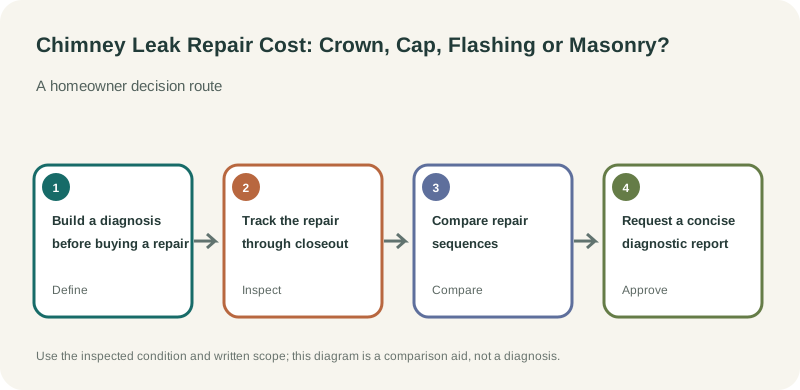
Track the repair through closeout
Have the estimate name the component and location being repaired, the materials, access, weather protection, and any roof or interior restoration. If more than one defect is found, request options that separate urgent entry points from secondary maintenance. Agree on how concealed damage is photographed, priced, and approved. Afterward, retain before-and-after images and the contractor’s report; if water returns, this record helps prevent repeating a repair that addressed only a symptom.
When flue or appliance function may be affected, use a qualified chimney professional and keep the safety inspection distinct from water repair. If a whole-roof or wall drainage problem dominates, coordinate the appropriate roofing or envelope scope.
Compare repair sequences
A leak diagnosis may recommend a small repair first, then observation during rain, or it may identify several defects that should be corrected together. Ask why the contractor proposes that sequence and what will be learned from each step. If work is staged, get a written estimate for the later phase and define the observation period; otherwise a low initial price can obscure likely repeat mobilization.
Where interior staining is present, clarify whether the quote includes only stopping exterior entry or also drying, mold assessment, insulation, and finish restoration. These tasks may require restoration specialists and should be priced separately. Keep invoices and moisture records by location, because unrelated leaks can leave similar marks in the same room.
Request a concise diagnostic report
The report should identify the inspected areas, weather conditions, inaccessible components, observations, proposed repair, and remaining uncertainty. Ask the contractor to distinguish direct findings from hypotheses. This is especially useful if a second opinion is sought or if an insurer needs documentation. No report can guarantee that every hidden path has been found, but a clear scope makes the repair decision and any follow-up more accountable.
Distinguish source correction from stain repair
A dry interior stain may remain after the exterior source has been corrected and can require separate finish restoration. Conversely, repainting or patching the stain without stopping water entry leaves the underlying repair incomplete. Ask the contractor to label which estimate items address the exterior source and which restore interior finishes. If the stain is growing or materials remain wet, obtain appropriate assessment rather than assuming cosmetic work is sufficient.
Before comparing estimates, list the exact symptoms, rooms, and elevations and share the same information with each contractor. The resulting diagnostic scope should identify what was inspected, what could not be reached, and what action is recommended. This reduces the chance that two providers are pricing different leak events under the same “chimney leak” label.