
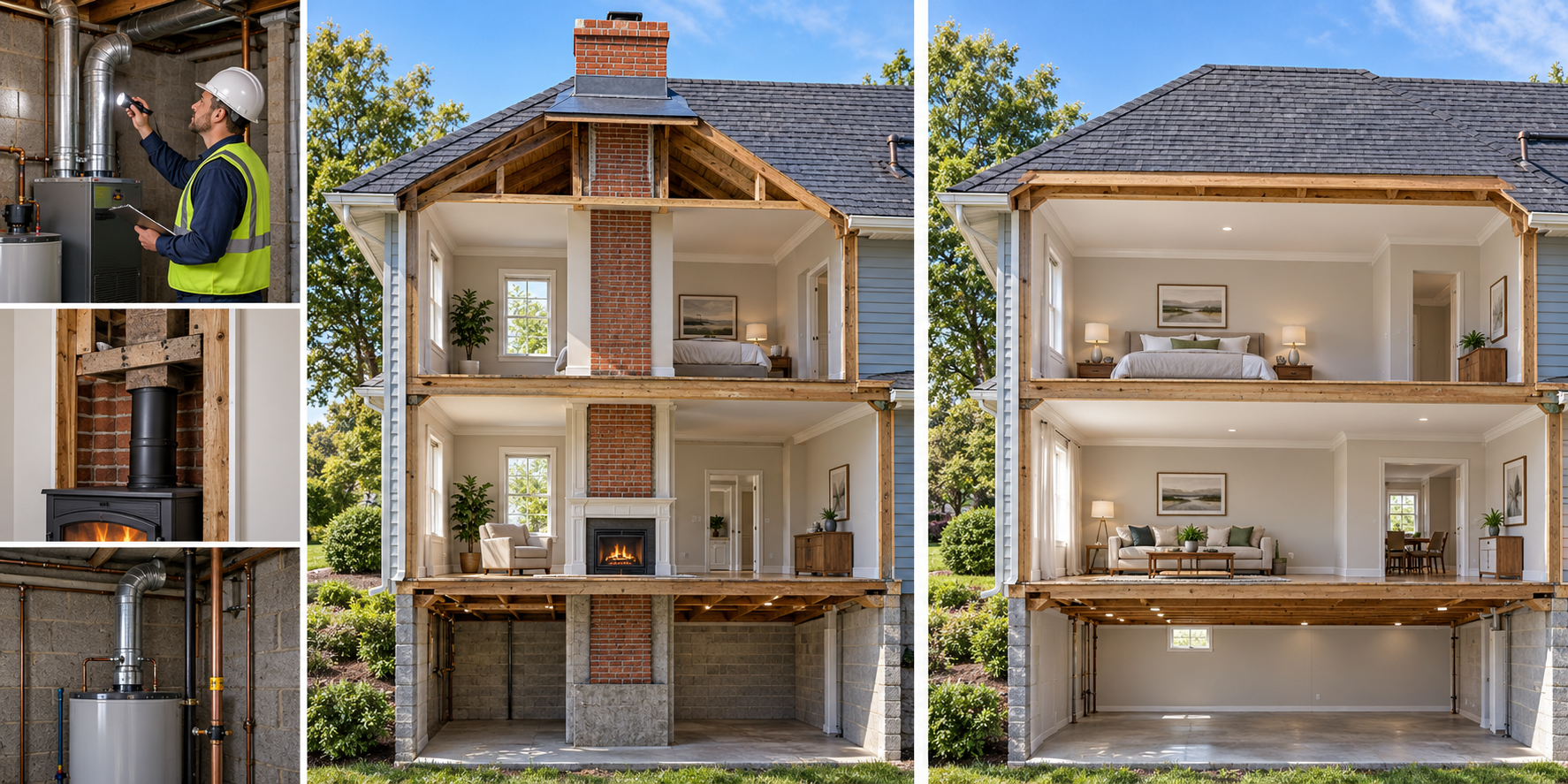
Chimney removal can mean taking down only the above-roof stack, removing the chimney through the house, or demolishing an attached appliance and venting system. Those scopes have very different costs.
Stack-only removal
Even exposed-stack removal can require roof protection, masonry demolition, disposal, roof sheathing and covering repair, flashing, and weatherproof closure. The remaining chimney below the roof must be stable and intentionally abandoned under applicable requirements.
Full removal
Removing the interior stack can add floor, ceiling, wall, chase, attic, and finish repairs. Structural support, fire separation, access, dust control, and disposal may dominate. A quote should show each level affected.
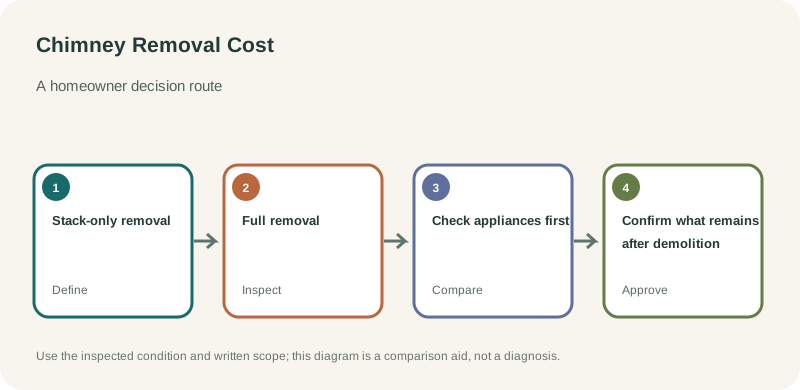
Check appliances first
An apparently unused flue may still connect to an appliance. CSIA guidance considers connected appliances and flues. The Napoleon S25 manual is one model-specific example that calls for a sound chimney, qualified installation, local authority consultation, and no shared flue with another appliance. Do not generalize it, but do not remove a chimney without an appliance and venting assessment.
Angi’s 2026 U.S.-oriented guide separates whole-chimney removal ($4,000–$10,000), above-roof stack removal ($1,000–$1,500), and an interior chimney-breast removal ($1,500–$2,500). Roof repair, structural support, and interior finishing can be additional, so these are source-reported planning ranges rather than complete project budgets or Canadian prices. Ask for demolition, access, roof closure, interior restoration, structural review, venting redesign, permits, disposal, and cleanup as separate lines. Compare with chimney rebuild cost.
Confirm what remains after demolition
A stack-only removal can leave a chimney below the roof or inside the house. The proposal should show exactly where demolition stops, how the remaining masonry is made stable and closed, and how roof sheathing, underlayment, shingles or other roofing are restored. Full removal also requires a plan for each floor, attic, ceiling, wall, and chase affected. Ask whether finish restoration is included or only rough closure.
Before work, have a qualified professional identify every appliance, fireplace, flue, and vent connected to the chimney. If the home still needs that venting, removal may require a separate compatible redesign. Do not rely only on whether the fireplace appears unused. Verify applicable permits, fire separation, structural support, and local requirements for the actual building.
Compare demolition and restoration lines
Request separate prices for access and protection, masonry demolition, interior dust control, debris removal, roof repair, structural review, vent changes, and interior finishes. A low demolition price may leave substantial patching and weatherproofing for another contractor. Ask how the building will be protected each day, where debris will travel, and whether the scope includes final cleanup.
If the chimney has historic or architectural value, check preservation constraints before removal. Keep photos of the chimney and concealed connections before they are covered, along with permit and contractor records. Compare removal with rebuilding only after the active system and the desired finished condition are clear.
Account for structural and fire-separation details
Full interior removal can leave openings at floors and ceilings and may alter support, fire blocking, or separation between spaces. Ask who assesses those conditions and whether structural and building-code review are included. The proposal should distinguish rough closure from finished surfaces such as plaster, drywall, flooring, paint, and trim. Verify whether the remaining chase or opening will be removed or simply closed in place.
If the chimney is on a shared wall or close to neighboring property, confirm ownership, access rights, and protection responsibilities before scheduling. Demolition may create dust and vibration throughout the house; ask what containment and cleanup are included and whether occupants can remain safely in the home during each phase.
Decide the final condition first
Some homeowners want the roof stack removed but retain interior masonry as a feature; others want all traces removed. State that target in the bid request. Include roof color and finish, interior surface restoration, disposal, and any utility or appliance changes. A clear finished-condition checklist prevents a bid from appearing less expensive merely because it stops after demolition.
Consider roof and exterior appearance
Removing a stack changes the roof plane and may leave mismatched roofing, visible patches, or a different exterior profile. Ask for a sample or description of the roof material used to close the opening and whether it can be matched. If exact shingles or tiles are unavailable, discuss a natural roof-plane boundary or broader replacement rather than assuming a small patch will be invisible.
For partial removal, clarify how the remaining stack is capped, protected, and documented, and whether future access is needed. Ask who inspects the closure after the first significant rain or at project completion. A written closeout record should include photos of the roof repair and confirmation that connected appliances were addressed.
Confirm who restores utilities and finishes
Lights, wiring, satellite equipment, roof vents, and interior electrical or mechanical routes can cross the chimney or its chase. Ask who identifies and relocates each item and whether licensed trades are included. The bid should state whether drywall and paint are included, whether flooring and trim are patched, and who handles insulation or air-sealing at the former chase. These are common boundary questions between demolition and finish contractors.