
A U.S. specialist source reports roughly $100–$175 for representative outdoor outlet replacement, while a new outlet is reported around $150–$350 before difficult routing or other site work. A Canadian specialist source gives comparable CAD observations for outlet work. Those figures are planning context only. Outdoor work can include weather-exposed boxes and covers, protection, wall penetration, cable routing, trenching, landscape restoration, and local inspection.
Replacement versus new installation
Replacing an existing exterior receptacle can be a bounded device project when the box, wiring, protection, cover, and mounting are suitable. Adding a new outlet requires a route from an existing circuit or panel and a suitable exterior location. A distant patio, detached garage, pool area, or garden may make the circuit and site access more important than the receptacle.
Do not treat an indoor extension cord as permanent outdoor wiring. Health Canada warns against using extension cords as permanent wiring and recommends recognized certification marks for electrical products sold in Canada. Product approval is not the same as a complete installation rule.
Cost drivers
- existing circuit extension versus new dedicated circuit;
- distance from panel or accessible junction;
- exterior wall, masonry, insulation, or finished interior access;
- weatherproof box, cover, device, and penetration treatment;
- GFCI or other protection and panel compatibility;
- underground route, trenching, conduit, and landscape restoration;
- number of outlets and shared mobilization;
- permits, notifications, inspections, and testing.
An outlet near an accessible interior circuit is a different budget case from one across a finished wall or buried route. Ask who owns patching and landscape repair.
Scenarios
Existing exterior location: The electrician assesses the box and wiring, replaces the device or cover, verifies protection, and tests. If heat, water entry, corrosion, or damaged conductors exist, it becomes a repair.
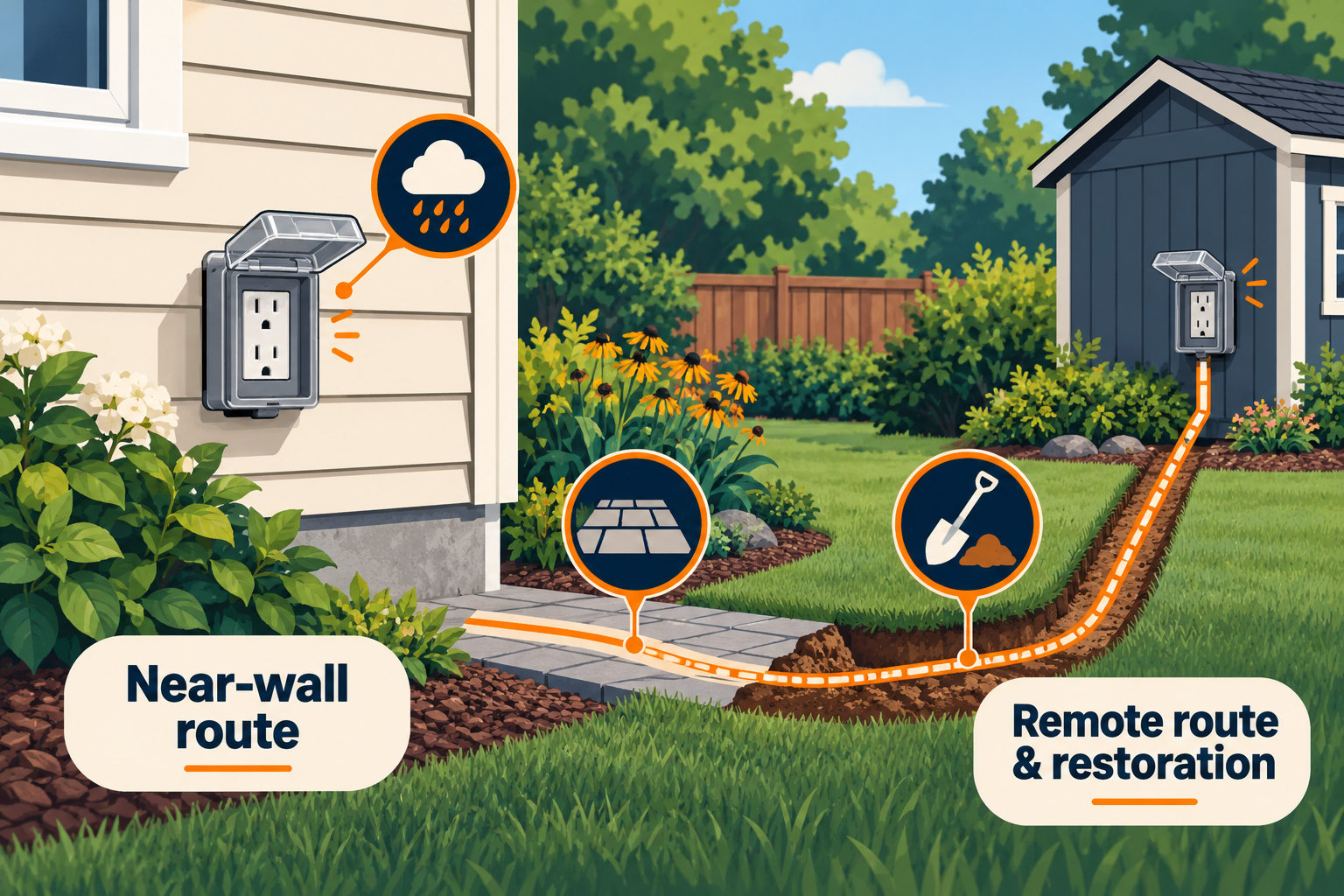
New outlet near the house: The circuit extends through an exterior wall with a defined box, protection, sealing, and finish boundary. Interior patching may be separate.
Remote or detached location: Distance, trenching, detached-structure routing, weather exposure, and a new circuit or subpanel can dominate. Major landscape electrical work belongs with its wider site context.
Requirements vary by location
Ontario ESA and other authorities distinguish protection devices and installation contexts, but the exact requirement changes by code edition and jurisdiction. Technical Safety BC lists homeowner permit examples that include electrical alterations, while its conditions and exemptions depend on who performs the work and the actual project. Do not generalize one province’s rule.
Newfoundland and Labrador has a specific trench sequence: its September 2026 bulletin requires a permit before applicable electrical trench work and an inspection before backfilling; photographs do not replace that inspection. Covering a trench early may lead to re-excavation, delay, and added contractor cost. Confirm whether the trench is under the provincial or utility authority and include inspection timing in the quote; this is not a general North American rule, and the bulletin states no fee.
Quote checklist
Ask for circuit source, load, device and cover, protection, weatherproofing, route, wall penetration, trenching, distance, access, panel interaction, permit/inspection, testing, patching, landscape restoration, and exclusions. Confirm that each product is suitable for the environment and accepted in the applicable market.
The useful comparison is not indoor outlet price versus outdoor outlet price. It is the complete exterior route and protection scope needed to place a suitable receptacle where it will actually be used.
Separate the outlet from the site project
A receptacle on the house wall is a small electrical installation. A remote outlet for a shed, pool area, deck, or workshop can involve trenching, a feeder, a subpanel, detached-structure work, landscape restoration, and separate capacity questions. If the main purpose is a new outdoor living area or landscape system, coordinate the electrical work with that project without turning this article into a general site-construction guide.
Ask for a route sketch and a restoration boundary. Soil, paving, planting, masonry, and seasonal access can make the non-electrical portion larger than the device.
Plan for use and maintenance
The location should match the equipment and environmental exposure. Ask how the cover, box, device, protection, and mounting will be maintained and replaced. Do not use a permanent extension-cord arrangement as a substitute for a properly installed outlet.
A complete quote separates service call, circuit, device, protection, weatherproofing, access, trenching, testing, permit/inspection, and restoration. That gives the homeowner a basis to compare a nearby wall outlet with a remote site installation.
Decide based on the use case
Ask what equipment will be connected, how far it is from the panel, whether it is seasonal, and who will maintain the cover and route. A wall outlet for occasional tools is a different economic decision from power for a detached workshop or pool equipment. The latter may require a feeder, subpanel, capacity review, or a category-specific project.
For a short horizon, use an existing suitable route when it meets the actual need. For a long horizon, include future access, trench restoration, weather exposure, and the cost of adding another circuit later. A cheap outdoor device is not a cheap installation if the route and protection are missing.
Route and restoration are part of the price
For a new outdoor outlet, the visible receptacle is usually a small part of the decision. The quote should identify the source circuit, route, exterior penetration, box and cover, protection, sealing, and how the route will be restored. A short run through an unfinished basement may stay contained; a finished interior wall, masonry façade, deck, or buried route can move labor and restoration into the main cost.
If trenching is proposed, ask for routing assumptions as the licensed contractor and local authority establish them, and separate excavation, conduit or cable, backfill, planting, paving, and inspection. Do not compare a wall outlet with a detached-building feeder as though they were the same “outdoor outlet” project. A future workshop, pool, hot tub, or vehicle charger may change the load and ownership boundary.
The best low-cost case is a defined use with a suitable nearby circuit and ordinary access. The difficult case is a remote use that requires new capacity, excavation, and restoration. The quote should make clear which case it assumes.
Compare location economics
A house-wall outlet, deck outlet, detached-garage outlet, and remote garden outlet may serve different uses even when each has one receptacle. Price the route, protection, environmental exposure, and access for the location that matters. If a future project will excavate or open the wall, coordinate timing to avoid paying for restoration twice.
Ask who will maintain the cover and how a future electrician will access the circuit. A well-documented route can be more valuable than a slightly cheaper installation with unknown buried work.