
Hardwired outdoor-lighting projects have no single useful national price because “outdoor lighting” can mean replacing one wall fixture, adding several fixtures to an existing circuit, wiring a new switch, or routing power through a yard. Canadian specialist labor observations around CAD $80–$150 per hour and U.S. electrician service-call observations provide planning context; obtain a local quote for the actual route and protection.
This article covers line-voltage residential installation. Low-voltage landscape systems, lighting design, and automation may belong with site or smart-home decisions.
Common scope choices
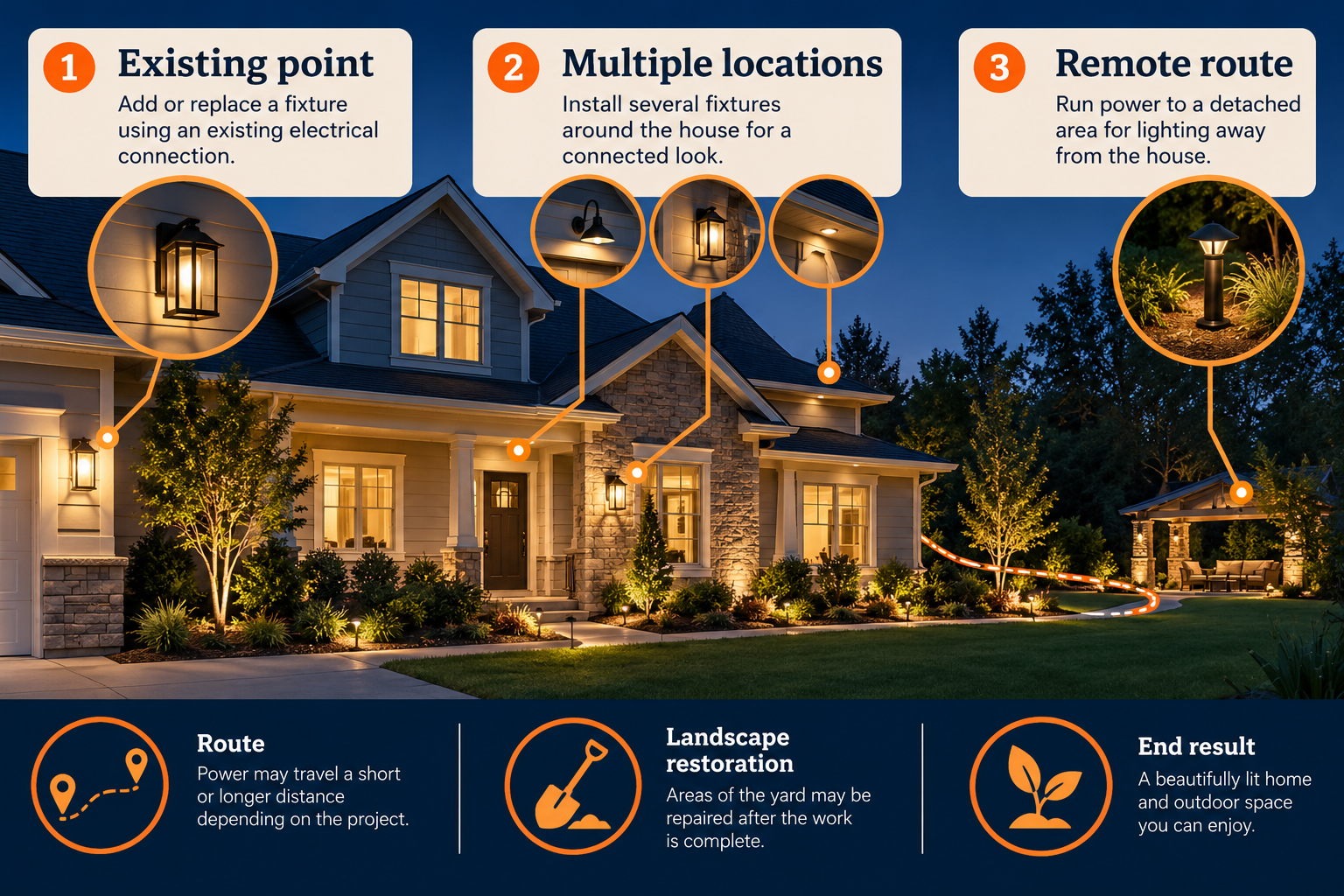
- replace an existing exterior fixture and box/cover;
- add a new wall, soffit, porch, or garage fixture;
- wire several hardwired exterior fixtures from an existing circuit;
- add a switch, timer, or conventional control;
- install a new circuit or route to a remote location;
- trench or otherwise route power through a yard or detached structure.
The fixture purchase is separate. Product suitability for outdoor exposure, certification, mounting, and controls must match the installation.
Cost drivers
Access, distance, exterior wall construction, finished interior surfaces, height, underground routing, trenching, conduit, weather exposure, protection, circuit capacity, number of locations, and restoration all affect price. Landscape restoration can be a substantial secondary cost even when the electrical materials are modest.
Health Canada warns that electrical products can cause shock or fire if used incorrectly and recommends recognized certification marks in Canada. ESA distinguishes protection purposes and installation contexts, but local requirements still control.
Scenarios
Existing-fixture replacement: The box, wiring, mounting, and product are suitable. The price is mainly access, service minimum, fixture labor, testing, and disposal.
New house-mounted fixture: A new box and cable route may be required, with interior and exterior finish work. A short accessible route is different from a finished masonry wall.
Multiple fixtures: Shared layout and mobilization can improve unit economics, but controls, circuit loading, and access must be priced as a project.
Yard or detached route: Trenching, route length, weatherproofing, restoration, and a new circuit or subpanel can dominate. If the main decision is landscape design or low-voltage lighting, do not compare it directly with this line-voltage scope.
Local process and quote checklist
Ask the electrician to state circuit source, fixture and control, route, access, outdoor rating, protection, trenching, mounting, panel interaction, permit/inspection, testing, restoration, and exclusions. Confirm who owns landscape repair. Ontario and B.C. evidence shows that electrical notifications and permits differ; neither jurisdiction’s process is a Canada-wide rule.
For applicable electrical trenches in Newfoundland and Labrador, a September 2026 government bulletin requires the inspection before backfill; utility-jurisdiction trenches are excluded. A covered trench may have to be re-excavated, adding delay and cost. Ask who schedules the inspection and when the trench can be covered; this is a local process example, not a general rule or a published price.
The useful budget is the complete outdoor route and installation boundary. A fixture count without route, protection, and restoration assumptions is not a comparable quote.
Line-voltage versus low-voltage scope
Confirm whether the project uses hardwired line voltage or a low-voltage landscape system. The equipment, transformer, controls, routing, and maintenance differ. If landscape design or an outdoor-living build is the primary decision, coordinate this electrical scope with the larger project without hiding it in a fixture allowance.
A remote hardwired fixture may need trenching, a new circuit, a subpanel, or detached-structure work. Ask who locates utilities, restores soil or paving, and handles seasonal access. Landscape restoration can exceed the cost of the visible fixture installation.
Control and ownership choices
Timers, sensors, dimmers, and smart controls add product compatibility and future-support questions. Compare a conventional switch with an automation option based on installation, maintenance, replacement, and network dependence. Do not assume a smart control removes the need for suitable outdoor equipment or local protection.
A complete quote separates fixture, control, circuit, route, protection, access, trenching, testing, permit/inspection, and restoration. That lets the homeowner decide which benefits justify the extra route and control complexity.
Check the maintenance boundary
Ask how the fixture, cover, control, and wiring will be accessed later. A remote or buried route may cost more to repair than a house-mounted fixture. Keep replacement lamps, sensors, batteries, timers, and network equipment outside the initial electrical total unless the quote includes them.
For a short project horizon, a simpler existing-circuit installation may be more rational than a long route with decorative controls. For a long horizon, price durability, future access, and landscape restoration. The best outdoor-lighting decision is a route and maintenance plan, not a fixture count.
Separate immediate need from expansion
If the goal is one safe light at a door, an existing house circuit may produce a contained quote. If the goal is perimeter coverage, path lighting, security integration, or a detached work area, the project may include multiple circuits, controls, low-voltage equipment, or site work. Keep the primary purpose clear so a small line-voltage article does not become an undefined outdoor improvement budget.
Ask for a base installation and priced options for additional fixtures, controls, trenching, and restoration. For a future-oriented installation, include conduit/access strategy and maintenance location. For a short horizon, avoid paying for a broad route unless it solves a current need. The quote should show which benefits justify each added work package.
Decide whether the project is electrical or site work
One replacement wall light can be a contained electrical visit. Multiple path lights, a detached structure, a long buried route, security controls, or landscape restoration can make the site work dominate. Ask for a base electrical scope and separate options for trenching, conduit, fixtures, controls, excavation, planting, paving, and restoration. This keeps a simple line-voltage installation from becoming an undefined outdoor-improvement allowance.
Fixture selection also changes the ongoing decision. Confirm whether the product is line-voltage or low-voltage, who owns the transformer or controller, how failed parts will be reached, and whether the desired control works without a network. If the homeowner supplies fixtures, list model assumptions and return responsibility. A lower fixture price may be offset by extra assembly, access, or unsuitable mounting.
For a future-oriented installation, route and document work while access is available. For a narrow immediate need, avoid paying for a perimeter system whose maintenance and operating cost the homeowner has not accepted.
Compare operation over time
Timers, sensors, dimmers, and smart controls can change both installation and maintenance. Ask what happens if a control fails, a battery is depleted, or network access is unavailable. For a basic door light, a simple conventional control may keep the project bounded. For a broader security or automation goal, use the relevant system category and price the electrical prerequisite separately.
A good quote makes the immediate use, future maintenance, product boundary, and restoration responsibility clear.