
A U.S. specialist source reports roughly $150–$350 for a new outlet, compared with about $80–$200 for replacing an existing one. A Canadian specialist guide reports a similar CAD $150–$350 observation for a straightforward new outlet near existing wiring. These examples assume a defined, ordinary installation; new circuit, finished-wall access, outdoor routing, and protection changes can move the total.
Adding an outlet is different from swapping a device because new cable, a box, circuit loading, access, and finish work may be involved.
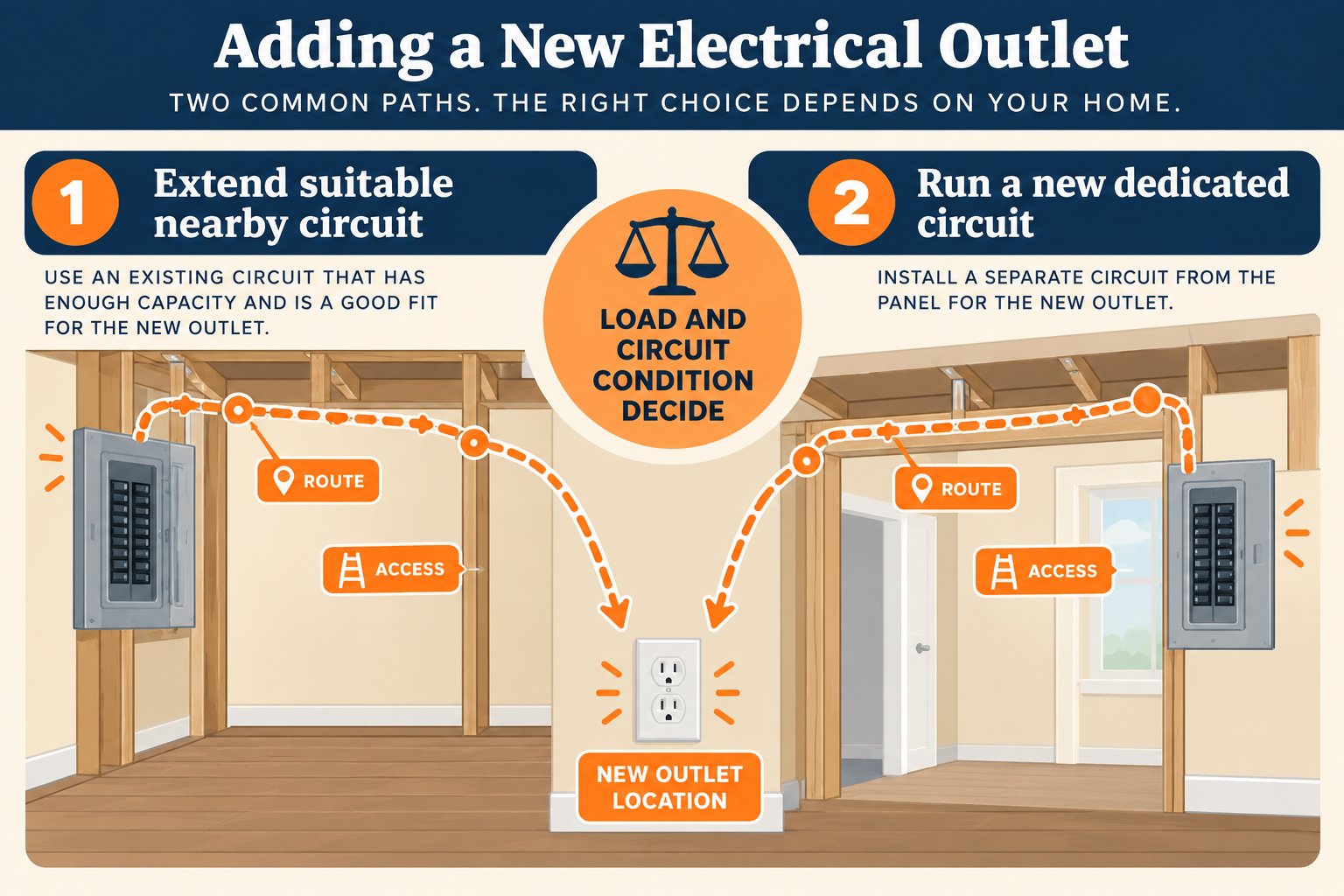
Two common installation paths
Nearby-circuit extension: The electrician finds a suitable existing circuit, routes a branch to the new box, installs the receptacle, and tests the work. The circuit must still be suitable for the intended use and comply with applicable requirements.
New dedicated circuit: The existing circuit cannot support the use, the equipment calls for a dedicated circuit, or the route and load make a new circuit the better scope. This includes a panel breaker and a longer run, so the economics change materially.
Do not decide between those paths by outlet distance alone. The load, panel, circuit condition, wiring route, protection, and equipment instructions matter.
Cost drivers
- distance from the panel or nearest suitable circuit;
- open framing versus finished wall, ceiling, tile, insulation, or masonry;
- one location versus many locations;
- standard versus specialty or outdoor equipment;
- new box, cable, protection, and panel space;
- patching, painting, trenching, or landscape restoration;
- permit, notification, inspection, and testing;
- older wiring, ungrounded circuits, or damaged boxes.
The electrician’s minimum visit can make one outlet expensive while several outlets in one planned route may have better per-location economics. Ask for the total and the incremental price of additional locations, but retain a line for each.
Scenarios
Simple interior addition: One outlet near an accessible circuit, serviceable box conditions, and no new circuit. The total is labor, device, cable, testing, and any local administration.
Finished-room addition: Cable and box access require openings and restoration. The electrician may exclude patching; compare the full installed project, not only the electrical invoice.
Load-driven addition: A freezer, workshop tool, appliance, or other defined use needs its own circuit. Compare the dedicated-circuit scope and do not hide the panel-capacity question.
Exterior or special location: Weather exposure, exterior boxes and covers, protection, penetration sealing, underground routing, and local rules add uncertainty. Use the outdoor outlet guide for that decision.
Safety and local administration
ESA distinguishes GFCI, AFCI, and tamper-resistant receptacle purposes in Ontario. Those functions and requirements are not interchangeable, and local code adoption varies. Technical Safety BC lists one new circuit or existing-circuit modification at CAD $136 in its 2026 homeowner fee schedule; that is a B.C. administrative example, not an installed price or a rule elsewhere.
Ontario ESA’s May 2025 bulletin also distinguishes unfinished-basement areas, laundry rooms and closets, dedicated utility rooms, and bathroom receptacles near tubs or showers when describing receptacle and circuit scope. Those classifications can change the work included in a quote. Ask the electrician to identify the applicable room or area and current Ontario requirement; do not apply this provincial bulletin elsewhere.
Quote checklist
Ask which circuit serves the outlet, intended load, device type, protection, route, box, access and restoration, panel interaction, permit/inspection, testing, and future circuit capacity. If the quote says “add outlet” but omits the route and circuit, ask for clarification.
The useful price comparison is extension versus new dedicated circuit under the same access and restoration assumptions. The outlet itself is only one line of the decision.
Use an incremental price only when scope stays constant
For multiple outlets, ask for the setup/mobilization cost and the incremental price per additional location, but keep circuit, protection, access, and finish assumptions visible. Ten outlets on an open wall may be efficient; ten outlets across finished rooms may require several routes and restoration zones. A per-outlet average can conceal that difference.
If the new outlet serves a high-load appliance or equipment, ask whether a dedicated circuit is appropriate. If it is outdoors, in a wet area, or at a detached structure, use the relevant protection and routing scope rather than a standard interior price.
Decide what “finished” means
A complete installation should identify device and box, cable route, protection, testing, labels where relevant, permit or inspection, patching, painting, cleanup, and any remaining capacity question. Agree on the change-order threshold before a wall is opened. The best budget is a defined route and load, not a count of faceplates.
Make the scope observable
Ask the electrician to mark the new locations, identify the circuit source, and state whether the wall, ceiling, cabinet, floor, exterior, or landscape must be opened. Include box, device, protection, cable, panel space, testing, restoration, permit/inspection, and cleanup. If the intended load is unknown, the quote should say what assumptions may change it.
For a short horizon, a nearby extension can be sensible when the circuit is suitable. For a long horizon, a dedicated circuit or accessible route may cost more now but reduce future rework. Compare the installed result and future access, not simply the number of outlets installed.
New location or new capacity
Adding a receptacle solves a location problem only when the existing circuit is suitable for the intended use. A convenience outlet near a desk, a basement workbench, and an outlet intended for a high-load appliance may look identical after installation but have very different circuit and protection implications. Tell the electrician what will be connected and what else may run at the same time.
For multiple outlets, ask whether they extend one circuit, use more than one circuit, or require a dedicated circuit. Confirm whether panel space, circuit labeling, grounding, and protection are included. If the route crosses finished walls, cabinets, masonry, insulation, or exterior areas, ask for a base route and an allowance rather than accepting an unexplained “per outlet” number.
The cost-effective decision is often made before the wall is closed: coordinate boxes and routes with the renovation, photograph or document concealed work where appropriate, and price patching as part of the complete result. A future access plan can be worth more than a small saving on the initial device count.
Make future use part of the decision
Ask what will plug into the outlet, whether it is a continuous or high-load use, and whether several outlets will operate together. An ordinary convenience outlet and an equipment outlet can require different circuit and protection decisions. Do not treat a room label as a load analysis.
For a renovation, coordinate new boxes and routes before insulation, drywall, tile, or cabinets close. For a finished home, price patching and paint separately. A complete quote explains the intended use, circuit, protection, access, and restoration.