
An inspection report is a list of observations and recommendations, not automatically a repair quote or a legal order. Budgeting starts by translating each electrical comment into a defined condition, affected circuit or equipment, proposed correction, and remaining uncertainty.
There is no useful universal “electrical inspection repair cost.” A report may lead to a few device replacements, a grounding or protection correction, panel work, legacy-wiring assessment, or a substantial rewire. U.S. specialist outlet observations range from roughly $80–$200 for replacement, while a Canadian specialist guide reports CAD $80–$200 for representative outlet replacement and CAD $130–$250 for breaker replacement. Those small-scope observations should not be multiplied into a whole-house budget without reading the report.
Turn each report comment into a scope
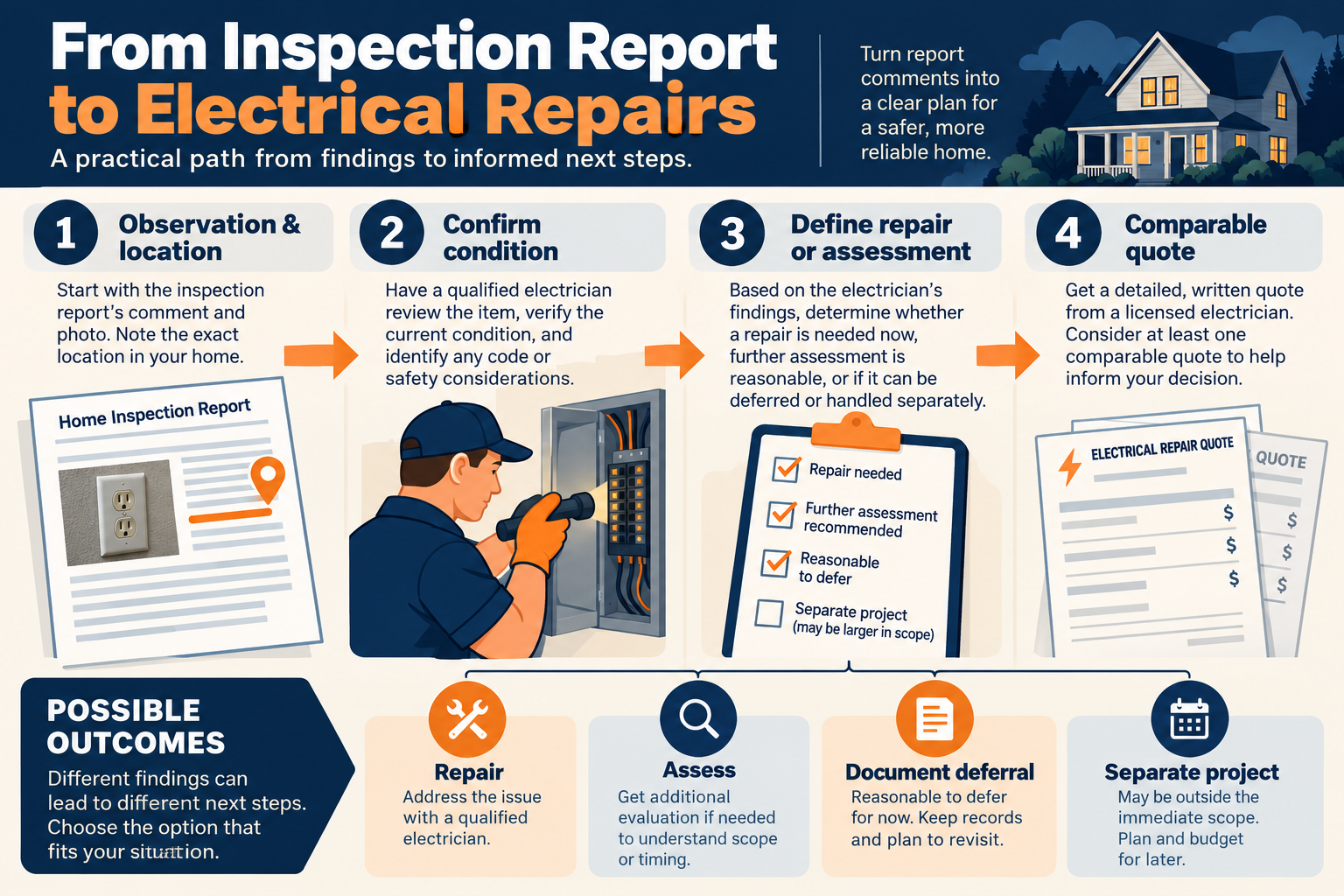
Copy the report wording and location into a repair matrix. Add the observed or confirmed condition, urgency, professional needed, proposed scope, access/restoration assumption, and unresolved question. Terms such as “recommend,” “evaluate,” “not verified,” and “upgrade” do not all mean the same thing. A report note is not automatically a code violation, and a code concern alone does not identify who must pay in a sale or shared property.
| Finding family | First budget question | Possible scope boundary |
|---|---|---|
| Heat, scorching, sparks, burning odor, or exposed damage | What professional assessment is needed now? | Do not infer a repair method or ordinary device price from a symptom. |
| Outlet, switch, fixture, or protection device | Is a specific failure confirmed, and what equipment/circuit is affected? | Device, box or wiring correction, compatibility, testing, and access may differ. |
| Repeated breaker trip or panel observation | Is the breaker faulty, is the circuit causing the trip, or is there a broader panel/service condition? | Diagnosis, circuit repair, panel work, and inspection are separate scopes. |
| Grounding/bonding or legacy wiring | What exact system or circuit is included, and what assessment is needed? | Avoid pricing a broad rewire or remediation from a shorthand report phrase. |
| New circuits, relocation, or whole-home rewiring | What condition or project trigger supports this larger work? | Treat a defined project separately from a small punch list. |
If a report raises a possible code issue, separate a confirmed condition from work triggered by a new project, an elective upgrade, or a request for documentation. Confirm local applicability with the authority or qualified electrician. If an exact product recall or insurer condition is mentioned, verify the specific model or requested document before treating it as ordinary repair work.
Bundle defined work without hiding it
Service-call minimums can make it economical to group several confirmed, ordinary repairs into one visit. Ask for an itemized price and a bundled visit price, with each report location still identified. A hot outlet, repeated trip, or legacy-wiring concern needs its cause kept visible rather than absorbed into a general device allowance.
Multiple observations do not automatically mean whole-house rewiring or panel replacement. A separate project is more plausible when conditions are distributed, the system is damaged or altered, parts are unavailable, access is already open, or repeated partial repairs would create duplicate disruption. Ask the electrician to connect the evidence to the proposed scope. For older homes, the inspection-cost guide and legacy-wiring articles help distinguish assessment from correction.
Keep permits and transaction requirements separate
Ontario ESA distinguishes a private electrical-system assessment from a general inspection and describes notification and inspection for applicable electrical work. Its 2026 guide includes dated administration fees, such as a CAD $86 contractor fee example for a panel change and a CAD $92 minimum notification fee for wiring installations. These are local administrative examples, not contractor totals or proof that each report item requires authority action. Check the actual jurisdiction for permit, notification, inspection, and documentation requirements.
The report describes the property at one point in time. A buyer may request a correction, a seller may want a defined work record, an insurer may need a particular document, and an authority may use different terminology. Confirm the requirement with the party that will rely on it; a contractor’s description is not a universal rule.
Compare estimates and set a decision threshold
Give each bidder the complete report and ask the quote to identify:
- the report item, location, and observed condition addressed;
- the exact circuit, device, panel, or wiring scope;
- the assessment or repair boundary and any safety-related timing;
- access, shutdown, and finish-restoration assumptions;
- compatibility, protection, grounding, and testing;
- permit, notification, inspection, utility, and documentation responsibility;
- allowances, unit prices, exclusions, and change-order approval thresholds.
Do not compare visible-device repairs with a quote that includes panel replacement or a rewire without asking what observation or new requirement explains the difference. Preserve conditional findings as conditional rather than turning them into fixed allowances. If concealed work may be needed, set an approval threshold and document quantities or photographs before additional work proceeds.
A purchase or insurance deadline may justify staged assessment, but it should not turn an uncertain allowance into a false total. Over a short ownership horizon, prioritize material safety and confirmed transaction requirements while retaining an accurate work record. Over a longer horizon, compare repeat mobilization, planned renovation access, and whether a coordinated project could reduce future disruption. Give every report item a disposition: defined repair, professional assessment, documented deferral, or a separate project.