
A current Canadian specialist guide reports CAD $8,000–$20,000 or more as a representative whole-home rewire observation. U.S. cost guides report broad ranges that vary widely because “rewire” can mean replacing a few circuits, replacing branch wiring throughout an occupied home, or combining new panel, devices, and finish work. These figures are planning context, not a national bid series. U.S. prices are not converted into CAD.
The cost is governed by the number and accessibility of circuits, the condition of the existing system, the panel and service interaction, device and box work, permits or notifications, and what happens to walls and ceilings after access.
Define “whole-house” before comparing prices
One quote may replace all branch-circuit conductors but retain a service entrance and panel. Another may include a new panel, grounding and bonding corrections, outlets, switches, fixtures, labels, drywall patching, painting, and cleanup. A third may price only accessible portions and use allowances for concealed sections.
Ask each bidder to state:
- circuits and areas included;
- wire and cable scope, boxes, devices, and fixtures;
- panel, service, grounding, and bonding work;
- demolition, access, disposal, patching, and painting;
- permits, notifications, inspections, and certificates;
- occupied-home sequencing and temporary power assumptions;
- unit prices or allowances for concealed conditions;
- testing, labeling, documentation, and exclusions.
Without those boundaries, two totals are not comparable.
Main cost layers
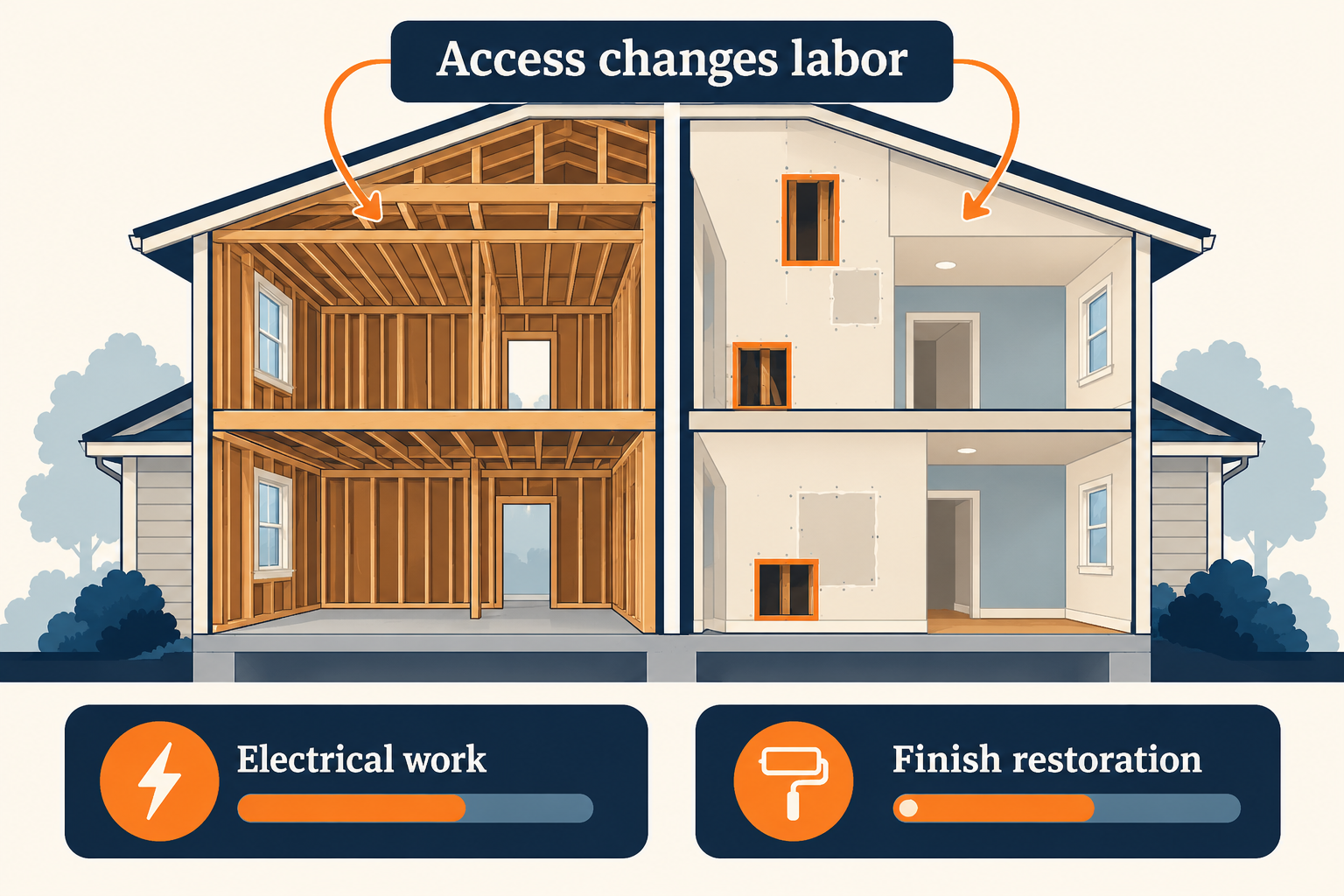
Labor usually dominates because every circuit must be reached, disconnected, routed, terminated, tested, and documented. Cable and devices add material, but walls, ceilings, insulation, masonry, and finished floors determine production time. Panel work can be a separate project or a necessary interface. Finish restoration may be performed by the electrician, a general contractor, or the homeowner, and that choice changes the total.
Access is often the largest swing factor. Open basement and attic routes allow more work with less disturbance. Finished plaster, tile, built-ins, multiple stories, and inaccessible crawl spaces require more openings and restoration. A house with fewer square feet can cost more than a larger one if its circuits are harder to reach.
Low, expected, and difficult rewire scenarios
Accessible rewire: A simple layout has open routes, limited finish repair, identifiable circuits, and a serviceable panel. Devices and documentation are included, but concealed contingencies remain explicit.
Occupied finished-home rewire: The crew works in stages, opens selected walls or ceilings, protects contents, and coordinates patching. The homeowner pays for electrical labor plus access, restoration, scheduling, and disruption.
Legacy or system-wide rewire: Knob-and-tube, older aluminum branch wiring, damaged insulation, undocumented additions, ungrounded circuits, or panel/service deficiencies widen the assessment. The quote may need partial demolition, remediation choices, and a separate service or panel scope.
What a rewire does not automatically include
A branch rewire does not automatically replace the service entrance, increase service capacity, correct every structural or moisture problem, update HVAC or appliance systems, repair post-fire damage, or make a historic property compliant with every current requirement. Those scopes may be related, but they need their own decisions.
Likewise, a rewire should not be sold as a generic cure for a symptom before diagnosis. If only one circuit is defective and the surrounding system is serviceable, partial work may be more economical.
Permit and inspection cost
Electrical administration varies by location. Ontario ESA guidance distinguishes electrical notification from a building permit and describes review before concealment for applicable work. Technical Safety BC gives separate homeowner permit classes and fees. Ontario’s 2026 wiring guide lists a CAD $92 minimum notification fee and other residential classifications; those are administrative fees, not electrician labor, materials, access, or total rewiring cost. Other provinces, territories, municipalities, and U.S. jurisdictions differ.
Do not conceal work before any required inspection. Have the contractor identify the applicable process before the walls close.
Occupancy and project sequencing
Rewiring an occupied home can require room-by-room shutdowns, temporary loss of outlets or lighting, protection of finishes, and coordination with patching. Combining work with an already planned renovation can lower duplicate access and restoration. Delaying a rewire may preserve short-term cash but can create a second mobilization, repeated patching, or a narrower work window. Neither schedule is universally cheaper; the condition and access plan decide.
How to evaluate the quote
Normalize every bid by circuit count, areas, access assumptions, device quantity, panel scope, restoration, permit/inspection, and allowance units. A low base price with broad exclusions may simply transfer risk to change orders. Ask for photographs of opened conditions, a cap or approval threshold for concealed work, and a clear definition of what “complete” means.
For Canadian homeowners, require CAD pricing from the local market. For U.S. homeowners, treat published USD ranges as broad planning signals. Do not average currencies or convert one market into the other.
Repair, partial rewire, or full rewire
Full rewiring is economically stronger when unsafe or unsuitable wiring is widespread, access is already open, repeated partial work would leave incompatible segments, or the homeowner needs a documented system-wide correction. Partial rewiring can be sensible when the defect is bounded, natural circuit or renovation boundaries exist, and the retained system is assessed and accepted for the intended use. There is no universal percentage of old wiring that creates a mandatory break-even point.
The best budget is a circuit-defined scope with visible assumptions, not a square-foot number detached from access and restoration.
Model the total by work package
Ask for separate lines for branch wiring, devices and boxes, panel or service work, access, restoration, permit/inspection, testing, and cleanup. This shows whether the bid is low because the contractor has found an efficient route or because patching, painting, or concealed conditions were excluded. A per-square-foot calculation can be a starting estimate, but it should not replace a circuit and access schedule.
The difficult case is not necessarily the largest house. A smaller home with plaster, tile, multiple stories, and limited access may require more labor than a larger home with open basement and attic routes. Ask each bidder to identify the two or three conditions most responsible for its price and show where they appear in the quote.
Decide what “complete” means before accepting the range
A whole-house rewire can mean replacement of branch wiring only, or it can include panel, service, grounding, devices, controls, access, and restoration. Ask for a circuit or work-package schedule and identify what remains outside the electrical contract. A broad total without a definition is less useful than a lower or higher quote with visible boundaries.
The strongest comparison has a base rewire, priced allowances for concealed conditions and finishes, and options for panel, grounding, device, or service corrections where the assessment supports them. If the home must remain occupied, include sequencing, temporary power, room-by-room disruption, and protection of furnishings. If the property is being renovated, coordinate openings and inspections before the finish schedule closes.
The decision may favor a complete project when access is already available, the wiring condition is widespread, or repeated partial work would cost more over time. It may favor a defined partial phase when the condition is localized and retained circuits are documented. The headline range should never conceal that choice.
When phasing creates value
Phase work when a defined hazard or renovation area needs attention and the retained wiring has been professionally assessed. Avoid phasing merely to make a broad problem look affordable if every phase will reopen the same finished surfaces. Combining a rewire with an already planned renovation can reduce restoration; combining unrelated work can make responsibility and change orders less clear.
For a long ownership horizon, include future loads, documentation, repeat access, and the cost of living through another shutdown. For a short horizon, do not overstate resale or insurance benefit; confirm the actual requirement. The economic result comes from a complete circuit scope and a realistic access plan.