
One U.S. specialist estimate reports $518–$2,192 for electrical-panel replacement, with higher totals possible when the project includes service changes, relocation, wiring, access, or finish work. A current Canadian specialist guide reports a representative CAD $1,500–$4,500 observation for a 200-amp panel upgrade, but its scope includes panel, breakers, labor, and permit in the example and does not establish a Canada-wide price. These figures are useful planning signals, not interchangeable national averages.
The first question is whether you need a panel replacement, a service upgrade, or a whole-home capacity decision. Those may overlap physically but have different economics.
Panel replacement versus service upgrade
A condition-driven replacement swaps or corrects distribution equipment because the existing panel is damaged, obsolete, overcrowded, difficult to service, or no longer suitable for the installation. A service upgrade changes the available service rating or service equipment and may require utility, meter, entrance, load, and permit coordination. If the driving question is how to support several future electric loads, whole-home capacity planning belongs with an electrification decision rather than a panel-only article.
Ask the electrician to state which of these is being quoted. A proposal that says “upgrade panel” without service rating, equipment boundary, and utility responsibility is difficult to compare.
What a base replacement may include
| Cost layer | What to clarify |
|---|---|
| Diagnosis and design | Why replacement is proposed and whether a load or compatibility review is included. |
| Panel and breakers | Enclosure, main disconnect, branch breakers, specialty protection, labels, and manufacturer compatibility. |
| Labor and shutdown | Removal, reconnection, testing, temporary loss of power, and cleanup. |
| Existing wiring | Condition, conductor length, terminations, grounding/bonding, and corrections discovered during transfer. |
| Service interface | Meter base, service entrance, utility disconnect/reconnect, or rating change—if part of the project. |
| Administration | Permit, notification, inspection, or certificate steps required by the local authority. |
| Finish and access | Wall opening, patching, paint, cramped equipment space, attic/crawl-space access, and relocation. |
| Documentation | Circuit directory, product information, inspection result, and warranty terms. |
The panel itself may be a smaller part of the total than labor, access, and the work needed to make the old wiring fit the new equipment.
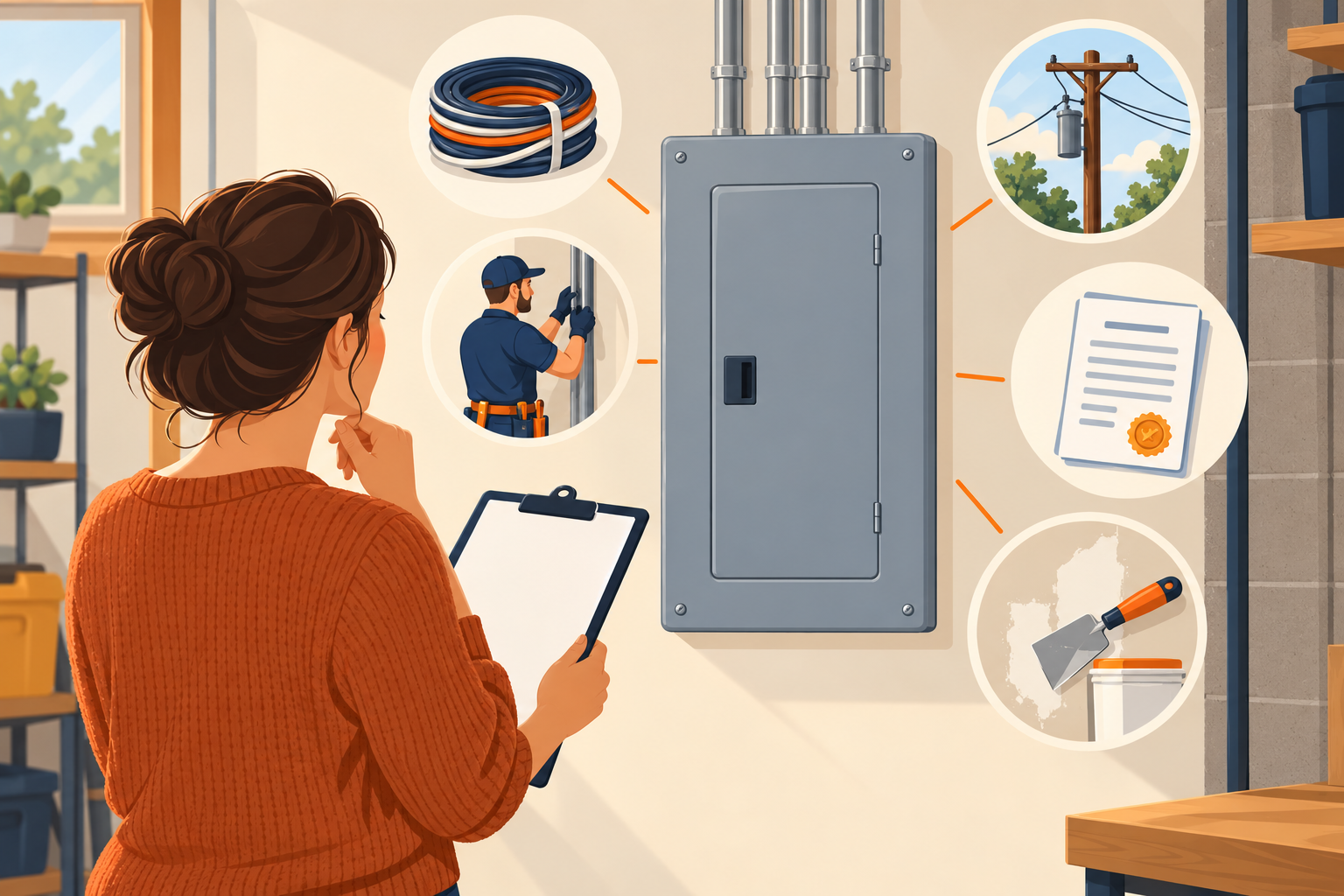
Main cost drivers
Price rises with the number of circuits, limited working space, damaged conductors, corrosion, inaccessible routes, unusual enclosures, specialty breakers, relocation, and service-entrance interaction. Finished walls can turn a simple equipment swap into a finish-restoration job. An occupied home may also require sequencing around refrigeration, medical equipment, security, or other critical loads.
The service rating matters, but a larger number is not automatically a better solution. Increasing capacity can trigger service-entrance, meter, utility, load-calculation, or downstream changes. A subpanel can improve distribution while leaving the service limit unchanged. The correct equipment is the one that matches the documented system need and applicable requirements.
Three budget scenarios
Same-location replacement: The existing location is accessible, service rating remains unchanged, circuits reach the new enclosure, and no concealed damage appears. The quote is mainly panel, breakers, labor, testing, and applicable administration.
Condition correction: Transfer reveals damaged or short conductors, missing labels, grounding/bonding deficiencies, specialty protection, or a crowded enclosure. The expected total includes defined electrical corrections and may need allowances or unit prices.
Service or relocation project: The panel moves, the rating changes, the service entrance is involved, or the utility must disconnect power. This is a larger project with coordination, possible wall work, and local authority requirements. It should not be compared with a same-capacity panel swap.
Ontario and British Columbia fee examples
Fees are not project prices. Ontario’s 2026 guide reports a CAD $86 contractor notification/inspection fee for a new service, service change or repair, or panel change, subject to its classification and conditions. Technical Safety BC’s 2026 homeowner schedule lists CAD $626 for a residential service upgrade up to 200 amps and different fees for service installation or existing-service alterations. Those examples exclude electrician labor, materials, utility charges, and many site costs. They illustrate regional administration only; other jurisdictions differ.
How to compare quotes
Give every bidder the same scope and request the old and new service rating, panel location, circuit count, included breakers, treatment of existing wiring, grounding/bonding work, meter/service boundary, utility responsibility, permits or notifications, inspection, finish restoration, shutdown, labeling, cleanup, and change-order rates. Ask which costs are fixed and which are allowances.
If the recommendation is based on an obsolete panel model, request authoritative documentation or a precise condition assessment. Do not accept a generic internet list as proof that a particular panel must be replaced. Insurance and resale concerns can influence the decision, but insurer treatment is not universal and should be confirmed with the actual policy or underwriter.
When replacement is economically stronger
Replacement becomes more persuasive when repairs require unavailable or incompatible parts, damage is recurring, the enclosure cannot safely accommodate necessary work, or a defined replacement removes repeated mobilization and uncertainty. Repair can remain sensible when the fault is localized, the equipment is serviceable and compatible, and the repair buys a credible holding period. Age alone does not decide the economics.
The useful comparison is not panel price versus panel price. It is the cost, remaining uncertainty, disruption, and future flexibility of the defined repair, replacement, or capacity project.
Separate base scope from allowances
Ask bidders to price the visible replacement separately from uncertain work. A useful proposal identifies the panel and breaker package, circuit count, service rating, labor, shutdown, testing, and labeling as the base. It then states unit prices or approval thresholds for damaged conductors, grounding/bonding, wall repair, utility work, and additional breakers. This makes a modest panel swap comparable with a quote that includes documented corrections rather than an undefined “upgrade.”
The panel location also affects ownership cost. A same-location replacement may minimize access, while relocating the panel can create circuit extensions and finish work. Keeping the old location may be cheaper now but unsuitable for a planned remodel. Ask which decision the proposal solves.
Panel replacement and future loads
If heat pumps, an electric water heater, cooking equipment, an EV charger, solar, storage, or a generator is the reason for the quote, ask for the integrated capacity analysis. A condition-driven replacement can preserve the existing service rating; a load-driven project may need service, utility, or managed-load decisions. Do not pay for a larger rating merely because it sounds more future-proof without a defined use and compatibility review.
Over a short ownership horizon, a same-capacity replacement may be sensible when condition and documentation are the main problem. Over a long horizon, include future equipment, service flexibility, parts, inspection records, and the risk of reopening the installation. The answer is a documented scope—not the largest panel available.