Electrical Distribution, Wiring & Lighting

Project cost and decision guide

Whole-house surge protection is a panel-connected protection decision, not backup power. Compare device type, panel compatibility, installation, limits, and local requirements.

On this page

How Much Does a Whole-House Surge Protector Cost to Install?

Whole-house surge protection is a panel- or service-connected device intended to reduce damage from transient overvoltage. It does not supply power during an outage and is not a battery, generator, or backup system. A current Canadian electrician guide reports labor observations around CAD $80–$150 per hour, but there is no dependable universal installed range because the device, panel, compatibility, access, and local administration vary.
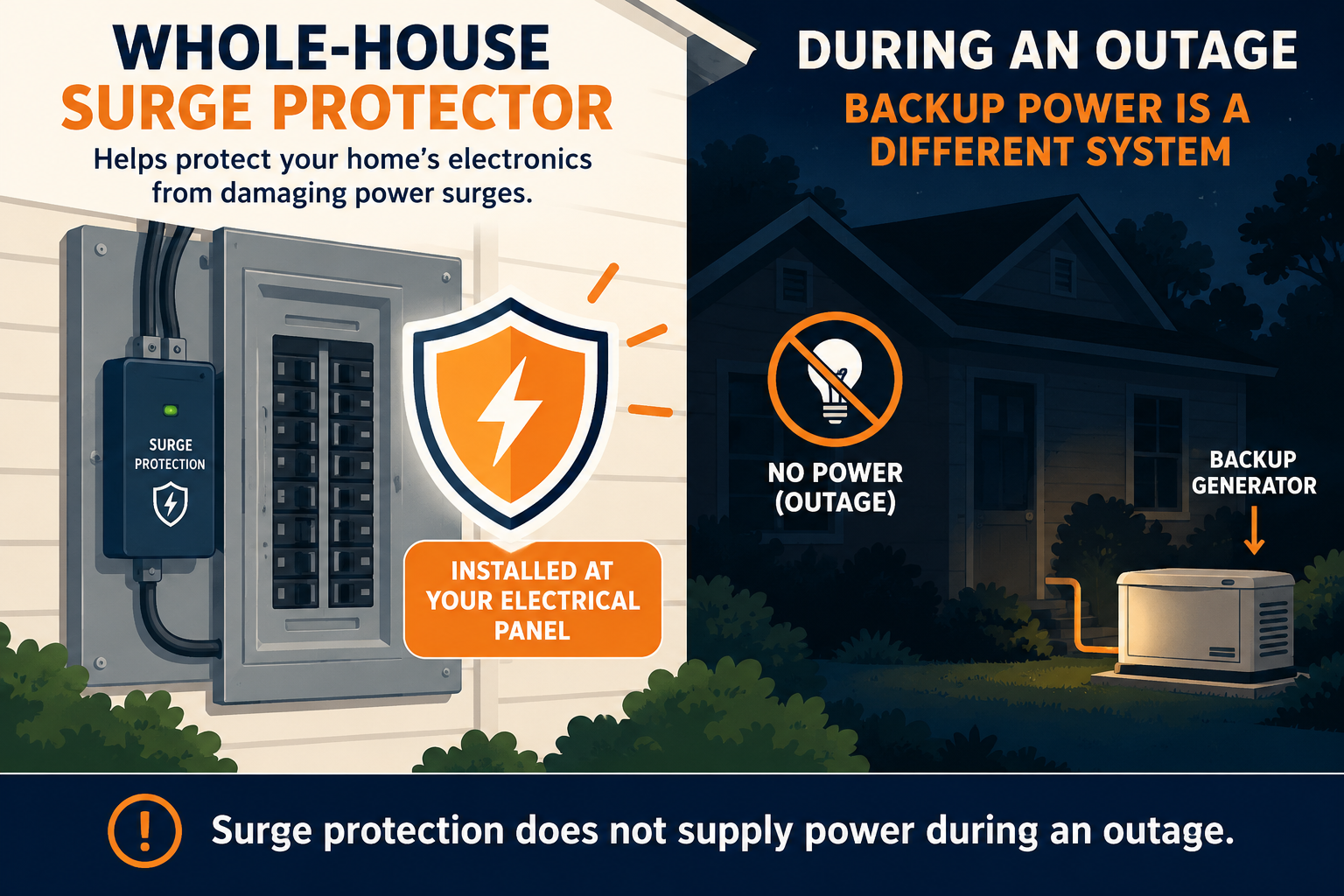
What the installation may involve

The electrician assesses the service and panel, selects a compatible listed device, installs it at the panel or in an approved external arrangement, connects and labels it, tests indicators where the manufacturer supports that process, and documents the equipment. Panel space, service condition, conductor route, and any required shutdown affect the scope.

Point-of-use protectors may be a complementary layer for sensitive equipment, but they do not transform the whole-house device into a guarantee against every surge or direct lightning event. Exact capability comes from the product documentation and applicable standards.

Cost drivers

  • device type and rating;
  • panel model, spaces, and compatibility;
  • existing service condition and access;
  • installation location and conductor route;
  • shutdown, permits, notifications, inspection, and testing;
  • replacement or end-of-life indicators supported by the manufacturer;
  • panel replacement if the existing equipment cannot accept a suitable device.

The protection device may be inexpensive compared with the professional visit or a panel correction. Do not let a low device price hide an unresolved compatibility question.

Scenarios

Straight installation: The service and panel are suitable, the device is compatible, and access is straightforward. Budget for device, labor, testing, and any local fee.

Panel-limited installation: The existing panel lacks suitable spaces or has a documented condition. The project may become panel work, and surge protection is only one line.

Broader resilience plan: The homeowner also wants outage power, solar, batteries, or generators. Surge protection may be a component, but the backup-power decision belongs elsewhere and has different economics.

What surge protection does not decide

It does not guarantee that appliances survive a direct lightning strike, prevent every utility event, correct poor wiring, or keep lights operating in an outage. It also does not replace a diagnosis after a surge has damaged equipment. ESA guidance supports treating surge damage and electrical equipment condition as safety matters; follow the actual product and authority guidance.

Quote checklist

Ask for the device model and documentation, panel/service compatibility, installation point, shutdown, grounding/bonding assumptions, indicator/replacement terms, testing, permit/inspection, warranty boundaries, and exclusions. If the quote includes panel replacement, ask why the existing equipment cannot accept the protection device and whether the panel project is condition- or capacity-driven.

The right decision is a compatible, clearly bounded protection installation with realistic limits—not a promise that one device makes the home immune to surges or outages.

Ask what risk the device is meant to address

A surge protective device can be part of a layered approach, but it is not a guarantee against direct lightning, every utility event, poor wiring, or equipment failure. Ask the electrician to explain the device’s documented function, installation point, status indicator, replacement condition, and limitations. Keep backup-power goals separate: a surge protector does not run the refrigerator or lights during an outage.

If the existing panel or service cannot accept the selected device, price the reason for panel work separately. Do not approve a panel replacement merely because a product salesperson implies that one model is universally required. Exact compatibility belongs to the product documentation and qualified installer.

Compare total ownership cost

Include installation, panel access, shutdown, administration, testing, warranty boundaries, and future replacement. A lower-priced device may have different monitoring or replacement provisions, while a higher-priced unit does not automatically provide a broader guarantee. The economically sound choice matches the actual equipment and risk, with its limits written into the quote.

Decide what evidence is worth paying for

For a simple installation, the useful deliverable may be the model, location, compatibility basis, testing, and any indicator or replacement guidance. If the device is part of a panel correction or insurance conversation, the record may also need the service arrangement, installation date, and the boundary between surge protection and unrelated panel work. Ask for that deliverable before comparing a low device-only price with a documented installation.

Keep manufacturer-supported capability separate from sales language. A warranty may cover a device under stated conditions without guaranteeing connected equipment or preventing every loss. If the homeowner’s actual concern is outage continuity, move the comparison to backup-power planning rather than buying a surge protector for a result it cannot provide.

Ask about the post-installation record

Keep the device model, installation point, indicator behavior, and any manufacturer replacement guidance with the panel documentation. If a future surge damages equipment, that record helps distinguish preventive device installation from post-event diagnosis. It does not prove that a particular loss is covered by a product or insurance warranty.

For a long ownership horizon, access to the device and replacement availability matter. For a short horizon, avoid paying for a broader panel or service project unless the existing equipment actually requires it.

Decide whether the existing panel is part of the project

An installer may be able to add a compatible surge protective device to an existing panel, while another proposal may include panel work because the equipment, space, service arrangement, or installation point differs. Ask for the technical reason before treating panel replacement as a required accessory. The device model, manufacturer instructions, panel compatibility, service condition, grounding and bonding assumptions, and local administrative path should be visible.

Compare the base device installation with options for panel correction, point-of-use protection, monitoring, or documentation. Do not let a marketing claim turn an ordinary protection decision into an undefined modernization project. Conversely, do not omit a real panel or service defect merely to preserve a low device price.

The result to buy is a compatible installation with stated limits and a record of what was installed. It is not immunity from every electrical event, direct lightning effect, outage, or equipment failure.

Price protection, not a promise

Ask whether the device is intended for the service arrangement, what indicator or end-of-life behavior the manufacturer documents, and what warranty applies to the device versus connected equipment. A warranty is not proof that every surge event is covered. Confirm whether the installer will document the model and location for future replacement.

Compare the installed device with point-of-use protection only when the homeowner understands the different layers. Compare it with backup power only when the decision is explicitly separated: surge protection reduces a particular risk; batteries and generators supply energy and require their own capacity, transfer, fuel, maintenance, and utility decisions.

Research notes

Sources used for this guide