
Panel relocation is usually much more expensive than replacing a panel in the same location because circuits, feeders, service equipment, or the wall around the enclosure may all change. One U.S. specialist source reports a $1,500–$4,000 relocation add-on observation. That is a site-specific market observation, not a complete installed range; service changes, circuit extensions, finish restoration, utility work, and difficult access can move the project beyond it.
Why a panel moves
Common reasons include a remodel, an enclosure that will be removed, poor access, a location that no longer works with the building layout, or a need to correct the service arrangement. The reason matters because a relocation embedded in a larger renovation may share demolition and finish work, while a standalone move may carry all of that mobilization itself.
Relocation cost layers
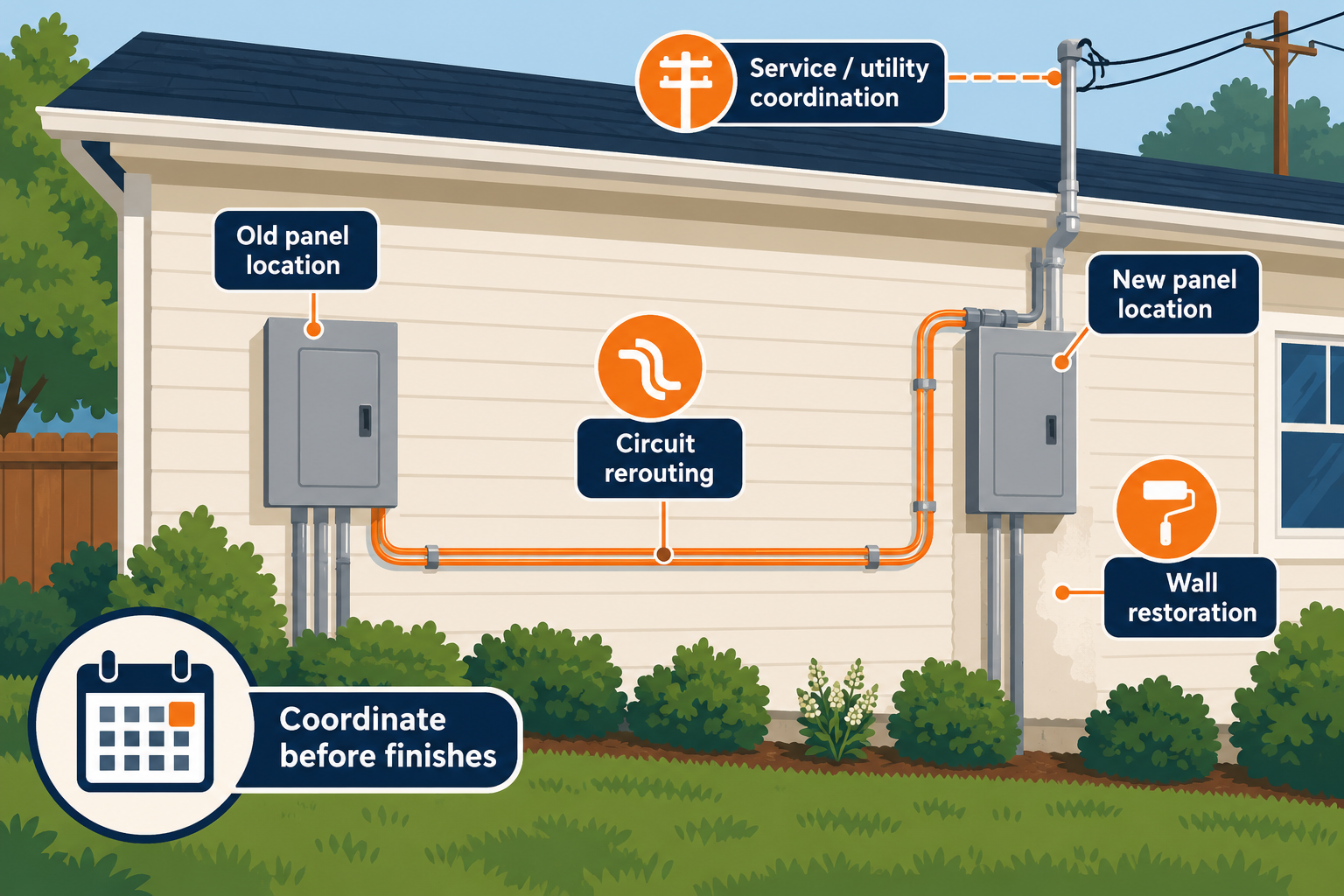
The electrician may need to assess the existing service and panel, choose a new location, disconnect equipment, extend or reroute branch circuits, move or replace feeders, install a new enclosure, reconnect and label circuits, correct grounding/bonding or damaged conductors, coordinate utility shutdown, complete inspection, and restore the wall. The old location may need a safe enclosure or finish treatment after removal.
Every circuit does not necessarily move the same way. Some paths may be accessible through an unfinished basement or attic; others may cross finished walls, masonry, insulation, or a second floor. The quote should identify whether extensions, junctions, raceways, or new runs are included and how concealed conditions are priced.
Three scenarios
Short accessible move: The new location is nearby, routes are visible, the service rating is unchanged, and finish work is minimal. This is the narrowest case.
Occupied finished-home move: Branch circuits need new routing through finished surfaces. Labor, patching, painting, and circuit identification become material parts of the budget.
Service-interface move: The main service equipment, meter, entrance, rating, or utility disconnect is involved. This is a service project as well as a panel move, with local administration and utility responsibility to resolve.
Location and technical boundaries
Panel clearance, working space, enclosure, feeder, and service requirements are high-consequence technical matters. Verify the exact location and method with the qualified electrician and local authority. Do not use a generic clearance diagram as a project approval. Ontario’s ESA process, for example, describes utility disconnection and inspection before power restoration for applicable service relocation or replacement work; this is an Ontario process example, not a universal North American rule.
Technical Safety BC’s 2026 homeowner schedule also lists separate fee classes for service installation, service upgrade/relocation, and existing residential alteration. Its fees are administrative only and exclude labor, materials, utility charges, and finish restoration.
Compare move, repair, and redesign
Relocation may be worthwhile when the current location blocks a necessary renovation, creates a documented access or condition problem, or lets several circuit and finish projects share one opening. It may be poor value when the move is cosmetic, the existing location can be corrected, or the proposed new path creates extensive concealed work.
Ask whether a same-location replacement, subpanel, circuit reconfiguration, or planned renovation sequence solves the actual problem. A subpanel may improve distribution but does not automatically replace a main service relocation or increase utility capacity.
Quote checklist
Request existing and proposed locations, service rating, meter and utility boundary, number of circuits, route and access assumptions, new and retained equipment, grounding/bonding, wall openings and restoration, permits/notifications, inspection stages, shutdown, labeling, cleanup, allowances, and change-order thresholds. Have bidders price the same circuit list and restoration boundary.
The meaningful comparison is the total cost and disruption of moving the panel versus correcting the existing location or coordinating the move with a larger project—not the relocation add-on alone.
Coordinate the move with the property schedule
A move is strongest when it resolves a defined obstruction, access problem, or service correction. Before comparing prices, map the circuits and ask which can reach the proposed location, which need rerouting or extension, whether the old position needs electrical or finish work, and who handles inspection and restoration. A same-location replacement, subpanel, or revised renovation layout may solve the problem with less disruption.
If the move is part of a remodel, coordinate it before framing and finishes are fixed; shared openings may reduce repeat access, but that saving should appear in the scope rather than be assumed. For a standalone project, ask when power will be off, whether utility scheduling or temporary arrangements are needed, and how concealed conditions will be authorized. If future loads are the reason for choosing a location, price the capacity analysis separately: a better panel position does not by itself increase service capacity.
Have the quote list every circuit, new location, feeder and service assumption, shutdown, testing, labeling, old-location treatment, and patching/painting boundary. Compare that complete cost and disruption with keeping the current location or coordinating the move with other planned work.