
An old panel is not automatically a failed panel, and a functioning panel is not automatically suitable for every future project. The repair-versus-replace decision should start with condition, compatibility, serviceability, and the reason the question arose—not the panel’s age alone.
A localized breaker repair may be priced around a service minimum plus a replacement part; one U.S. specialist observation places breaker replacement near $100–$200. Full panel observations span roughly $518–$2,192 in one U.S. specialist source, while a Canadian specialist example for a 200-amp upgrade is CAD $1,500–$4,500. These are not comparable promises: a replacement can include different service, permit, labor, and access scopes.
What should be assessed
Ask a qualified electrician to identify the actual condition: heat or scorching, corrosion, physical damage, altered wiring, poor terminations, missing or incompatible components, nuisance tripping, capacity limitations, or a service-interface concern. CPSC advises qualified professional involvement for panel work because the panel environment can remain hazardous even when the main breaker is off.
Do not turn a brand name, internet blacklist, or age estimate into a replacement mandate without authoritative, installation-specific support. Exact recalls are different: CPSC’s 2022 recall covers specified Square D QO Plug-on-Neutral load centers, not every Square D or QO panel. Check the catalog number and date code in the recall notice and Schneider Electric’s current safety notice; the CPSC notice directs owners to arrange a free inspection by a trained electrician, who determines whether repair or replacement is required. Contact Schneider to confirm current remedy terms. Do not remove the panel cover to look for a date code.
CPSC’s 1983 notice on Federal Pacific Stab-lok breakers is also narrower than many online summaries suggest. The agency said the data then available did not establish a serious injury risk, but expressly made no determination that the breakers were safe or that the manufacturer’s position was accurate. That historical investigation is not a current condition assessment or a universal replacement rule.
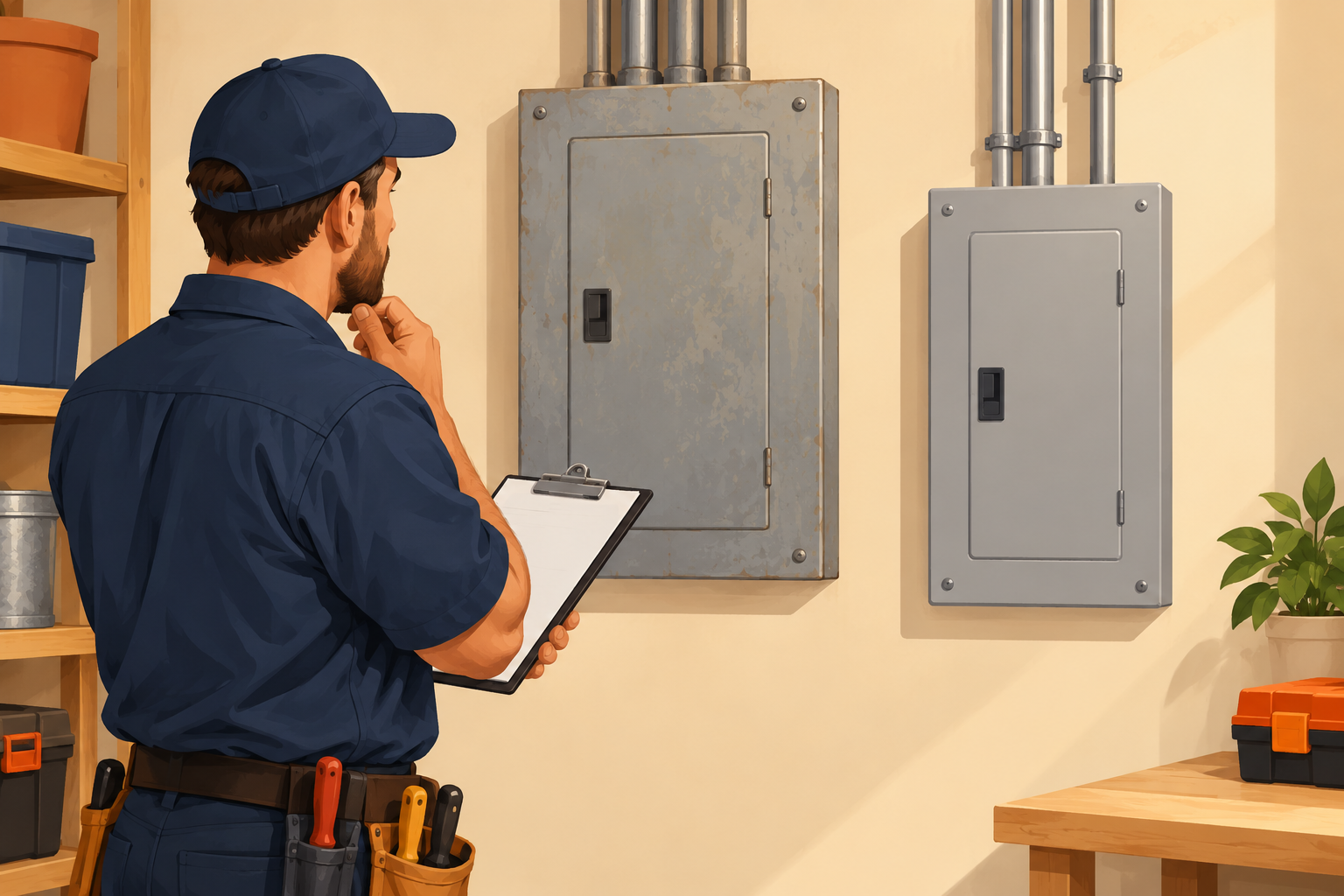
Conditions that favor repair
Repair is more defensible when the fault is clearly localized, compatible replacement parts are available, the enclosure and surrounding equipment are in acceptable condition, the proposed correction addresses the cause, and the repair creates a credible period before another major intervention. Examples include a diagnosed compatible branch breaker, a documented connection correction, or a labeled device repair that does not conceal wider damage.
The electrician should explain what was tested, what was not inspected, and whether the repair changes any future service or capacity options. A low part price does not make repair economical if two visits, temporary work, and recurring trips are likely.
Conditions that favor replacement
Replacement becomes stronger when the panel has documented heat or physical damage, repeated failures, unavailable or incompatible parts, inadequate spaces for a defined need, widespread deterioration, or a transfer scope that would require extensive correction anyway. It can also make sense when a single repair would leave the homeowner with a known unresolved equipment risk—but that conclusion should be tied to the observed condition, not a generic age rule.
Replacement is not automatically a service upgrade. The quote must state whether the service rating changes, whether the meter or service entrance is included, and whether the job is driven by capacity planning. A future electrification program may require separate analysis.
Insurance and resale considerations
Insurers, buyers, sellers, and authorities may ask different questions about older electrical equipment. An insurer’s underwriting position is not a universal legal or technical standard. Ask the actual insurer what documentation or remediation it requires. A buyer’s inspection recommendation also does not automatically establish that replacement is mandatory.
An electrical-system assessment can be worthwhile before an expensive decision, especially if multiple defects or legacy wiring are involved. The assessment should distinguish visible condition from concealed uncertainty and provide a defined basis for repair quotes.
Compare the economics over your ownership horizon
| Repair case | Replacement case |
|---|---|
| Lower immediate cost when the fault is truly contained | Higher upfront cost but may address broad condition or parts risk |
| Less disruption if the panel remains in place | New equipment, labeling, documentation, and possible future flexibility |
| Retains uncertainty about the next failure | May reveal additional wiring, service, or finish work during transfer |
| Can be sensible for a short holding period | May be stronger for a long horizon if repeat repairs are likely |
For a short ownership horizon, a documented safe repair may preserve capital if it does not misrepresent the system. For a long horizon, include repeat mobilization, part availability, future renovation, planned loads, and the cost of reopening work. Do not assume replacement improves resale value by a fixed amount.
What the quote should say
Request the observed defect, equipment identification, proposed repair or replacement, branch-breaker compatibility, service rating, number of circuits, grounding/bonding treatment, panel relocation or access assumptions, permits or notifications, utility work, inspection, finish restoration, warranty boundaries, and the price of concealed corrections. For replacement, ask which components are retained and why.
The decision is resolved when a professional has tied the recommendation to a specific condition and the quote makes the future risk visible. “Old” is a reason to investigate, not by itself a reason to replace.
Use a decision threshold, not a percentage rule
Compare the repair’s complete cost with the replacement’s complete cost, but also compare what each leaves behind. A repair is weaker when it needs repeated diagnostic visits, depends on uncertain parts, or leaves documented heat, corrosion, or compatibility concerns. Replacement is weaker when the recommendation is based only on age, a generic internet list, or an unrelated future load that has not been analyzed.
Ask what would make the electrician stop a repair and recommend broader work. Examples might include evidence of panel damage, inability to source a compatible component, or a condition that affects multiple circuits. Agreeing on that threshold prevents an urgent visit from turning into an open-ended project.
Compare the two paths with the same scope
For repair, list the component, compatible replacement, testing, labeling, and the condition expected to remain. For replacement, list the panel, breakers, shutdown, service and grounding interaction, permits or notifications, inspection, access, finish restoration, and future-load assumptions. If one quote includes a service upgrade or broad rewiring and the other does not, the prices cannot be compared as repair versus replace.
Age alone is not a sufficient threshold. Repair can be rational when the panel is serviceable, the problem is localized, compatible parts are available, and the correction has a clear expected result. Replacement becomes stronger when damage is broad, the equipment is obsolete or incompatible, parts are uncertain, work would be repeated, or the existing arrangement cannot support a defined project. These are decision inputs, not universal rules.
Ask what observation would stop the repair path and trigger broader work. That threshold is more useful than a generic percentage of replacement cost because it ties the recommendation to the actual panel and ownership horizon.
Read the report and policy together
If a home inspection mentions an old panel, obtain the actual observation and ask whether an electrical assessment is needed. If an insurer asks for action, request its written requirement and deadline. A buyer, seller, authority, and insurer can each use different language. None of those documents automatically proves a particular panel is unsafe or that replacement will increase resale value by a predictable amount.
For a short ownership horizon, a well-documented repair may preserve cash when the system is serviceable. For a long horizon, include parts availability, future renovation, repeat service calls, and the cost of a later shutdown. Replace when the evidence supports the broader scope, not because a headline age is easy to quote.