
The service entrance is the part of the electrical system that connects the utility supply to the home’s service equipment. Depending on the installation, a repair discussion may involve a mast, weatherhead, service conductors, meter base, main disconnect, or panel. These components are kept together here because ownership, shutdown, inspection, and utility coordination can matter more than the isolated part name.
There is no reliable universal service-entrance repair price. A panel source reports broad U.S. panel observations and identifies wiring, access, permits, and relocation as major adders; Ontario’s 2026 wiring guide classifies service equipment to include items such as the mast, meter base, service-entrance equipment, main disconnect, and main panel. Labor, material, service rating, utility work, and local authority fees still need a property-specific quote.
Establish responsibility before pricing
The utility may own or control some equipment, while the homeowner or electrical contractor owns other equipment. The boundary can change by utility, jurisdiction, service arrangement, and point of connection. Do not authorize a repair based on a generic diagram or assume that the meter marks the responsibility line.
Ask the electrician whether the utility must inspect, disconnect, approve, or reconnect the service, and ask the utility which component it considers its responsibility. A quote should identify the handoff point and state what happens if the other party finds a different defect.
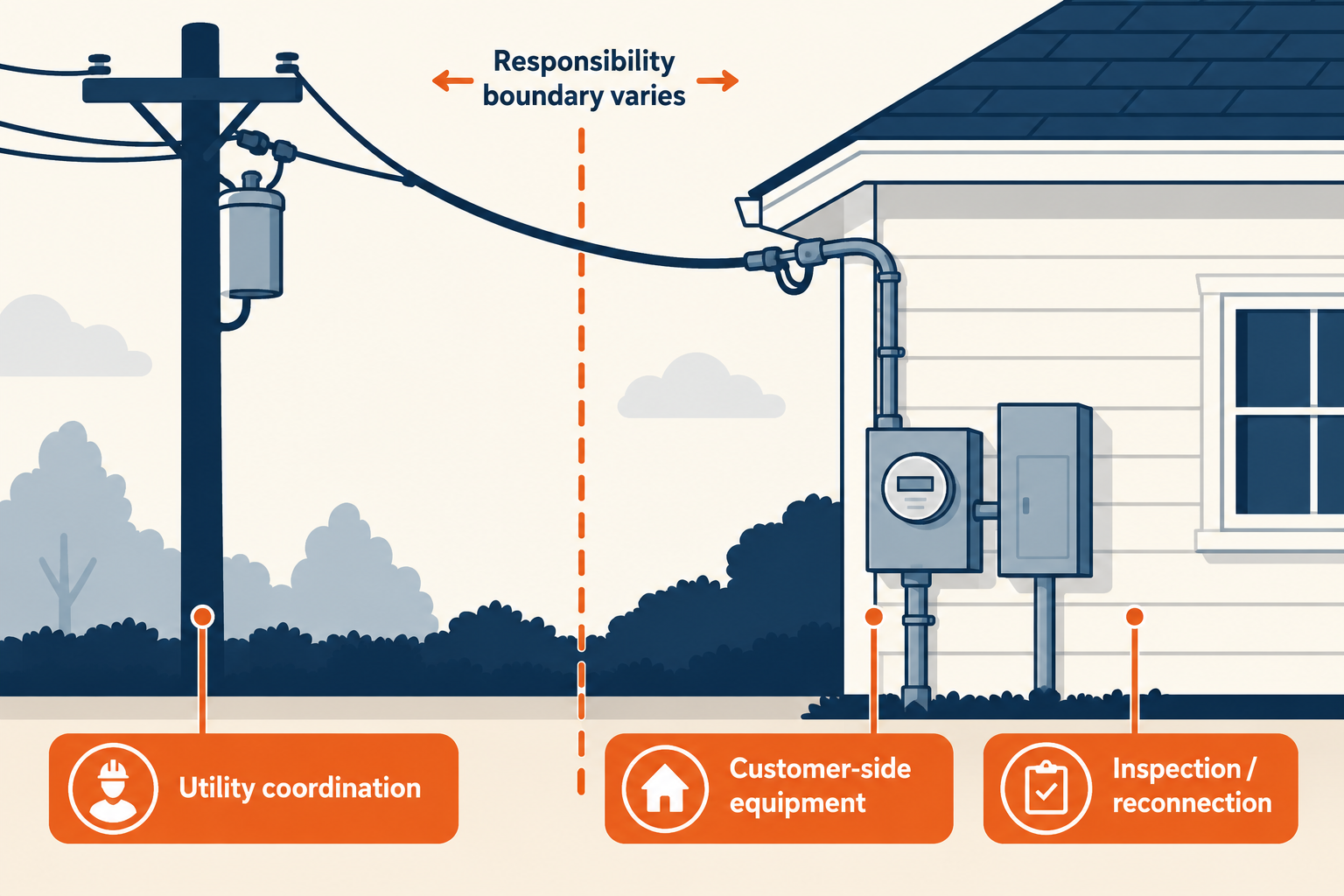
Utility examples show why the boundary must be checked
The boundary differs even among named utilities. Hydro One’s conditions for wholly owned residential secondary service place the demarcation at the top of the customer’s service-entrance stack for overhead service and at the line side of the customer’s meter base for underground service. Con Edison says it owns the meter and service wire from the street, while assigning its overhead customer’s weatherhead, service bracket, entrance cable, and meter pan to the customer. Its underground diagrams treat components separately. These are examples for those utilities and configurations, not a North American rule.
BC Hydro assigns the customer supply and installation of underground customer service conduit and grounding that meet its current requirements. Its connection guidance warns that a nonconforming installation may be rejected and callback charges may apply. This can affect trenching, scheduling, and who pays for rework, but it is not a construction specification. Confirm current standards and the actual service configuration with the utility and qualified electrician before pricing.
| Example | Cost question it can change |
|---|---|
| Hydro One overhead or underground secondary service | Which side of the stated demarcation includes the damaged component? |
| Con Edison overhead or underground service | Does the utility or customer arrange the repair for this specific part? |
| BC Hydro underground connection | Who supplies the conduit and grounding, and what happens if the connection is not accepted? |
Common service-entrance scenarios
- Weatherhead or mast damage: Wind, impact, corrosion, movement, or an attachment problem may require access equipment and service shutdown.
- Meter-base or socket issue: Heat, water entry, corrosion, or physical damage may require a component replacement and utility coordination.
- Service cable or conductor damage: The repair may be localized or may involve the route, attachment, rating, and connection to the panel.
- Panel interaction: A damaged service entrance may expose a panel, disconnect, grounding, or bonding issue.
- Storm or post-loss work: If the damage is part of a fire, flood, or storm claim, restoration and insurance scopes may surround the electrical repair.
The visible damage does not establish how far the repair extends. Opening a service component may reveal deterioration that was not visible from the ground.
What drives the cost
Height and access can require a lift, staging, or additional safety controls. Service rating affects equipment and process. Underground versus overhead arrangements have different routes and excavation implications. Corrosion, water entry, damaged mounting, inaccessible conductors, and adjacent siding or roofing work add coordination. A planned repair may also require a temporary shutdown; urgent storm work may be priced around availability rather than ordinary scheduling.
Permits, notifications, inspections, and utility fees are separate layers. Ontario’s ESA process describes utility disconnection and inspection before power is restored for applicable service upgrade, relocation, or replacement work. B.C. homeowner permit schedules classify service installation and upgrade/relocation differently from other alterations. Neither example creates a universal rule or total cost.
Low, expected, and difficult cases
Contained component repair: The responsible party is clear, access is straightforward, the service rating is unchanged, and the damaged component can be replaced without panel or finish work.
Coordinated service repair: The repair requires electrician labor, utility shutdown, authority inspection, a service-equipment component, and possibly panel corrections. The quote should list each party and dependency.
Difficult or post-loss repair: Storm damage, corrosion, high access, structural attachment damage, water entry, or a restoration claim creates multiple scopes. Temporary protection, utility scheduling, roof/siding repair, and interior restoration may not be part of the electrician’s total.
How to compare proposals
Ask for the exact damaged component, ownership assumption, service rating, access method, shutdown and utility responsibility, equipment and conductors, panel interaction, permits/notifications, inspection, weatherproofing or adjacent finish, emergency premium, warranty, and exclusions. Require an allowance or unit price for concealed deterioration instead of an undefined contingency.
If a service-entrance recommendation is actually driven by planned heat pumps, an EV charger, electric water heating, solar, storage, or several new loads, connect it to a whole-home capacity analysis. Ordinary repair belongs here; coordinated electrification capacity belongs elsewhere in the portal.
The economic decision is not “what does a mast cost?” It is which party controls the work, what service boundary is affected, and whether the visible repair is a contained defect or the beginning of a broader service project.
Price the handoff and restoration
Before comparing totals, name the component, the party controlling it, the party arranging shutdown or reconnection, and the authority or utility that must inspect or approve the work. Ask who will contact the utility, how temporary protection and scheduling are handled, and whether the home can remain occupied. A quote should say what happens if the utility identifies a separate defect instead of hiding that possibility in an open-ended contingency.
If siding, roofing, masonry, landscaping, or interior finishes must be opened, price restoration under a named party. Keep ordinary damage repair separate from a service-rating change, panel replacement, or whole-home capacity decision. A contained repair is easier to budget when responsibility, access, and condition are clear. Broader work needs a documented reason such as multiple damaged components, a panel or grounding issue, or a service arrangement that cannot support the repair. If future electrification is the driver, request that capacity analysis separately.