
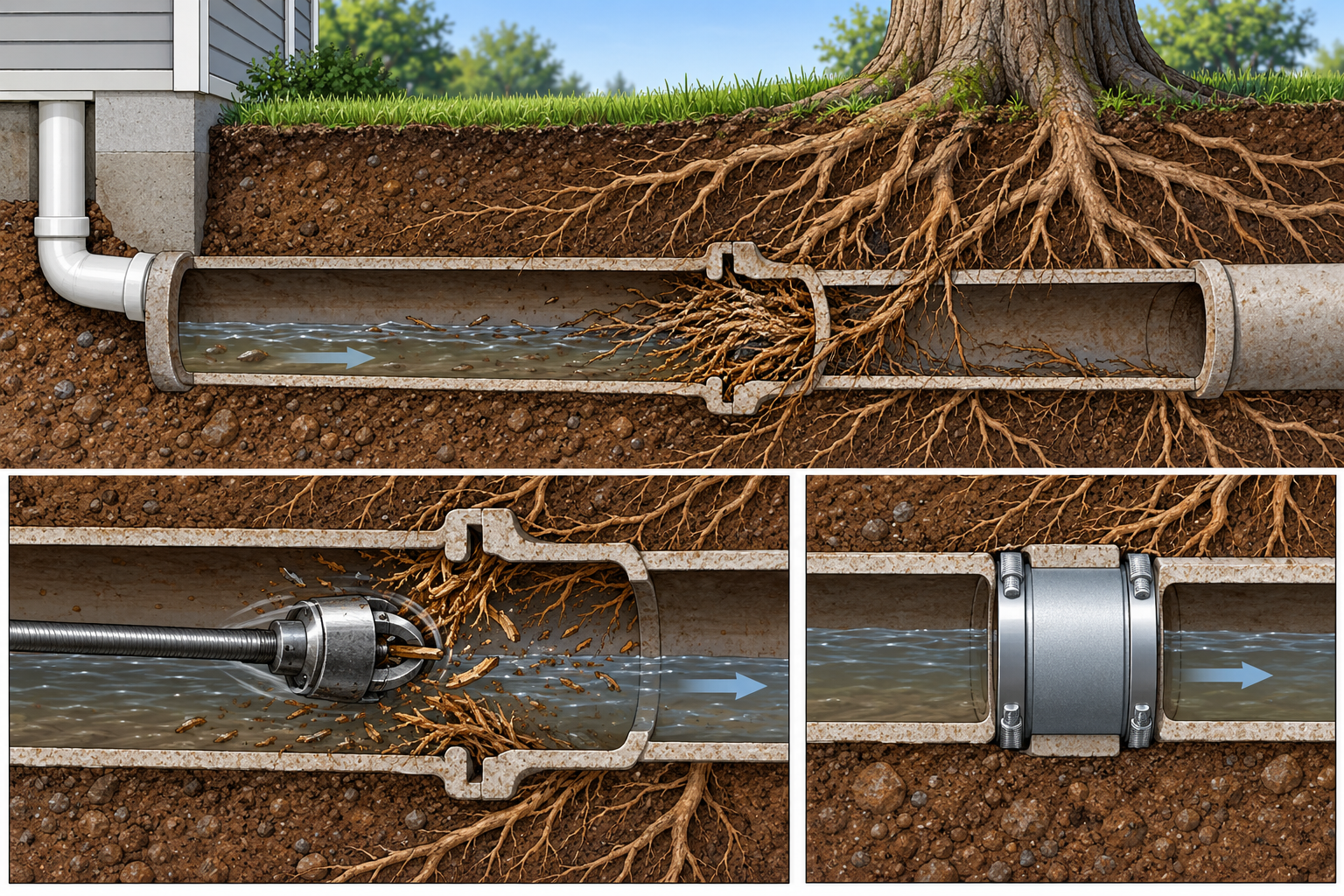
Roots in a sewer line create two different costs: the immediate cost of restoring flow and the longer-term cost of correcting the entry path, if correction is feasible. A root-cutting or cleaning visit may solve today’s blockage while leaving a joint, crack, or deteriorated pipe that allows roots to return. The right budget therefore depends on whether roots are simply obstructing the line or revealing a structural defect.
The first service is not the final diagnosis
Root removal may involve mechanical cutting, snaking, or hydro jetting. Angi’s 2026 US market observations put ordinary snaking around $100 to $250 and hydro jetting around $350 to $600 as illustrative service ranges, but neither range is a root-specific national price. Access, emergency timing, length, equipment, and the condition of the line can change the quote.
Ask the contractor to state whether the quoted work is intended to cut roots and restore flow, inspect the line afterward, or repair the point of entry. “Roots removed” and “roots prevented from returning” are different promises.
Why inspection after clearing matters
Once the camera can travel, the useful question is where the roots appear and what allowed them to enter. A joint, crack, break, or connection defect may require a localized repair or a broader method comparison. If roots are spread through a long deteriorated run, a single spot repair may not change the recurrence pattern.
Camera evidence should identify distance from the access point and, when possible, the route or surface location. It may not establish full structural condition or who owns the segment. Seattle Public Utilities distinguishes cleaning from spot repair, open-cut work, pipe bursting, and CIPP lining; that separation prevents a cleaning invoice from being mistaken for a permanent pipe repair.
Cost scenarios
Isolated first event: The line is accessible, roots are cleared, the camera shows no material structural concern, and flow remains normal. Scheduled monitoring or future maintenance may be reasonable. There is no universal service interval; set expectations around observed recurrence rather than an annual rule.
Repeated roots at one location: The immediate cleaning cost may be lower than a repair, but repeated mobilization and emergency exposure can make inspection and spot-repair pricing worth comparing. Ask whether the repair would remove the entry defect and what retained pipe remains.
Roots with distributed deterioration: Lining, bursting, open-trench replacement, or another rehabilitation strategy may enter the discussion. Suitability depends on geometry, collapse, alignment, access, connections, and local requirements. Do not choose a method solely because it is labeled trenchless.
Roots near a public boundary or tree: Before authorizing work, document the location and ask the utility or municipality whether its rules address public trees, right-of-way segments, or city-owned infrastructure. Responsibility and reimbursement are intensely local. A city example cannot be generalized to another market.
Cleaning, lining, and replacement are different economic bets
Repeated cleaning preserves cash today but leaves recurrence risk. Spot repair spends more to address a defined defect but may not solve other weak sections. CIPP lining may reduce surface disturbance where the host pipe is suitable, but it is rehabilitation inside the existing route and may not solve collapse or serious alignment problems. Pipe bursting replaces the pipe through access pits in suitable conditions, while open cut exposes more of the route and may carry greater restoration cost.
The best choice depends on the ownership horizon and the cost of repeat access. A homeowner staying for years may value reducing recurring service calls. A seller or owner planning near-term excavation may coordinate root correction with a larger project, but a short horizon does not justify a temporary fix that leaves an active defect undisclosed.
Do not assume the tree is the responsible party
A nearby tree is not by itself proof that a municipality, neighbor, or homeowner owes the repair. The pipe may be private, shared, or public; the tree may be privately or publicly managed; and local rules may assign maintenance differently. Some municipal guidance places responsibility on the property owner even for portions under the street, while other rules create exceptions or assistance programs.
Ask for the applicable utility policy, bylaw, easement, and program conditions in writing. Keep the camera video, location data, photographs, invoices, and any utility response. If a dispute turns on title, easement, or legal responsibility, obtain local legal advice rather than treating an example in a cost guide as a ruling.
Landscaping is a related but separate budget
Removing or protecting a tree, changing planting, replacing roots, restoring a lawn, or rebuilding hardscape may be separate from the sewer contractor’s price. King County recommends considering root-damage potential when planting and locating the sewer before landscaping. That is planning context, not a guarantee that one landscaping decision prevents future pipe problems.
If excavation is needed, ask whether the quote protects or removes plants, handles soil, restores irrigation, replaces paving, and covers only temporary surface repair. Those items can be significant even when the pipe repair itself is localized.
Questions to ask
- Were roots merely cut, or was the entry location inspected?
- Is a camera inspection included after clearing?
- Does the report identify the affected distance and route?
- Is the proposed fix spot repair, lining, bursting, or open cut, and why?
- What other defects could remain outside the proposed repair length?
- Are access, permits, restoration, emergency timing, and future cleaning separate?
- Does a utility or municipal rule affect the segment or tree involved?
Treat root removal as a useful first step when flow is at risk, but do not let it close the structural decision prematurely. The durable budget is the one that prices both the immediate service and the recurrence that service may leave behind.
Separate root-removal frequency from repair scope
When a contractor recommends a recurring root-cutting schedule, ask what observation supports the interval and how the service will be adjusted if roots return sooner or later. A scheduled visit may be manageable for an accessible line with infrequent recurrence, but repeated emergency callouts can add mobilization, cleanup, and disruption. A camera report can show whether roots are localized at one joint or distributed through a deteriorated section; those findings support different repair comparisons.
The cost of cleaning is not a proxy for the cost of correcting the entry point. A root cutter can restore flow while leaving the joint defect in place. A spot repair may need excavation and surface restoration; lining or replacement may cover a longer route but requires a suitable host, alignment, access, and connections. Request the total cost of each complete path and identify which future cleaning visits would still be expected after the structural work.
Map the pipe and the nearby tree separately
Before attributing damage to a tree, establish where the line runs and where roots were observed. Roots may enter at a defect from a nearby planting, but the camera alone may not identify the tree or establish ownership of the pipe. A surface locate, property records, and utility response can help distinguish the private lateral from a public segment or shared route. Keep the video, marked location, photographs, and any written municipal rule together.
If a public tree or neighbor’s planting is involved, ask the local authority who investigates and whether notification or permission is required before removing or altering it. Do not assume that pruning, removal, chemical treatment, or public reimbursement is part of the sewer quote. The repair estimate should clearly state the pipe work; landscaping, tree work, and public claims can require separate professionals or approval.
Compare the homeowner’s alternatives
For a first root event, the immediate clearing and a later inspection may be enough information. For roots that return quickly at one point, price cleaning plus a defined spot repair against continued maintenance. For multiple entry points or deteriorated pipe, compare a longer rehabilitation or replacement scope and the amount of retained pipe. Include surface restoration and future access, not just the fee for the next root-cutting visit.
No option guarantees that roots can never approach or enter a sewer. A useful proposal states which defect it corrects, what adjacent pipe remains, how the result will be documented, and what recurrence should trigger another assessment. That turns a recurring symptom into a bounded decision rather than an indefinite cleaning subscription.
When comparing bids, check that the root-entry location, repair length, and access assumptions match the camera report. A quote for removing visible roots is not equivalent to one replacing a joint, and a repair at one location does not establish the condition of the full lateral.
Decide whether recurrence is acceptable
The value of a structural project depends on the interval and consequence of recurrence. A line that needs an accessible scheduled cleaning after many years may be managed differently from one that backs up into finished space after every season. Compare the expected cleaning path with the cost and disruption of correcting the documented entry defect, including the surface that must be opened.
Do not assume a chemical root product is a safe or permanent answer. The evidence here does not establish a universal treatment, compatibility rule, or public-tree reimbursement. Ask the contractor and local authority for specifically supported guidance, and keep any treatment outside the structural quote unless its purpose and responsibility are clear.