
Hydro jetting uses specialized equipment to propel high-pressure water through a drain or sewer line. In US market observations, Angi places illustrative hydro-jetting prices around $350 to $600, but the useful question is not whether that range is “the price.” It is what the quote includes, whether the pipe can safely receive the service, and whether cleaning will solve the underlying problem. Canadian prices are not established by this evidence and should be obtained locally.
What you are paying for
A hydro-jetting visit may include equipment transport, access setup, cleaning passes, disposal or water management, and a flow check. The contractor may recommend camera inspection before or after the cleaning. Some providers bundle inspection; others charge it separately. Root cutting, locating, cleanout work, and structural repairs are separate possible scopes.
Jetting is a cleaning intervention. It can remove or loosen certain accumulations, but it does not by itself rebuild a cracked joint, correct a collapsed section, restore a bad alignment, or guarantee that roots will not return. A quote that calls a line “clean” should not be read as a statement that the line is structurally sound.
Why the range is wide
Access and setup: A usable cleanout makes the work more predictable. A buried or missing access point may require additional work before the hose can reach the line. The route and length affect equipment time and the number of access points.
What is being removed: Grease, scale, roots, and compacted debris can require different equipment choices and cleaning effort. A single soft blockage is not the same project as a line that has accumulated material along a long run.
Condition of the host pipe: High-pressure cleaning is not automatically appropriate for every old or damaged line. The contractor should consider pipe material, visible defects, prior repairs, and whether pressure could worsen an already compromised section. Seattle distinguishes cleaning and root-removal services from structural side-sewer repair, an important boundary for homeowners comparing proposals.
Timing and follow-up: An emergency call may carry a response premium. A camera, written report, electronic locate, or repeat visit can add cost but may be economically useful if the line has a history of recurring blockage.
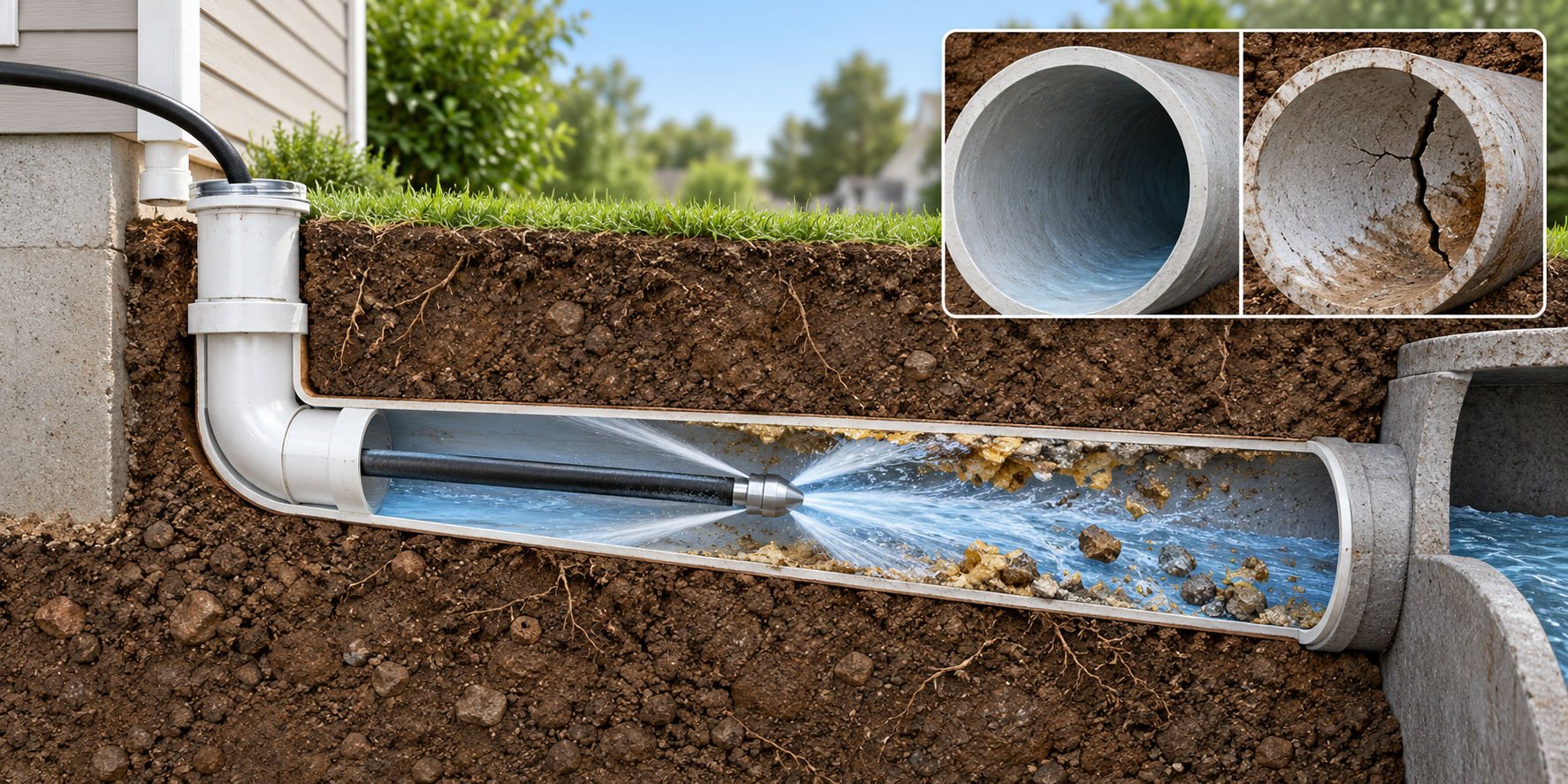
Three common scenarios
One heavy buildup in a serviceable line: The line is accessible, there is a plausible accumulation, and there is no history of structural findings. Jetting may be a reasonable cleaning choice. Ask whether a flow test or camera record is included and whether the provider will stop if the pipe condition appears unsafe.
Roots or scale keep returning: Jetting may restore flow more thoroughly than a limited mechanical pass, but it does not remove the reason roots can enter or explain why scale forms. Add the cost of inspection to the decision. A small repair at a defective joint, lining, or replacement may be more economical over the ownership horizon than repeated intensive cleaning.
The line is old, damaged, or unknown: The lowest-uncertainty economic sequence may be condition assessment first, followed by a method recommendation. Do not accept “jetting” as a substitute for diagnosing a collapse, severe crack, offset, or persistent belly. If a line cannot drain, a camera may not show the full condition until flow is restored.
Hydro jetting versus ordinary snaking
Mechanical snaking usually aims to open a path through an obstruction. Jetting is a higher-intensity cleaning approach intended to scour or remove accumulated material along more of the pipe. Neither description predicts the correct choice without knowing the blockage and pipe condition.
For a first, accessible, isolated clog, ordinary clearing may be adequate. For recurring buildup or roots, a contractor may propose jetting because a narrow opening is unlikely to remove the material that keeps catching debris. For a structurally failing line, both may be temporary. Compare snaking versus hydro jetting by the decision and not just by the equipment name.
Read the quote in layers
Ask the contractor to separate:
- access and setup;
- cleaning method and included passes;
- camera inspection and recording;
- locating or marking the defect;
- root treatment, if proposed;
- repair or replacement options;
- permits, traffic control, and restoration;
- emergency, water-management, or disposal charges.
That list helps explain why two hydro-jetting quotes differ. One may be a cleaning-only visit; another may include a camera report and a follow-up recommendation. Neither is necessarily wrong, but they are not equivalent.
When the added expense is justified
Jetting is easier to justify when a blockage is extensive, repeated, or associated with grease, scale, or roots; when mechanical clearing provides only a narrow temporary opening; or when a clean line is needed before meaningful camera inspection. It is harder to justify when the proposal offers no explanation of the blockage, ignores obvious structural defects, or promises permanent results without inspecting the line.
Keep the distinction between immediate function and long-term condition. If wastewater is backing up, restoring flow may be urgent. After that, decide whether the cleaning result answers the problem or merely buys time. A useful contractor will state what was observed, what remains unknown, and what event would justify a repair investigation.
Safety boundary
Hydro-jetting is professional equipment, not a homeowner procedure. High pressure can injure people and can damage compromised infrastructure. The homeowner’s useful role is to describe symptoms, disclose the pipe’s age or previous repairs, ask what condition assumptions the contractor is making, and request documentation of the result.
Before and after the cleaning
Ask what preparation is required and whether the contractor will inspect the line before applying high pressure. If the service is intended to prepare for a camera, confirm whether the camera visit is included and whether the video will show the cleaned length. Afterward, ask what material was removed, whether the same restriction remains, and what observation would justify repair rather than another cleaning.
This matters because a clean interior can create a false sense of completion. A line may flow after jetting while still having a cracked joint, root-entry path, or alignment defect. The useful result is both restored flow and a clear statement of what the cleaning did not establish.
Know when jetting should stop
Ask the provider to pause if the camera or equipment reveals a collapse, a pipe that cannot be safely traversed, a displaced connection, or another condition outside the cleaning scope. Request the observation and the cost of a separate structural assessment before proceeding. A fixed cleaning quote should not silently expand into excavation or repair, and an urgent need to restore flow should remain distinct from a permanent project authorization.
When setup and scope change the price
Two jetting quotes can differ because one is a cleaning-only service while the other includes a camera, a recorded report, a second access point, or additional time for a long run. Ask whether the provider expects to make one pass or several, whether a camera inspection is before or after cleaning, and what happens if a blockage remains. If the quote is hourly, request an approval point before the next hour or a more intensive method is added.
Access can also change the equipment and preparation. A usable cleanout at the right end of the line may make a direct service possible. A blocked, buried, or poorly located cleanout can add discovery or opening work. A branch or unusual connection may prevent the equipment from cleaning the whole relevant segment. The contractor should identify the route and portion expected to be reached rather than imply that “whole line” means every drain branch and connection.
Price the likely sequence, not only the jetting visit
An accessible serviceable pipe with a documented grease or debris buildup may need a planned cleaning, followed by a flow check. A recurring root problem may require clearing to restore drainage, camera inspection to identify the entry point, and a separate repair quote. A line with a collapse or severe offset may be a poor candidate for jetting as the main solution; budget for professional assessment and any safe immediate stabilization separately.
Those paths have different cost profiles. In the first, the cleaning may be the final paid work. In the second, a jetting invoice is only one stage before diagnosis and structural correction. In the third, spending on an intensive cleaning before checking pipe condition could be wasted or inappropriate. Ask the contractor to describe the decision that follows each outcome and to price optional work separately.
Evaluate recurrence without assuming payback
Repeated jetting can become an expensive maintenance pattern, but there is no reliable universal number of visits at which lining or replacement becomes cheaper. Compare the actual interval between clearings, the access and emergency charges, the consequence of another backup, and what an inspection shows about the host pipe. A home with a long service interval and easy cleanout may reasonably continue maintenance; a home with rapid recurrence at a documented defect needs a different comparison.
Use the same service record for each contractor: dates, material removed, location, method, result, and time until symptoms returned. Ask whether the proposed cleaning changes the pattern or simply repeats the previous outcome. If the answer is uncertain, buy the diagnostic step that can distinguish buildup from structural failure before comparing long-term cost.