
Repeated cleaning is not automatically evidence that a sewer lateral has failed. It is, however, a change in the economic decision. The first service may be about restoring flow; the fourth service may be about why the flow keeps stopping. Angi reports a broad US range of about $99 to $1,600 for main sewer clog repair, with cleaning, hydro jetting, camera work, access, labor, and urgency priced differently. Add those invoices together before treating another low-looking service call as the cheapest option.
What recurrence can mean
Recurring blockage can come from material that keeps accumulating, roots entering through a joint or crack, scale or corrosion, deformation, an offset, a belly, or a larger structural problem. Slow drains and sewer odors can also be warning signs, but no symptom identifies the cause by itself. A public-main restriction or municipal event can produce similar trouble.
The first useful distinction is between a line that is repeatedly obstructed and a line that is structurally deteriorated. Cleaning can address the first condition temporarily. It cannot rebuild the second. The two can coexist: roots may block a line because a joint or crack gives them entry.
Gather the history before paying again
Create a simple record of the dates, affected fixtures, backup locations, clearing method, time until recurrence, photographs, camera videos, and amounts paid. Note whether the problem appears after heavy rain, affects all fixtures or one branch, or returns at roughly the same location if the contractor recorded one.
This history changes the quality of the next quote. A contractor who knows that a line was jetted twice and roots reappeared at the same distance should propose a different investigation from one responding to an undocumented first-time clog. Records also help separate a private-line issue from a public-system report.
When inspection earns its cost
Inspection becomes more valuable when clogs recur quickly, clearing requires unusual effort, roots or scale are mentioned, more than one fixture is affected, or a repair recommendation is based on assumption rather than evidence. Seattle Public Utilities notes that camera inspection is generally more useful after a blockage has been cleared because a full obstruction can limit visibility.
The aim is not to force a camera visit every time. It is to obtain information before a pattern of service calls becomes an unplanned capital expense. Request the video, report, location of findings, access limitations, and whether the inspection covers the building drain, exterior lateral, or route toward the public main.
Compare the next three paths
Another cleaning: This can be rational if the prior event was isolated, the interval between events is long, the line is believed to be serviceable, and the homeowner needs immediate flow. Ask what result is expected and what recurrence would trigger inspection.
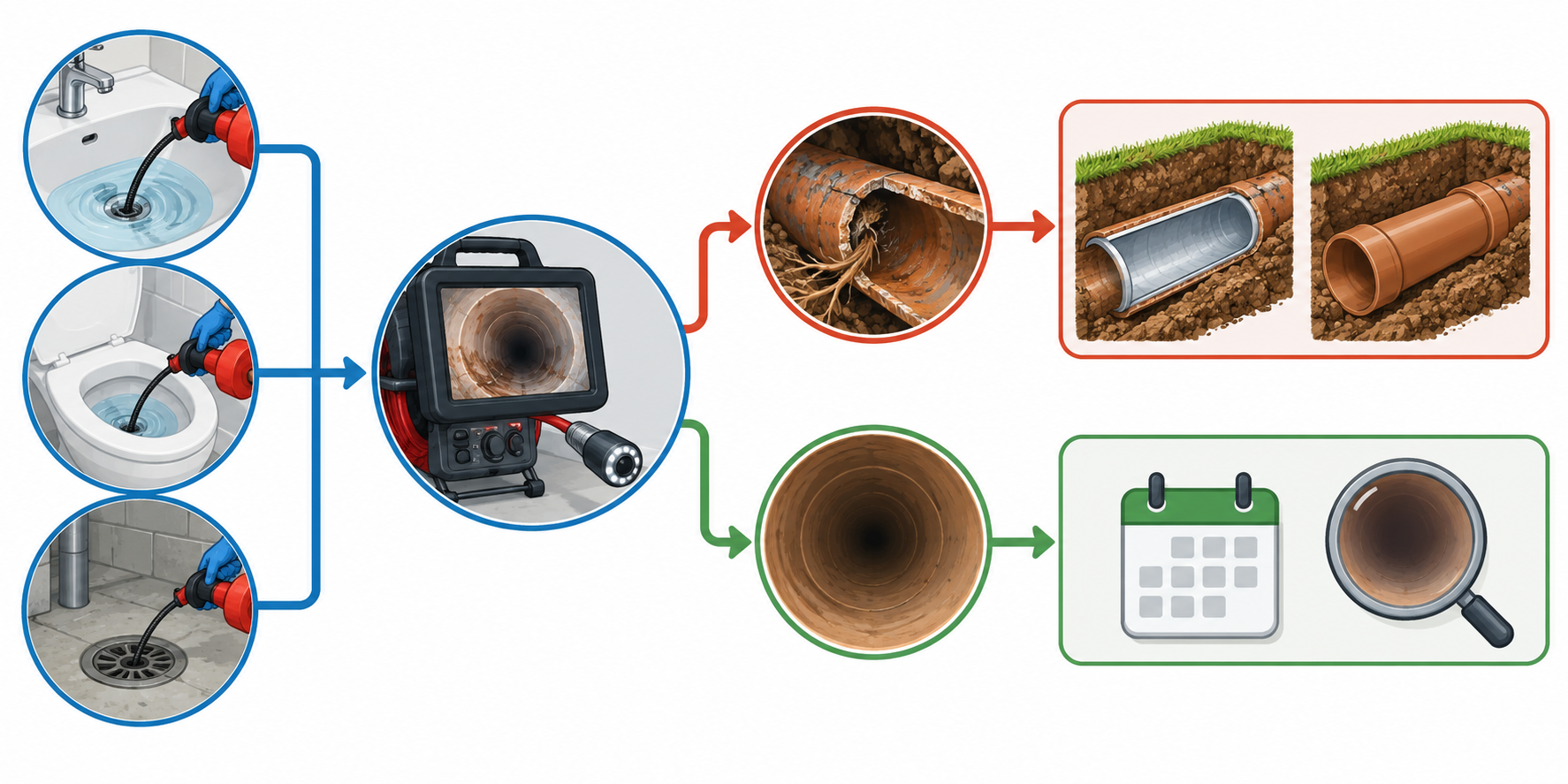
Cleaning plus inspection: This costs more at the next visit but may identify roots, cracks, deposits, offsets, or collapse. It is often the useful middle path when the homeowner is not ready to authorize repair without evidence.
Structural evaluation: A repair, lining, or replacement proposal becomes more credible when inspection shows a localized or distributed defect. Ask for the affected length, method assumptions, access, restoration, and alternatives rather than accepting a total based only on the word “old.”
Do not jump from recurrence to replacement
Repeated clogs do not establish that full replacement is needed. A localized defect may suit spot repair; a cleanable buildup may justify a maintenance plan; distributed deterioration may support rehabilitation or replacement. Seattle’s defect guidance treats severity as a decision variable: minor findings may be monitored, moderate findings may warrant periodic reassessment and planning, and severe defects may require repair. Its suggested intervals are local guidance, not universal rules.
Similarly, a clean camera does not guarantee a permanent result if the inspection was incomplete or the cause lies outside the viewed segment. The decision should reflect evidence quality as well as the visible condition.
Read cleaning and repair quotes together
Ask each contractor to state whether the quote includes access, clearing, camera inspection, locating, repair, permits, excavation, restoration, and emergency timing. A $400 cleaning quote and a $4,000 spot repair are not competing solutions if one restores flow and the other corrects a defect. Compare the likely recurrence exposure and what each price leaves unresolved.
There is no defensible universal break-even number of cleanings. A homeowner with a low-cost accessible line and infrequent events may rationally maintain it. A homeowner facing repeated emergency backups, rising access costs, or damage to finishes may value a defined structural project sooner. Ownership horizon matters, but it cannot make an unsound repair acceptable.
Check the public/private boundary
Private lateral responsibility varies by municipality. In some places, the owner may be responsible only to a property-line boundary; elsewhere responsibility can extend to the public main or under the street. Before paying for an expensive repair near a right-of-way, contact the utility and ask how it investigates the suspected segment.
Do not assume that a blockage under public property is public or private based on location alone. Cause, ownership, local code, easements, and utility policy may all matter. Keep the camera location and cleaning history available for that discussion.
A decision threshold you can actually use
Move from “clean” to “investigate” when the next cleaning would not answer why the problem repeats, when the line has never been documented, or when the service history is approaching the cost of useful inspection. Move from “investigate” to “repair comparison” when the evidence identifies a defect whose location and extent can be described. Move from “repair” to “replacement or rehabilitation comparison” only when the defect pattern, access, method limits, or repeat-work risk supports that broader scope.
That sequence avoids both wasteful repeat calls and premature replacement. The objective is not to predict failure from a symptom. It is to buy the next piece of information or work that most reduces the homeowner’s actual uncertainty.
Separate cause, response, and result
For every prior visit, write three lines: what the contractor thought caused the clog, what service was performed, and how long the result lasted. If the cause was never established, the history is a sequence of responses rather than a diagnosis. If the same location or material recurs, the pattern supports a more targeted inspection. If different fixtures and locations are involved, the problem may need a broader system assessment rather than a single lateral repair.
This record also improves quote fairness. One bidder may recommend another cleaning because the line has remained clear for a long period; another may recommend a repair because roots returned quickly at a measured defect. Put both recommendations against the same history and ask what evidence would prove each assumption.
Read the pattern before choosing the next service
The interval between events is useful, but it is not the only pattern. Note whether each incident affects the same fixtures, occurs after the same weather, involves similar material, or is cleared from the same access point and distance. One branch clog can suggest a different investigation from several fixtures backing up at once. A line that fails only after rain may require a utility conversation or wider drainage assessment as well as a private camera scope.
The price path can also change over time. A first scheduled cleaning may be a limited service. A repeated emergency call adds response cost and disruption; cleaning plus camera work adds a diagnostic expense but may prevent another blind service. If a documented defect is repaired, the follow-up question is whether the problem returned at the same location or shifted to a different segment. Track each outcome rather than totaling invoices without context.
Agree on a trigger for moving from cleaning to investigation
Set a practical threshold with the contractor before approving the next clearing: return within a short interval, roots at the same measured point, inability to pass the camera, or a blockage affecting multiple fixtures could trigger inspection or utility review. The trigger should follow observed conditions, not an arbitrary number of visits or a sales package. If the line clears and stays open, document the result and wait for a meaningful change before buying more work.
When a repair estimate arrives, ask what portion of the recurrence history it addresses and what could still cause another clog. A spot repair might correct one entry point while leaving scale or another weak joint. A broader method may reduce repeat access but could include sound pipe. Compare evidence, retained sections, restoration, and future service exposure; do not infer a full replacement from recurrence alone.
When an incident affects several fixtures at once, record their order and timing and ask whether the suspected restriction is before or after the branches they share. This can help a plumber decide whether to inspect the building drain, an exterior lateral, or more than one segment. The symptom pattern is evidence to investigate, not a substitute for a camera or utility response.
After any structural work, retain the location and final inspection so later recurrence can be compared with the original defect instead of automatically repeating the same repair.