
An old pipe material changes the questions you should ask, but it does not by itself establish failure, remaining life, or the need for replacement. Cast iron, clay, Orangeburg, and other legacy materials can have different joints, deformation risks, connection details, and compatibility with rehabilitation methods. The economic decision still turns on observed condition, extent, location, access, recurrence, and the cost of disturbing sound work.
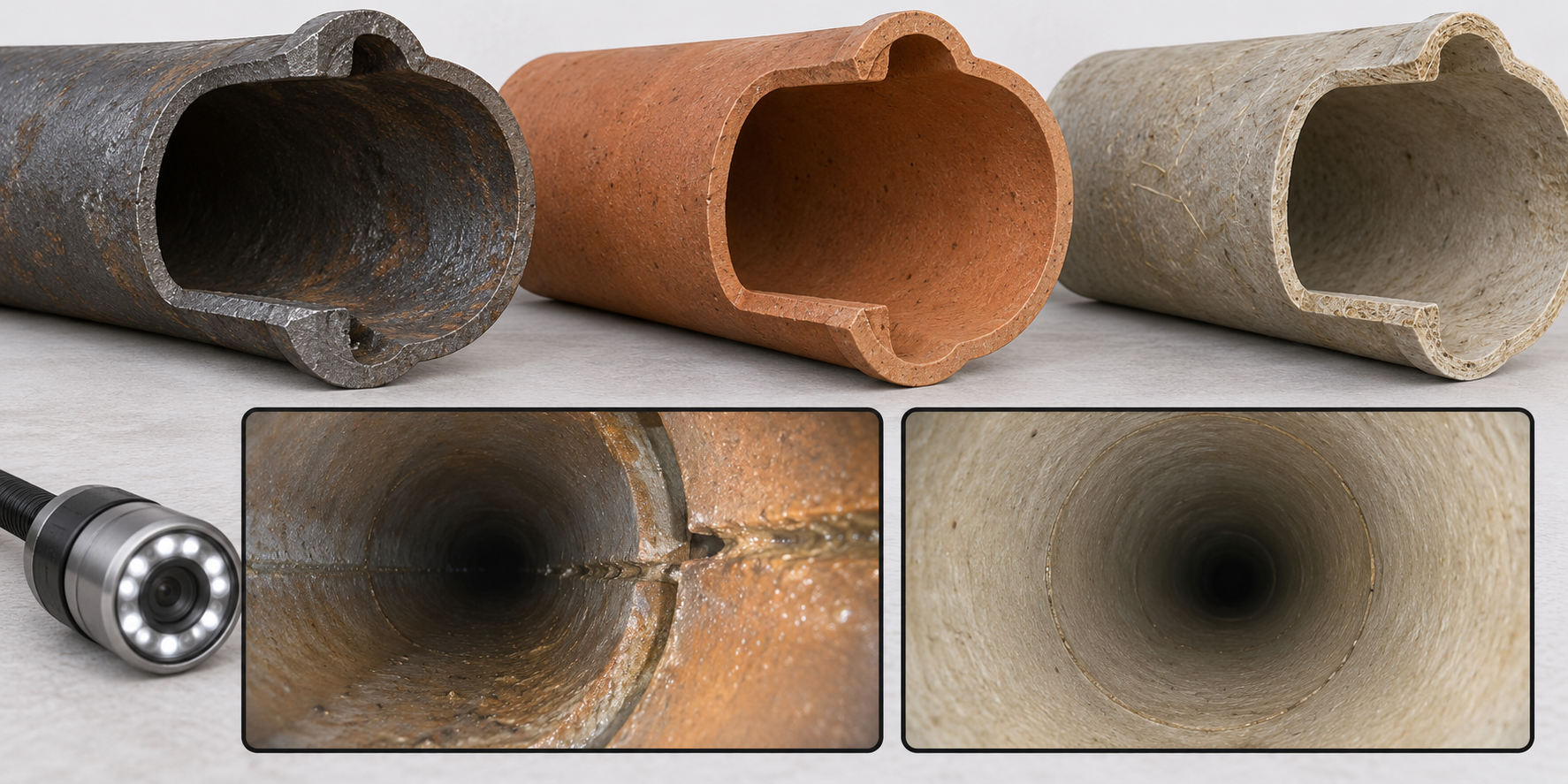
Identify material without treating age as a diagnosis
Material may be inferred from visible sections, records, or a camera image, but a short view can be misleading. Ask for the evidence supporting the identification and whether the report describes cracks, breaks, roots, scale, deformation, offsets, standing water, or collapse. “Old” is useful context; it is not a condition grade.
The EPA describes private laterals as varying in construction and ownership arrangements. That variability is a reminder to define the actual segment before comparing material-based costs. A building drain, exterior lateral, shared sewer, and public connection may use different materials and carry different responsibilities.
What material changes in the quote
Legacy materials can affect how a contractor accesses, cuts, supports, joins, cleans, or abandons a section. A brittle or deformed host pipe may not accept every rehabilitation method. Connections between old and new materials can require specialized fittings and careful scope definition. Disposal, access, and surface restoration can dominate the material difference.
Do not accept a universal service-life number as a substitute for inspection. Soil, installation quality, loading, groundwater, roots, joint condition, corrosion, prior repairs, and use all affect actual performance. The evidence for this category does not support a universal remaining-life table.
Match intervention to condition
Cleaning: May restore flow where the problem is an obstruction and the pipe can safely be cleaned. It does not correct a failed structure.
Spot repair: May fit an isolated break, joint, or localized defect if surrounding pipe is serviceable and access is manageable.
CIPP lining: Creates a liner inside an existing host pipe. Seattle describes it as a resin-soaked tube cured inside the pipe. It requires suitable geometry and condition; it is not a universal answer to collapse, severe deformation, or an alignment problem.
Pipe bursting: Replaces the pipe through access pits in suitable conditions. It follows an existing alignment and is not zero-excavation work. Existing utilities, access, connections, and structural condition affect feasibility.
Open-trench replacement: Exposes the route and replaces a section or run. It creates more surface disturbance but can address conditions that trenchless methods cannot.
The method descriptions explain different economic paths; they do not authorize a homeowner to select a method from material alone.
Scenario bands
Old material, no material defect: A camera shows a serviceable line with no meaningful obstruction or structural finding. Replacement based only on age may destroy useful service. Keep records and ask whether inspection should be repeated only if conditions or symptoms change.
Old material with one defined defect: A localized repair may preserve the rest of the line. Compare its access and restoration cost with lining or replacement of the same run, especially if opening the surface is already required.
Old material with recurring roots or deposits: Cleaning may be a maintenance event, but recurrence should prompt an inspection of the entry path and adjacent condition. Repeated service costs can justify a structural comparison without proving full replacement.
Distributed deterioration or collapse: A broader rehabilitation or replacement scope becomes more credible. Ask what length is affected, what method limitations exist, and how the proposal addresses alignment, connections, and restoration.
Quote normalization
Ask every bidder to state material assumptions, affected length, retained sections, cleaning and camera preparation, access, connection work, permits, restoration, testing, and warranty. A quote for CIPP per linear foot may not include cleaning, access, service reconnections, permits, or restoration. A replacement quote may include excavation but omit hardscape or interior finishes.
The Angi trenchless guide reports illustrative US observations of approximately $135 to $150 per linear foot for pipe lining and $150 to $190 per linear foot for pipe bursting or lining in one 2026 guide, while also reporting broader trenchless ranges. These figures are method- and scope-dependent, not a material price list or Canadian estimate.
Questions after an inspection
- Is material identification certain, and which section was actually viewed?
- Which findings are obstructions and which are structural?
- Are defects isolated or distributed?
- Can the proposed method address the actual geometry and alignment?
- What pipe remains outside the repair or rehabilitation boundary?
- What happens at old-to-new connections?
- Are access, locating, permits, and restoration included?
- What evidence supports replacement instead of monitoring or spot repair?
Material should change the investigation and quote questions, not replace them. The economical choice is the smallest durable intervention supported by the condition evidence and the property’s access and ownership reality.
Compare by material and observed condition
The repair question differs from one material to another, but not in a way that can be answered from age alone. A cast-iron line may show corrosion or deposits that narrow the opening; a camera should distinguish removable scale from damage to the pipe wall. Clay can have separated joints or root entry, but a single root does not show how many joints remain sound. Orangeburg or another legacy material may deform, yet a contractor should identify the observed shape and length rather than price replacement from a name on a record.
These are investigation prompts, not universal failure profiles. Ask for the camera view, approximate location, recurrence history, and any exposed sample or record that supports the material identification. If the line is functioning and no material defect is documented, monitoring or a targeted assessment may be more proportionate than a full replacement. If a defect is clear, price the segment that corrects it and the adjacent pipe that would remain.
Make material-related work visible in the quote
Request separate amounts or allowances for removal and disposal, access, transition fittings, connections to retained pipe, cleaning and inspection, permits, backfill, and surface restoration. Ask how the contractor handles a transition that is more deteriorated than expected and whether the repair can be stopped at a defined approval point. A bid that says “replace old pipe” may omit the connection work that makes the new section functional.
Material can also affect whether a proposed method remains feasible after access. A liner depends on host-pipe condition and geometry; bursting depends on the route and utility clearances; open excavation may expose a longer section but carry more restoration. Price the suitable alternatives for the same defect and endpoint. Avoid comparing an isolated spot repair with a full-line replacement without accounting for the different pipe left in service.
Preserve useful records for the next decision
Keep inspection video, route and depth information, repairs, invoices, material identification, and any warranty for the work performed. A later contractor can compare changes in the same segment rather than repeat a generic age-based assessment. If only part of an old line was replaced, record the transition point and the condition of retained pipe. That evidence makes future repair, sale, and maintenance decisions more specific without promising a remaining service life that the available evidence cannot establish.
Do not compare material quotes in isolation
An old-pipe quote should be normalized by condition and access. A cast-iron section exposed in a basement, a clay lateral under a driveway, and a deformed legacy line beneath a public road may have different economics even if each is described as “replacement.” Ask for the same endpoints, retained pipe, connection treatment, restoration, and evidence of method suitability.
If a contractor proposes a material upgrade, separate the required correction from optional capacity or modernization work. A new material may be a sensible choice for the replacement section, but it does not make adjacent pipe fail automatically. The useful decision is how much work the condition supports and what future access remains.
When a material finding is not enough
If the report identifies only material and age, request condition evidence before accepting replacement. If it identifies a measured defect, ask whether spot repair, rehabilitation, or replacement addresses the surrounding pipe and the access that would otherwise be repeated. A material change can justify different connection and labor assumptions without justifying a larger project boundary.
For a material-based bid, ask whether the quote includes adapting new pipe to retained older sections and documenting those transitions. If another contractor recommends a different method, compare the actual defect, host condition, route, and retained length rather than assuming the disagreement is about material alone.
For example, a visible crack in a short clay section may support a localized scope if adjacent joints are viewed and serviceable; roots at many joints may call for a broader assessment. A deformed older pipe may constrain lining even when surface disruption matters. These examples describe questions to verify, not automatic material-to-method rules.
Use the report’s observations, not a material label alone, to explain the price difference between proposals.
Separate replacement from optional modernization
If a contractor proposes a larger diameter, reroute, cleanout, or material upgrade while the line is open, ask which items are required to correct the observed defect and which are elective improvements. Price them separately and confirm compatibility with the retained pipe. A modernization choice may have value, but it should not be hidden inside a condition-based repair total.