
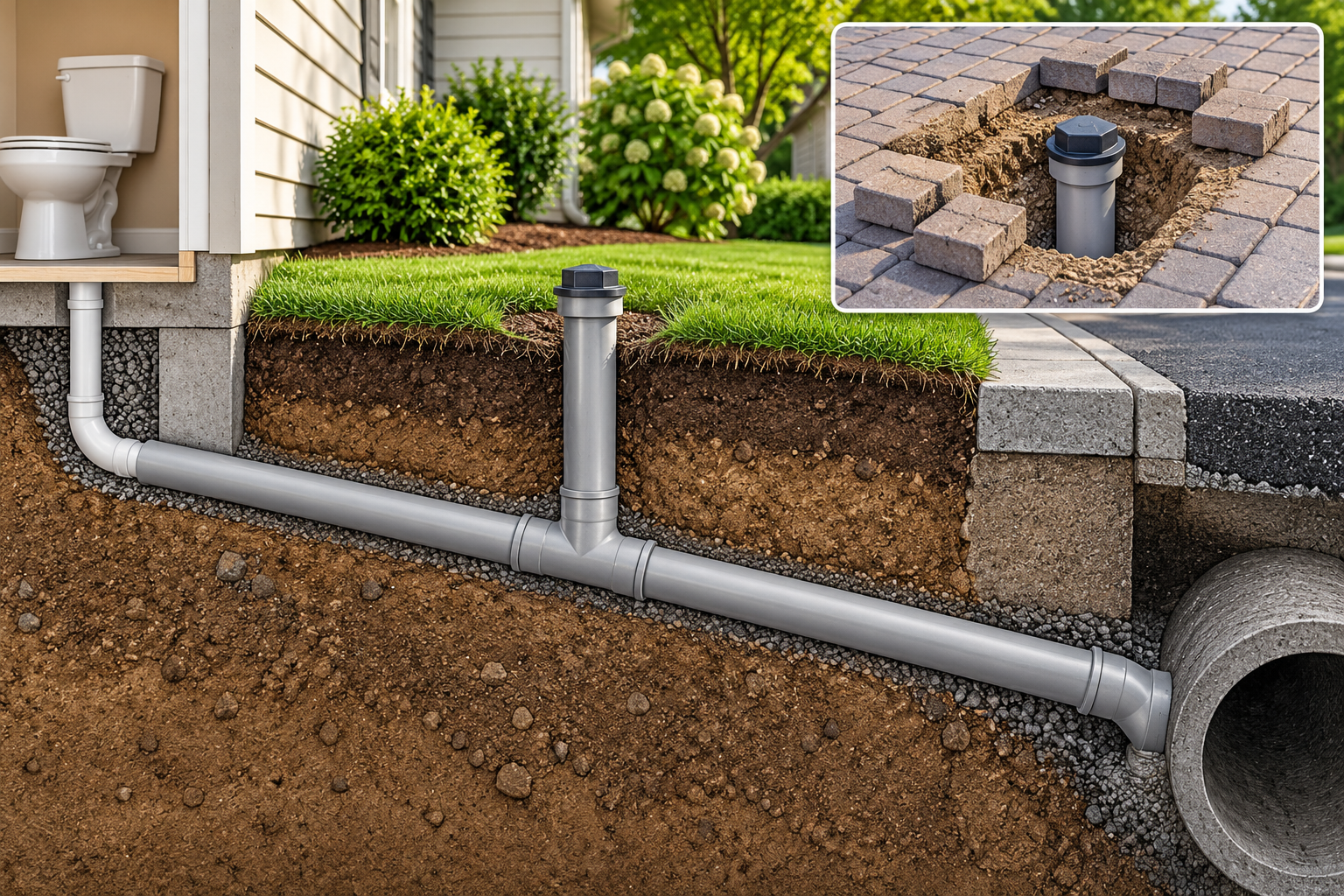
A sewer cleanout is an access point that allows future cleaning or camera inspection without searching for an entry through a fixture, finished floor, or excavation. The evidence for this category does not establish a reliable standalone national cleanout-installation price. The practical budget is best modeled as access discovery plus excavation or opening work, pipe and fitting work, permits or inspection where required, surface restoration, and future service value.
Why homeowners add one
A cleanout can make a recurring service easier to reach and can give a camera a defined starting point. It may be installed when an existing access point is missing, buried, damaged, too far from the blockage, or poorly located for the route. A new cleanout does not repair a defective line or guarantee that every future obstruction will be reachable.
The value is highest where service access is currently causing repeated labor, damage to finishes, or delays during a backup. If the line is already open for a planned repair, adding a suitable access point may be less disruptive than returning later. The contractor should explain why the proposed location serves the relevant building drain or lateral.
What determines the project cost
Finding the pipe: If the route and depth are unknown, locating may be required before excavation. A camera with electronic locating may provide better evidence than opening a random point, but locating is often a separate service.
Depth and surface: A shallow accessible area is a different project from a cleanout under concrete, paving, finished flooring, landscaping, or a narrow side yard. Restoration can equal or exceed the visible plumbing work.
Pipe condition: Cutting into an old or damaged line can reveal that the cleanout cannot be added without replacing a section, correcting a connection, or addressing a larger defect. Ask for a unit price or approval point for concealed conditions.
Configuration and local rules: The required location, direction, fittings, access chamber, inspection, and permit vary by plumbing arrangement and jurisdiction. Do not rely on a generic diagram or assume that one municipal rule applies elsewhere.
Scenario bands
Replace an exposed damaged cleanout: The access point is visible and the surrounding pipe is serviceable. The work may be a focused plumbing repair with little restoration.
Add a cleanout in an accessible yard: The route is known, excavation is limited, and the surface is inexpensive to reinstate. This is more predictable but still requires confirmation of pipe depth and configuration.
Add access through a hard surface or finished area: The fitting may be modest; cutting, protection, excavation, backfill, concrete, paving, or interior finish restoration drives the total.
Open the line and discover deterioration: The cleanout becomes part of a repair or replacement scope. Compare the cost of adding access alone with correcting the defect while the area is open.
Future economics
An accessible cleanout can reduce the setup burden of future snaking, hydro jetting, or camera work. That does not mean it pays back on a fixed schedule. Estimate value from your actual history: prior access charges, finish damage, repeated emergency work, and the likelihood that the line will need inspection or cleaning again.
If a line has never caused trouble and access is easy through another suitable point, a new cleanout may be a convenience rather than a priority. If recurring clogs require opening surfaces or searching for an entry each time, the same installation may be a sensible risk-reduction project.
Quote questions
- Where is the proposed cleanout relative to the house, lateral, and likely defect?
- How will route and depth be confirmed before opening the surface?
- Is this replacement of an existing point or a new access point?
- Does the price include excavation, pipe, fittings, backfill, inspection, and restoration?
- What happens if the exposed pipe is cracked, offset, or too deteriorated to connect?
- Will the cleanout support the intended camera, snaking, or jetting equipment?
- Are permits or utility notifications required locally?
- Is future access protected from landscaping, paving, or construction?
Cleanout versus full repair
Installing access is often a prerequisite to understanding the line, not a substitute for understanding it. If a contractor recommends a cleanout because repeated clogs cannot be investigated, ask whether the price includes a follow-up camera inspection and what decisions that inspection will enable. If a known structural defect is nearby, compare cleanout installation with repairing the defect during the same excavation.
The most defensible budget separates the access improvement from possible pipe repair and surface restoration. It tells you what you are buying today, what the new access may make cheaper later, and what unknown condition could change the project.
New cleanout or replace the line section?
If the proposed cleanout is near a known defect, compare two scopes: install access and leave the defect for later, or repair the defect while the surface is open. The second option is not automatically better; it should be supported by camera evidence and a defined repair boundary. If the line is sound, access alone may be the more proportionate project.
If a cleanout is being installed because the line cannot be inspected, ask whether the follow-up camera service is included and whether the new access will reach the entire decision-relevant segment. A point that serves one branch may not help diagnose a downstream lateral. Clarify the direction of access and what a future contractor can reasonably use.
Include the cleanout’s future protection in the surface plan. Paving, landscaping, decks, or later construction can bury or block the very access the homeowner paid to create. Record its location, photograph it before covering, and retain the contractor’s final description with the property records.
Measure value by the next service
Ask the contractor to explain which future services the new access supports and which still require another point. A cleanout may reduce the labor of a camera, snaking, or jetting visit, but it does not guarantee that equipment can reach a downstream defect or pass a collapse. If the line is shared or crosses a public boundary, access alone does not resolve responsibility.
The most useful installation record names the pipe segment, direction, approximate location, surface depth, and any limitations. That record can reduce future locating cost and improve quotes, particularly when another contractor—not the installer—handles the next service.
New installation, replacement, and repair are different scopes
Replacing a damaged exposed cap or riser can be a small plumbing task if the surrounding pipe and access are sound. Adding a new cleanout to an existing line may require locating, excavation, cutting into the pipe, fittings, a riser or access chamber, inspection, and surface restoration. If the pipe is deteriorated where access is proposed, the contractor may need to replace a section rather than simply add a fitting. Ask the quote to separate those possibilities.
When a repair is already planned, a cleanout can sometimes be added while the area is open. Compare the incremental labor and fittings with the cost of a later excavation, but make sure the new point serves a segment that needs future access. A cleanout installed on the wrong branch or at a location equipment cannot reach may not reduce the future service burden. Request a simple drawing showing the route, intended direction, and reachable portion.
Include the surface and future access in the project
The final cost may involve more than opening the ground once. Ask who removes and reinstalls sod, pavers, concrete, flooring, or landscaping; whether the finish is temporary or final; and whether settlement or matching is included. A low plumbing quote with restoration excluded should be compared with the full reinstatement cost. If the cleanout lies in a driveway or finished area, ask whether an accessible cover or chamber is part of the bid and how it will remain usable.
Future benefit depends on whether the access stays known and clear. Have the installer photograph the point before covering, record its location and depth, and explain which camera or clearing equipment can use it. Keep that note with property records and avoid placing permanent features over the cover. A cleanout can reduce discovery and setup work, but it cannot make an unserviceable or collapsed downstream section passable.
Decide whether access is the next best purchase
If the line is blocked and the cause is unknown, a camera or locate may be needed before deciding where a cleanout belongs. If the pipe is already exposed during replacement, adding a cleanout may cost less than returning later, but only if local configuration rules and the contractor support the location. If an existing access point works, a new one may add little value. Tie the decision to a specific future task—camera inspection, snaking, jetting, or reaching a known segment—and price that service with and without the new access where possible.
Before closing the project, record the access point’s location and keep it clear of landscaping or later construction. This protects the value of the installation and can reduce future search work.
Photographs and a measured location are useful to a contractor who did not install it.