
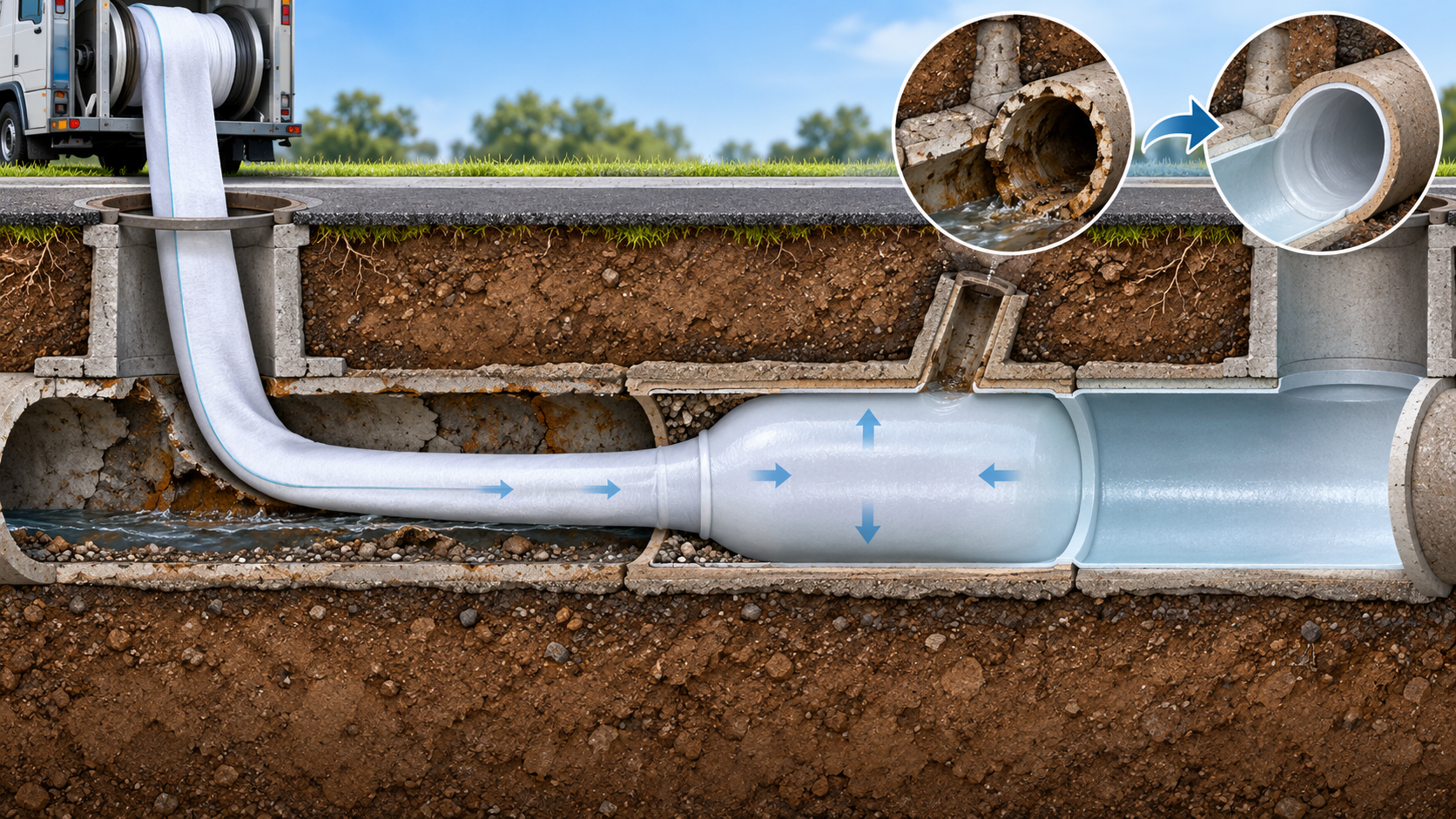
Cured-in-place pipe lining, or CIPP, rehabilitates an existing sewer by placing a resin-soaked tube inside the host pipe and curing it in place. It can reduce surface disturbance compared with open excavation when the existing line is suitable. It is not a universal no-dig replacement, and a lining quote is only comparable when preparation, connections, access, inspection, permits, and restoration are visible.
Approximate market context
Angi reports illustrative 2026 US observations of roughly $135 to $150 per linear foot for pipe lining in one guide and broader trenchless project ranges of about $1,900 to $6,000. Those figures are not a universal CIPP rate: source methodology, length, access, cleaning, connections, and restoration differ. No dependable Canadian market range was established, so Canadian homeowners should obtain local CAD quotes.
Two contractor-published Canadian examples add context without establishing a market rate. OCM Excavation’s Greater Toronto Area table lists CAD $9,000–$18,000 for CIPP lining with no taps along the run. HYDROPRO’s Vancouver guide displays $4,000–$12,000, depending on length, but does not state a currency code or provide a normalized project scope. The two ranges should not be averaged or read as the same installation. Confirm length, connection treatment, preparation, access, permits, restoration, and currency with the bidder.
What the process changes economically
The liner uses the existing route and host pipe. That can reduce the amount of surface opened, but it does not eliminate access. A contractor may need to clean the line, inspect it, expose or prepare access points, manage service connections, and verify the finished liner. A property with an accessible cleanout and limited restoration has a different total from one requiring excavation or a new access point.
The host pipe must be suitable for the method. A proposal should address geometry, alignment, collapse, deformation, deposits, groundwater or infiltration concerns, connection locations, and the part of the line not being lined. Do not accept “trenchless” as a substitute for a condition assessment.
Cost layers to request
| Layer | What to clarify |
|---|---|
| Preparation | Cleaning, root or scale removal, and whether another method is needed |
| Inspection | Pre-work camera, measured length, findings, and post-work verification |
| Access | Cleanouts, openings, excavation, and restoration of access points |
| Liner | Product, installed length, connection treatment, and retained sections |
| Administration | Permits, inspection, public or right-of-way requirements |
| Restoration | Hardscape, landscape, interior, or temporary surface work |
An apparently low per-foot price can omit several of these layers.
Permits, acceptance, and temporary service can affect the scope
Portland’s ENB-4.33 rule applies to certain privately maintained pipe in the public right-of-way or a public sewer easement; it is not a general CIPP standard. For work under that rule, the contractor must meet City review and permit requirements, document pre- and post-lining CCTV, submit a dimensioned as-built, and provide photos of required locate markers. If the seal or final liner does not meet the City’s criteria, additional surface excavation or even liner removal and open-trench replacement may be required. Ask whether approval, both recordings, the final drawing, marker installation, permit close-out, and a fallback method are priced. The rule publishes no private-lateral market price.
Portland’s municipal CIPP page also says households on some City sewer projects may need to limit water and sewer use for one to several hours, with 24–48 hours’ notice when needed. That is a municipal-project example, not a universal private repair outage rule. Ask your contractor whether a private job requires a bypass, temporary service limit, or separate coordination.
When lining may fit
Lining may be worth comparing when deterioration extends along a compatible host pipe, the route is difficult to excavate, surface restoration would be expensive, and the line’s geometry and connections can be accommodated. It can be attractive when the owner wants to reduce disruption and the pipe does not require correction of a major collapse, bad slope, or incompatible alignment.
The project is not necessarily appropriate because the homeowner wants to avoid digging. Seattle identifies CIPP as one repair-method family among spot repair, open cut, and pipe bursting. The method must match the observed condition, not merely the surface preference.
When it may not solve the problem
Lining does not automatically correct a severely collapsed or deformed host pipe, a persistent alignment problem, or every connection defect. It may reduce internal diameter and may require special treatment at lateral connections. The exact suitability is a contractor and local technical question.
Ask what happens if the camera reveals an unsuitable section or the liner cannot pass. A fixed price should identify the boundary of that risk. If the response is an open-ended change order, request a staged investigation or unit-price schedule.
Compare lining with replacement
Lining can trade lower surface disturbance for specialized preparation and a host-pipe limitation. Pipe bursting replaces the route through access pits but needs suitable alignment and clearances. Open trench exposes more of the route and may address conditions that trenchless methods cannot, while creating more restoration.
Compare complete totals, not liner rate versus replacement pipe rate. Include cleaning, inspection, access, connection work, permits, traffic, restoration, service interruption, warranty, and the portion of old pipe retained. A higher total may buy a broader correction; a lower total may leave the costly access or surface work out.
Scenario bands
Accessible compatible line: Preparation is straightforward, the liner length is known, connections are manageable, and restoration is limited. This is the most predictable lining case.
Long deteriorated route under a driveway: Lining may reduce surface removal, but access points and connection work remain. Compare its total with bursting and open cut, including the value of avoiding or reducing driveway restoration.
Collapse or poor slope: A lining-only quote deserves scrutiny because it may not correct the controlling defect. Obtain a method assessment and ask whether replacement is required for function.
Questions for a lining quote
- What camera findings establish host-pipe suitability?
- What cleaning and preparation are included?
- What access points and surface openings are required?
- How are service connections treated?
- What length is lined and what remains outside it?
- Is electronic locating, permit, inspection, and restoration included?
- What evidence will verify the finished result?
- What conditions trigger a different method and require approval?
Lining is a potentially valuable rehabilitation choice when it fits the pipe and the homeowner’s access economics. The goal is not the least excavation at any cost; it is a complete method whose price, limitations, and retained risk are understood.
Price the preparation before the liner
The liner length is only one part of the proposal. Ask whether root cutting, descaling, cleaning, bypass pumping or flow management, camera documentation, locating, access-point preparation, and treatment of service connections are included. If the line is too blocked or deformed to accept the equipment, identify the price and approval point for cleaning or another method. The cost of that preparation can change whether a per-foot liner amount is useful for comparing complete projects.
Ask how the contractor will confirm the liner’s start and end points, deal with branches or taps, and document the finished result. If a connection is excluded or left untreated, the owner should know whether a later opening or another repair is expected. A quote should also identify any surface work at access points, permit and inspection charges, and what happens if the host pipe is found unsuitable after preparation.
Compare one defined defect pattern at a time
A short defect at one joint does not necessarily justify lining a long route; conversely, several connected defects may make a sequence of spot repairs less coherent. Use the camera report to mark the proposed liner length and the condition at both ends. Ask whether roots, cracks, offsets, standing water, or a collapse are within that length and which condition the liner is expected to correct.
For a straight, compatible run beneath an expensive driveway, the avoided surface work may make a liner worth comparing. In an open yard, direct replacement could have similar access economics while offering a different scope. Where the line has poor grade or severe collapse, the lower-disruption label should not outweigh a method limitation. Obtain a fallback price for the condition that would force a change before the contractor starts.
Separate warranty from future pipe risk
Ask who backs the liner warranty, what it covers, how long it lasts, and whether the warranty depends on inspection, maintenance, or access. The promise may address the installed liner or workmanship but does not automatically cover branches, connections, upstream drains, public pipe, or a separate future cause of backup. Retain the camera record and final connection map with the warranty.
The ownership comparison should include the liner’s initial project, any excluded restoration, expected maintenance, and the condition left outside its boundaries. Do not assign a universal service life from a quote. Ask the contractor what evidence supports the proposed length and what result would require open repair or replacement instead.
When the lining premium is rational
The premium is easier to justify when open excavation would disturb an expensive surface, the host pipe is compatible, the lined length is well documented, and connection and access work are included. It is harder to justify when the route has bad grade, severe collapse, unknown branches, or a restoration project that would happen anyway. Ask the contractor to price the fallback before the work begins.
If the source of the failure is unclear, pay for a condition report before approving a liner length. That keeps preparation spending attached to a decision and helps distinguish a complete rehabilitation proposal from a per-foot headline.
The final comparison should state which taps and branches remain functional, what portion of the host pipe was lined, and whether any weak area remains outside the liner. A line that flows after work does not by itself document the rehabilitation boundary.
Ask whether the contractor will provide that boundary in the completion record and how it relates to the original camera distance markers.
Ask whether the written warranty depends on a complete pre-work inspection, the installed length, or ongoing maintenance, and keep those conditions with the final liner map. A warranty on the installed liner does not automatically cover an unlined connection or retained upstream pipe. The homeowner can then compare the promise with the portion actually rehabilitated.