
A spot repair corrects a defined section of damaged sewer rather than replacing the complete run. The evidence does not establish a reliable standalone national price for this narrow project. Model the cost as diagnosis and locating, access or excavation, pipe and connection work, testing, permits where required, and surface restoration. A short repair can still be expensive when the defect is deep or under a driveway.
For local context, OCM Excavation publishes a CAD $3,500–$7,500 Greater Toronto Area range for a single-pit repair of one joint or cracked section. HYDROPRO’s Vancouver guide displays $2,000–$6,000 for a spot repair or patch, without stating the currency code or fully defining the project boundary. Both are single-provider observations without an auditable quote sample. They are not directly comparable or representative local averages; confirm the actual defect, access, included restoration, currency, and repair length in a current written quote.
What qualifies as a spot repair
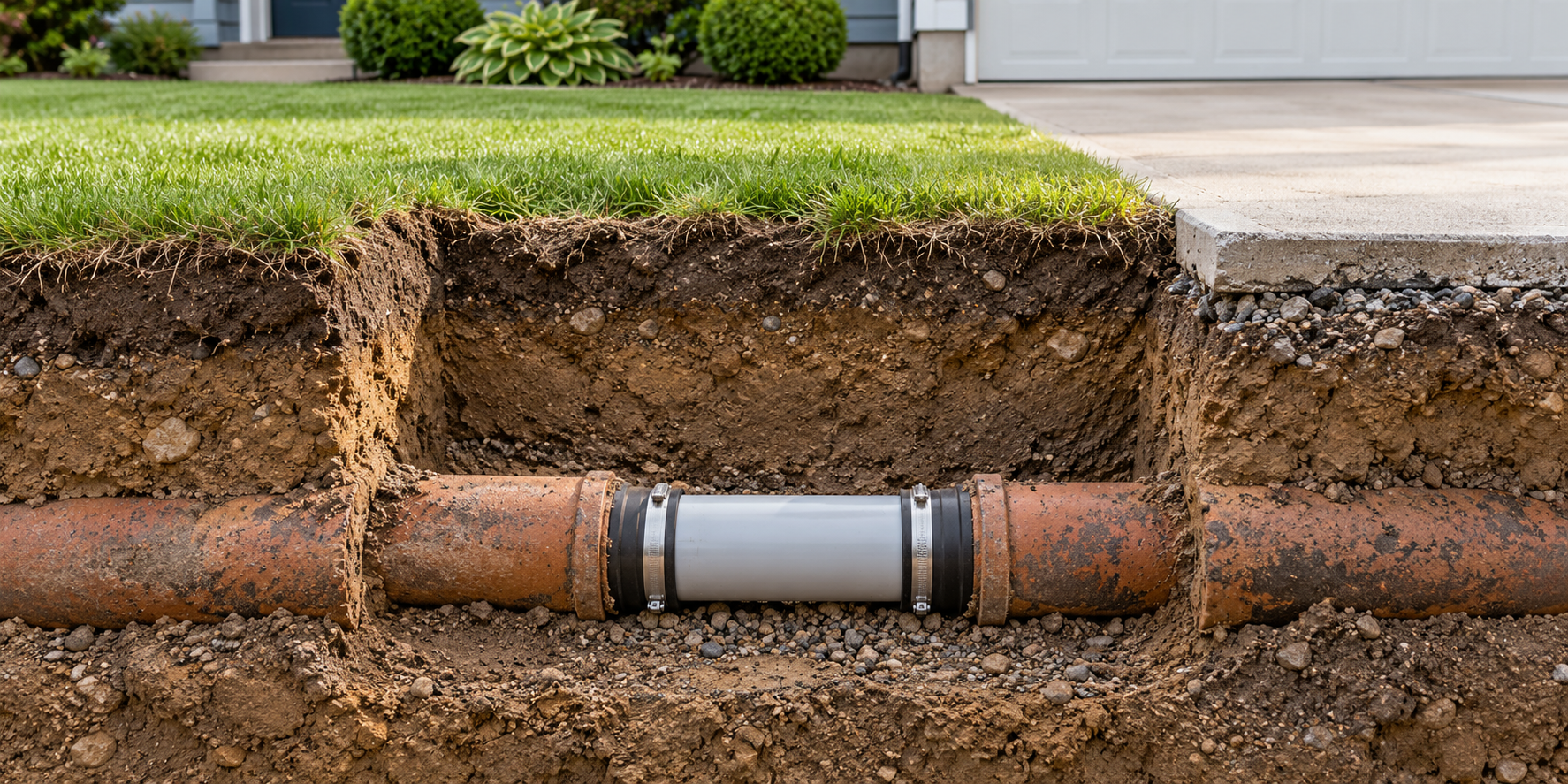
Seattle Public Utilities describes spot repair as localized replacement at a specific defect, with examples including offsets, collapse, and roots. The concept is useful, but it does not mean every camera finding is eligible. The contractor should show that the defect is bounded and that adjacent pipe is serviceable enough to retain.
Cleaning a root or opening a blockage is not spot repair. A short length of new pipe, a connection repair, or another structural correction is the relevant scope. Ask whether the proposed work addresses the entry mechanism, alignment, leakage, and flow—not just the visible obstruction.
The cost structure
| Component | Lower-cost case | Expansion risk |
|---|---|---|
| Diagnosis | Clear camera finding and location | Incomplete view or uncertain surface position |
| Access | Shallow open soil or existing access | Concrete, pavement, depth, narrow access |
| Pipe work | One defined section and simple connections | Multiple defects or difficult old-to-new transitions |
| Restoration | Lawn or limited patch | Driveway, patio, landscaping, wall, or interior finish |
| Administration | Ordinary private work | Permit, inspection, public road, utility or easement coordination |
The pipe may be a small portion of the total. Ask for separate prices or allowances for each layer.
Scenario comparison
One visible break in an accessible yard: A spot repair may be the smallest durable option if the camera shows serviceable pipe on both sides. Request follow-up documentation and a statement of retained pipe.
Root entry at one joint: Root cutting can restore flow immediately, but the structural question is whether the joint can be corrected. A spot repair may reduce recurrence; repeated cleaning without addressing the joint may be poor value.
One defect under hardscape: The plumbing scope may be localized while excavation and restoration are not. Compare spot repair with a longer method if opening the same surface would otherwise be repeated.
Several findings in one route: Calling each one a “spot” can hide distributed deterioration. Ask whether the quote is truly correcting a single defect or beginning a series of mobilizations.
When it is not enough
Spot repair is weaker when the camera cannot pass the defect, the surrounding pipe is uninspected, several repairs already exist, the line has repeated backups, or the defect reflects a broader slope or alignment issue. In those cases, a longer replacement or rehabilitation assessment may be more coherent.
That does not mean a full replacement is automatically justified. It means the homeowner should not compare a certain small price with an unsupported large price. Obtain the evidence and ask what the proposed scope leaves unresolved.
Follow-up and warranty questions
Ask whether the post-repair inspection is included, whether the connection is tested, and what warranty applies to the repaired section versus retained pipe. A camera may show that the repair is open and aligned, but it does not create a universal warranty or prove every surrounding condition.
Clarify whether restoration is temporary or final and who handles soil, pavement, plantings, fences, floors, or walls. If the area is already open for another project, coordinate only when the scopes and responsibilities remain visible.
Compare with lining or replacement
Lining rehabilitates an existing host pipe and may suit a longer defect pattern where geometry and condition allow. Replacement removes and renews a defined route. Spot repair preserves more original material but may leave weak sections. Compare total installed cost, access, disruption, service connections, repeat-work risk, and the life of retained pipe rather than the initial plumbing line item.
Quote checklist
- camera evidence and exact location;
- affected length and retained pipe;
- access and excavation assumptions;
- pipe material and connections;
- permits and inspection;
- backfill and surface restoration;
- post-repair inspection and documentation;
- contingency trigger and homeowner approval;
- warranty boundaries.
The right question is not whether spot repair is cheaper in the abstract. It is whether one localized intervention corrects the demonstrated failure without leaving the homeowner to pay for the same access and disruption again.
Surface and future-access economics
The restoration surface can change the choice even when the pipe defect is small. A spot opening through lawn may be easy to close; the same opening through a driveway, finished slab, patio, or public pavement may require specialist restoration, curing time, permits, or traffic control. Ask for the surface standard and schedule, not merely the word “restore.”
If a larger repair or rehabilitation would use the same access, compare the avoided future mobilization with the extra pipe being corrected. Include the portion of line that would remain uninspected and the cost of reaching it later. This is a lifecycle comparison, not an argument for replacing every nearby section.
For an emergency spot repair, separate temporary stabilization from the permanent repair and document any condition that could expand the work. A clear approval threshold protects the homeowner while allowing the contractor to respond to what is exposed.
Define how much pipe is part of the repair
A “spot” label should be translated into a measured length or a specific joint, break, or connection. Ask how far the excavation will extend, which fittings or transitions are included, whether the repair covers the full defect, and what footage remains uninspected. A one-pit price in a provider’s table cannot tell you whether a deep defect under concrete, a leaking connection, or a collapse at the edge of the opening fits that offer.
The two local examples above are not a universal range: OCM’s GTA figure describes one pit and one joint or crack, while HYDROPRO’s Vancouver page does not state the currency or detailed work boundary. A quote for a localized opening should therefore specify pipe length, depth assumptions, access, connection work, backfill, inspection, permit, and restoration. If the contractor cannot estimate the repair boundary before opening the ground, ask for an initial investigation price and approval threshold.
Compare access options before the surface is opened
When a spot defect is beneath a high-cost surface, compare the complete opening-and-restoration project with a suitable longer rehabilitation or replacement option. The larger scope may use existing pits or avoid a second mobilization, but it also adds pipe that may not be defective. Include the surface area each method would disturb and whether the same restoration is required under either option.
If another planned project will open that surface, coordination could reduce duplicate disruption, but it does not make extra sewer work necessary. Keep pipe scope and unrelated landscaping or driveway replacement separate. The best comparison shows the additional cost of treating more pipe, the evidence that supports it, and the uncertainty that remains outside both scopes.
Document the repair for future owners and bidders
Ask for before-and-after images, the repaired location relative to the access point, the length and material replaced, the connection details, and any inspection or permit record. The warranty should say whether it covers workmanship at the repaired section, materials, or another defined item and how long it applies. It should not be assumed to cover retained pipe or a separate future blockage.
This record helps determine whether later symptoms are a recurrence of the same defect or a new issue elsewhere. If a spot repair is followed by a clog, use the camera evidence and service history before authorizing a second opening. Without that record, each bidder may price a different presumed failure and the apparent price spread will be misleading.
For two comparable quotes, require the same defect, repair length, access point, surface standard, and post-work inspection. Ask each provider to list exclusions and a change-order rate for exposed conditions. The total cost is clearer when the homeowner can see what is fixed, what is conditional, and which adjacent pipe remains.
Decide whether a nearby defect belongs in the same project
If inspection shows another weak joint close to the proposed opening, ask for two totals: the single documented repair and a broader scope that includes both conditions. The contractor should identify what evidence supports the second repair, how much additional pipe and surface area it adds, and whether one access point can serve both. This comparison may show that the extra work is efficient while the ground is open, or that sound pipe should be retained. Do not treat proximity as proof that defects share the same cause.
If a homeowner chooses the narrow repair, request the report and location for the untreated finding and a clear trigger for reassessment. That preserves a defensible maintenance choice without hiding known risk. If the adjacent area was not inspected, label it unknown rather than pricing it as a confirmed failure.