
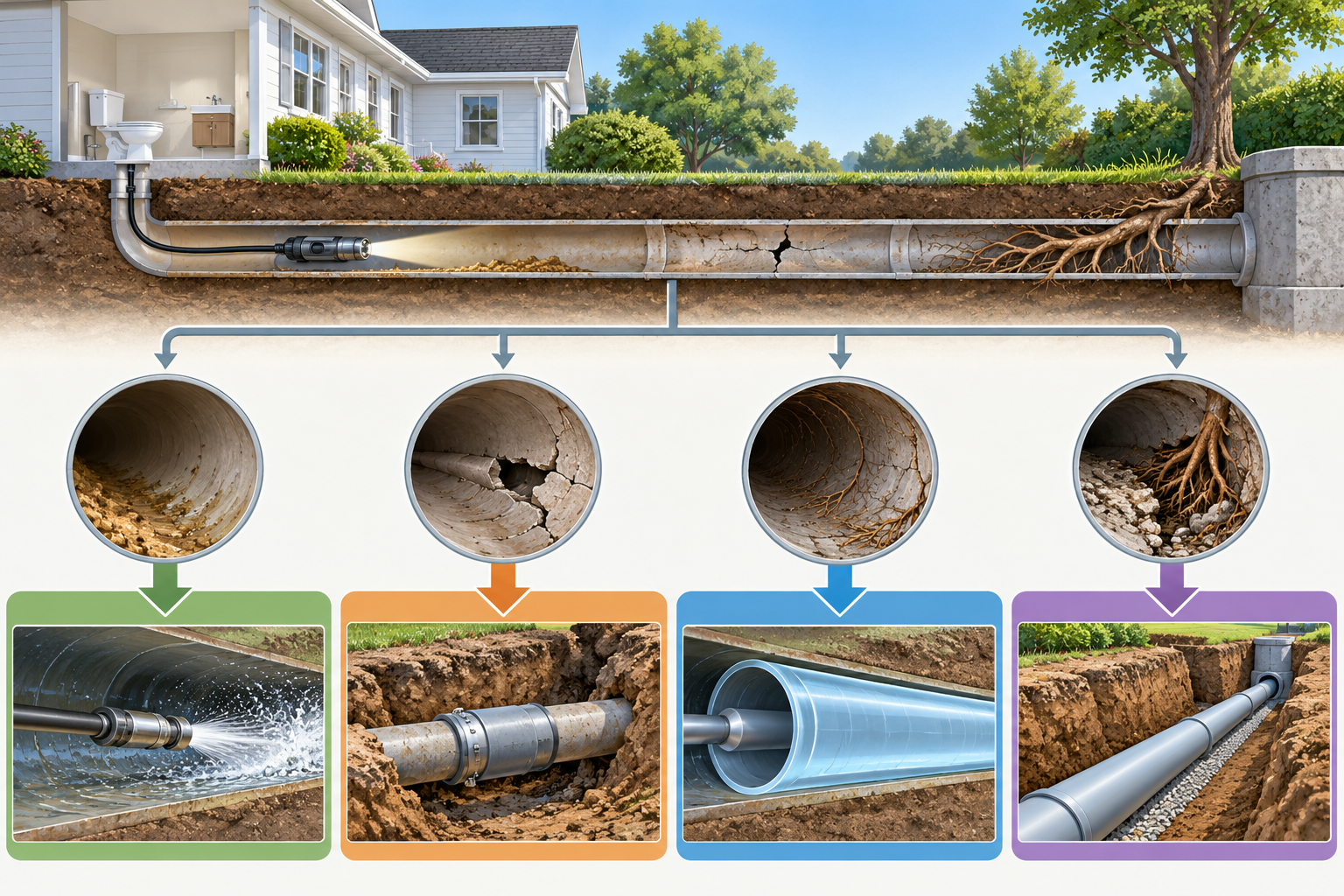
The choice is rarely just repair versus replacement. A homeowner may choose continued cleaning, localized repair, rehabilitation such as CIPP lining, or full replacement. The right option depends on the evidence about condition, the cost and disruption of access, the recurrence history, the uncertainty beyond the inspected area, and how long the owner expects to keep the property. There is no universal age, dollar threshold, or percentage of damage that decides every line.
Four decision states
Maintain: Cleaning or observation can be rational when the line is functioning, the finding is limited or uncertain, and repeat costs are acceptable.
Repair: A spot repair or limited replacement fits a localized defect with serviceable surrounding pipe and manageable access.
Rehabilitate: Lining or another rehabilitation method addresses a longer host-pipe condition when geometry, access, connections, and structural suitability support it.
Replace: Full replacement is more credible when deterioration is distributed, collapse or alignment makes rehabilitation unsuitable, the same access would be repeated, or the retained line creates unacceptable risk.
These are economic categories, not a remote diagnosis. The EPA describes condition assessment as a process that informs maintenance, rehabilitation, or replacement rather than prescribing one response from one image.
Evidence to collect
Before comparing bids, obtain the camera video, written findings, access point, distance markers, approximate route, and portions not viewed. Record cleaning history, recurrence interval, roots, backups, and previous repairs. Ask whether the report distinguishes obstruction from structural defect and whether severity or extent was actually assessed.
The quality of the evidence changes the confidence of the decision. A full view of a short line with a clearly localized defect supports a bounded quote. A blocked line that the camera could not traverse supports an investigation allowance, not a precise full-replacement conclusion.
The cost of recurrence
Add more than invoices. Include emergency premiums, access damage, disruption, cleanup after backups, time away from the property, and the risk that a failure occurs at an inconvenient season. A low-cost cleaning can remain rational if events are infrequent and the line is otherwise serviceable. Repeated work can become poor value when the same defect returns or each visit requires harder access.
Do not invent a break-even number. Instead compare a defined maintenance path with an inspection and a structural option over the ownership horizon. Make assumptions visible: expected recurrence, service accessibility, financing or cash constraints, planned landscaping, and the condition of retained pipe.
When localized repair is strong
Localized repair is attractive when inspection identifies one crack, break, offset, or root-entry defect; the line on each side is in acceptable condition; and access and restoration are reasonable. It preserves sound pipe and may avoid a larger surface project. Ask whether the repair corrects the cause or only creates another access point.
It becomes weaker when camera findings are distributed, the pipe cannot be viewed beyond the proposed limit, several prior repairs exist, or the route has a recurring alignment problem. A low spot-repair price may be misleading if another opening will likely be needed soon.
When rehabilitation may fit
Seattle describes CIPP lining as a resin-soaked tube cured inside the existing pipe. A liner can reduce surface disturbance compared with open excavation where the host pipe, alignment, access, service connections, and local requirements are compatible. It is not a universal no-dig solution and should not be treated as equivalent to replacing every condition outside the liner.
Ask what preparation, cleaning, connection treatment, access, inspection, and restoration are included. Confirm whether collapse, severe deformation, bad slope, or a poorly aligned run prevents the method from addressing the actual problem.
When replacement becomes more credible
Replacement deserves comparison when defects are widespread, the line has collapsed or cannot maintain function, rehabilitation cannot correct the geometry, or the cost of repeated access approaches the cost of a coherent project. Open-trench, pipe bursting, and other methods create different restoration and feasibility profiles.
Replacement still needs a defined boundary. It may not include the interior building drain, the public main, a shared segment, permits, or finished-surface restoration unless the quote says so.
Compare total scope, not labels
| Question | Maintenance | Repair/rehabilitation | Replacement |
|---|---|---|---|
| What is corrected? | Flow or known recurring material | Defined defect or suitable host pipe | Defined route replaced |
| Main risk | Recurrence and emergency timing | Defects remain outside scope | Larger up-front cost and disturbance |
| Key evidence | Service history and condition | Location, extent, method suitability | Route, endpoints, access, restoration |
| Best quote comparison | Visits and included services | Affected length and retained sections | Complete project boundary |
Ask every contractor to state diagnosis, method, length, access, permits, connections, restoration, warranty, and what remains. A higher price may buy a broader or more durable scope; a lower price may omit the very access or restoration that makes the project complete.
Ownership horizon and timing
A long-term owner may value reducing repeat service and future access disruption. An owner planning a major landscape or driveway project may coordinate sewer work with that opening. A seller may need a documented condition and transparent repair allowance. None of these horizons makes a temporary or unsupported repair sound; they change how much recurrence risk is acceptable.
If a backup is active, restore safe function first and make the structural decision once evidence is available. Do not let emergency pressure turn a clearing invoice into an automatic replacement authorization.
A defensible decision statement
You should be able to explain the choice in one sentence: “We are maintaining because the finding is limited and recurrence is acceptable,” or “We are repairing because one defect is documented and the surrounding line is serviceable,” or “We are replacing because deterioration is distributed and the retained route would require repeated access.” If the sentence cannot be supported by the report and quote, buy information before buying a larger project.
Compare complete owner costs across the same horizon
For each option, include the immediate contractor scope, expected access and restoration, likely follow-up services, and the consequence of another failure. Maintenance may have the smallest first invoice but require repeated access. A spot repair may correct one defect while leaving nearby pipe untouched. Lining or bursting may address a longer run but require preparation, connections, pits, and a suitable route. Open replacement may cost more to restore yet expose or correct conditions the other methods cannot reach.
Choose a time horizon based on a real property decision, such as a planned sale, expected renovation, or the owner’s intention to remain. Do not convert that horizon into an assumed service life or a guaranteed financial return. Write assumptions explicitly: how soon the line might need another service, whether access can be reused, what condition is retained, and which surface work would occur anyway. If the result changes when one assumption changes, ask for a staged quote or monitoring plan instead of treating one forecast as certain.
Three examples of how evidence changes the choice
One localized crack, clear access, sound adjacent pipe: A spot repair can be compared with continued monitoring or a longer rehabilitation. The quote should show whether the crack is corrected and what evidence supports retaining the rest of the route.
Roots recur at several joints along an older run: Another cleaning may restore flow but does not address entry points. Ask for a camera-defined route and compare repeated clearing with a suitable rehabilitation or replacement project. The number of root sightings alone does not prove the entire line should be replaced.
The camera cannot pass a collapse under expensive hardscape: The immediate need may be access or stabilization, while the final boundary remains unknown. Price an initial opening or inspection stage with a clear approval limit, then compare repair methods after the route is visible. A large replacement estimate from an incomplete view should name its contingency.
State what happens after the decision
If you maintain the line, record the next symptom or camera finding that would trigger investigation. If you repair, retain the post-work inspection and warranty boundary. If you rehabilitate or replace, keep the route, endpoints, connections, permit close-out, and retained segments. These records reduce repeated discovery costs and make future decisions more grounded in the actual work.
The comparison is complete only when the owner can identify the condition addressed, the amount of pipe retained, the restoration obligation, the expected next service, and the uncertainty that remains. A contractor’s method name or total price cannot answer all five questions on its own.
Recognize when a low quote is only a stage
A low repair amount may pay for clearing or locating, not structural correction. A spot-repair bid may include excavation and connection but exclude final surface work. A lining bid may cover the liner but price preparation or service reconnections separately. A replacement quote may include the route but exclude the public tap or indoor building drain. Put each proposal into stages—investigation, immediate function, permanent work, close-out, and restoration—and compare the same stages across bidders.
If only one contractor has priced the whole route, do not treat a partial alternative as a lower-cost replacement for it. Ask for the missing scope or ask the contractor to price a smaller, evidence-supported option. Where the condition is uncertain, a capped diagnostic stage may be more useful than choosing between an unknown repair and a complete replacement.
Include the cost of retained uncertainty
Every smaller scope leaves something behind: pipe outside the work, an unviewed segment, a future cleaning need, or a public responsibility question. Record the uncertainty and the event that would prompt reassessment. For example, if the spot repair succeeds but roots appear elsewhere, the next decision is different from a quick recurrence at the same joint. If a camera did not pass a blockage, the unseen section should remain an explicit unknown in the budget.
The aim is not to price every possible future failure. It is to avoid treating uninspected pipe as either sound or failed. That distinction can make a monitoring plan, staged opening, or limited repair more rational than a premature full replacement while preserving a clear route to a larger project if new evidence appears.