
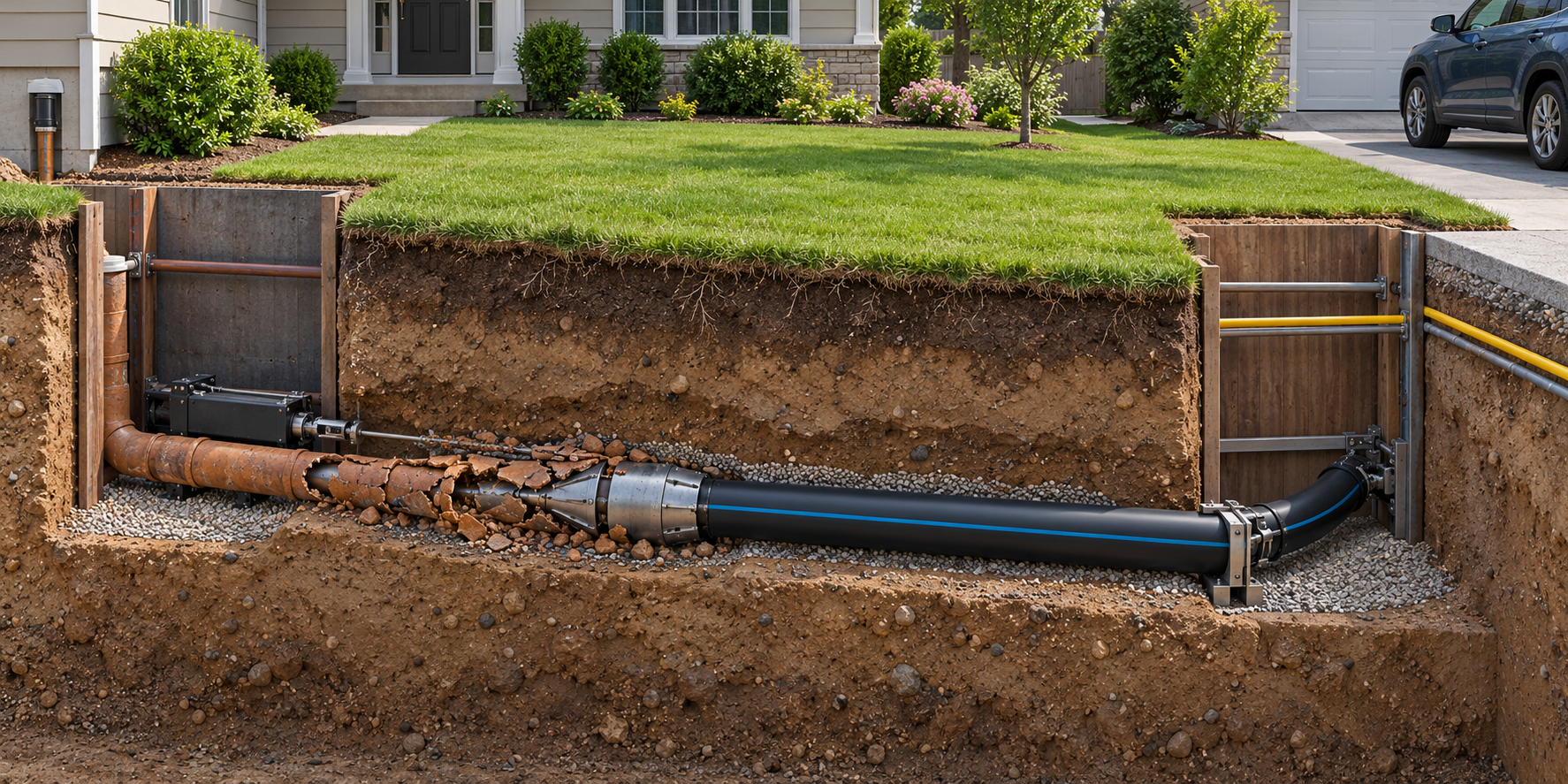
Pipe bursting replaces an existing sewer along a suitable alignment by using access or launch and receiving pits rather than excavating the entire route. Seattle Public Utilities describes it as replacement through access pits with less surface disturbance than open cut. It is not zero excavation, and it is not automatically feasible for every pipe, route, or property.
Cost context
Angi reports illustrative US 2026 observations of about $150 to $190 per linear foot for pipe bursting or lining in one trenchless guide, alongside broad trenchless project ranges of roughly $1,900 to $6,000. These figures are method- and scope-dependent. They may not include cleaning, pits, connections, permits, locating, traffic controls, or restoration, and they are not Canadian prices.
The useful budget is the installed project: assessment, preparation, pits, replacement pipe, connections, inspection, backfill, restoration, and administration.
OCM Excavation’s 2026 Greater Toronto Area table lists CAD $11,000–$24,000 for pipe bursting on a straight run with launch and receiving pits. HYDROPRO’s Vancouver guide displays $5,000–$15,000, depending on line length and depth, with no currency code or comparable itemized scope. These single-provider observations do not establish regional market prices or equal project totals. Ask each contractor to price the same endpoints, pit locations, connections, permit, and restoration scope.
How bursting differs from lining
Lining rehabilitates a host pipe from within. Bursting replaces the pipe with a new pipe along the existing route, subject to site and utility conditions. Bursting may be preferable when the owner wants a replacement rather than a liner and the route can accommodate the method. It may be less appropriate when the existing alignment is wrong, the host is collapsed in a way that prevents the tool from passing, or utilities and structures leave insufficient clearance.
Ask the contractor to state whether the new pipe changes size, route, capacity, connection arrangement, or access. A “trenchless replacement” label does not establish any of those details.
The access-pit budget
Access pits still require locating, excavation, equipment setup, safe work space, spoil handling, backfill, and surface restoration. Their position may affect driveways, lawns, patios, trees, fences, building foundations, public roads, or neighboring property. A narrow route can make pit placement the controlling issue even when the line itself is short.
The quote should show pit locations and whether the pits are included in the base price. Ask what happens if actual depth, soil, groundwater, rock, buried utilities, or a connection changes the planned layout.
Suitability questions
Pipe condition and geometry matter. Major collapse, improper slope, severe deformation, difficult bends, unknown connections, or utility conflicts may make bursting unsuitable or require a different scope. The Canadian private-side drainage guidance also emphasizes that slope, site conditions, lot size, discharge capacity, and other property factors affect drainage choices; it is draft/general guidance rather than a universal code.
Do not accept a promise of minimal excavation without an explanation of what evidence supports the route. Require a camera or condition assessment, locate information, and a professional method recommendation tied to the actual property.
Scenario comparison
Open yard with a straight accessible route: Bursting may reduce the amount of surface opened compared with open cut. The budget is comparatively predictable if endpoints and connections are known.
Line beneath a driveway or mature landscaping: Avoided restoration can be valuable, but pits may still disturb the surface. Compare the complete pit, pipe, connection, and restoration totals with open-trench work.
Line with bad slope or uncertain alignment: Bursting follows the existing path and may preserve the problem. Open excavation or a designed route change may be more appropriate if function depends on correcting grade.
Shared or public-boundary line: Access and responsibility need to be settled before work. A private quote may not include municipal permission, neighbor agreements, easements, or public restoration.
Quote normalization
Ask each bidder for the same replacement length and endpoints, pipe specification, pits, cleaning, camera inspection, service reconnections, permits, inspection, locating, utility clearance, traffic controls, backfill, and restoration. Keep optional landscaping or paving upgrades separate from necessary reinstatement.
If the line is being replaced because of collapse or repeated roots, ask what the inspection shows beyond the access pits and whether a future cleanout is included. Replacement of the carrier pipe does not automatically solve every upstream branch or backup mechanism.
When bursting is a rational choice
Bursting is strongest when the owner wants full pipe replacement, the existing route is suitable, access pits can be placed safely, utilities and connections are understood, and surface restoration savings are meaningful. It is weaker when a liner would adequately rehabilitate a compatible host pipe, when open cut is already required for another reason, or when the existing alignment itself must change.
The method should be selected after condition and route assessment, not from a promise that “trenchless” is always cheaper. Compare disruption, up-front cost, remaining unknowns, future access, and the durability of the corrected route.
Questions before approval
- Where will launch and receiving pits go?
- What pipe condition and alignment evidence supports bursting?
- How will existing utilities and service connections be handled?
- Is the method still feasible if collapse, rock, or a bad grade is found?
- Are permits, right-of-way, inspection, traffic control, and restoration included?
- Is the quote a complete project total or a per-foot allowance?
- What video or test documents the finished replacement?
Pipe bursting can reduce surface disturbance while delivering a replacement, but its economics are conditional. The best quote makes the access pits and method limits as visible as the new pipe.
Understand the route and pit assumptions
Bursting uses the existing alignment, so the contractor should map the proposed route, launch and receiving pits, bends, depth changes, connections, nearby utilities, and structures. The pit plan can affect concrete, landscaping, a narrow side yard, or public space even if most of the route is not excavated. Ask whether the stated price assumes an unobstructed straight pull and what happens if a utility crossing or connection prevents that layout.
The method may also affect pipe diameter or service connections. Ask the contractor to state the proposed pipe, whether it changes size, which existing branches are reconnected, and how the new line will be inspected. A single total without endpoints and pit locations is difficult to compare with a lining or open-cut proposal.
Decide whether replacement is needed along the whole run
Pipe bursting replaces a route rather than merely coating its interior, but that does not automatically mean every foot should be replaced. The inspection should show whether the damage is localized or distributed and whether the retained sections and connections are serviceable. If the defect is one joint, compare a localized repair and a longer project that shares the same access; include the extra pipe and any additional restoration.
Where the current route has a bad slope or must move around an obstruction, bursting may retain the problem because it follows the alignment. Open excavation or a professionally designed alternate route may be more suitable. Where the host is compatible and the goal is to rehabilitate it, CIPP is a separate comparison. Each bid should explain the failure mode it addresses rather than use “trenchless” as the reason.
Plan for close-out and retained service
Ask for post-installation inspection, connection testing, permit sign-off, photographs before pits are closed, and a record of the final route and access points. Confirm whether restoration is temporary or final and who returns to complete it after inspection or settlement. Keep that record for future locating, maintenance, sale, or another repair.
The warranty should identify the new pipe and its connection work separately from retained upstream branches and the public connection. A replacement along one route does not establish that the whole wastewater system is new. Future costs may still arise from an interior building drain or another segment, so the quote should identify what remains outside the project.
Ownership cost after bursting
Ask how the new route will be recorded and where future cleanout access will remain. Reduced surface disturbance today does not eliminate future maintenance or prove that upstream branches and the public connection are sound. Compare the retained risk and future access with lining and open excavation, especially when the owner expects to remain in the home through another repair cycle.
When pits sit near a property line or public space, confirm access permission and permit responsibility before scheduling. A planned pit that cannot be used can change both method and price after mobilization.
If the existing line is not straight or its connections are unknown, ask whether an added camera, locate, or exposure is needed to establish feasibility. That investigation belongs in the budget before equipment and crews are scheduled.
The contractor should identify which condition could make bursting unsuitable before mobilization.
Define a fallback price before mobilization
A bursting quote should state which event could force a change to open excavation or another method, such as a route conflict, unsuitable alignment, or pit access problem. Ask for an investigation limit, a fallback allowance or unit rate, and a homeowner approval point before a second opening is made. That keeps specialized-equipment mobilization from turning an uncertain method into an uncontrolled project total.