
Professional sewer locating answers a different question from camera inspection. A camera may show a defect from an access point; locating tries to relate the pipe and finding to the surface, route, or approximate depth. The evidence does not establish a reliable standalone national locating price. Budget it as a separate service or an inspection add-on, then ask what deliverable and accuracy the contractor provides.
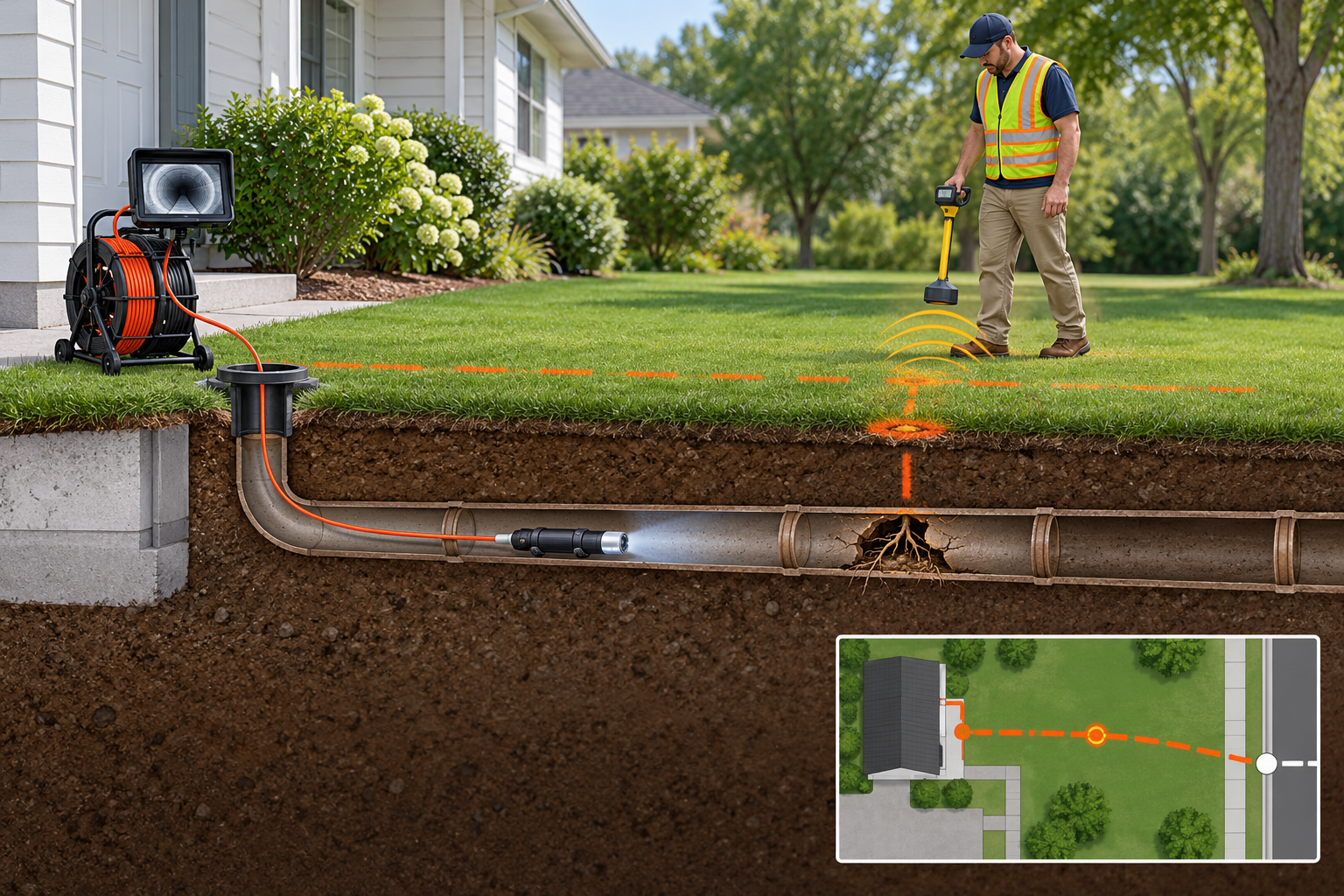
Scope, locate, and public utility marking are different
A sewer camera scope may document the inside of a private building drain or lateral. Electronic locating may mark the route or a defect on the ground. A depth estimate or map may require additional equipment and judgment. Public utility marking services address buried utilities under local “call before you dig” systems; they do not automatically map a private sewer on the property.
Tell the contractor whether the objective is a repair opening, a full route map, a responsibility boundary, landscaping, remodeling, or a home purchase. The required deliverable changes with the decision.
What may be delivered
- access point and inspection direction;
- route markings at the surface;
- approximate defect location;
- approximate depth or depth range;
- distance from the access point;
- connection, cleanout, or branch observations;
- sketch, map, photographs, video, and written limitations.
NASSCO describes typical inspection-direction differences between building-sewer/drain and lateral programs. That context helps a homeowner ask whether the inspection traveled from the building or main and whether the requested segment was actually covered. It does not establish one universal standard or credential requirement.
Cost drivers
Access: A usable cleanout and clear route make the work easier. Missing, buried, damaged, or inaccessible access can require extra opening or investigation.
Line condition: Blockage, standing water, collapse, or inability to pass the camera may limit the locate. Cleaning may be needed first.
Route complexity: Branches, shared lines, nonconforming connections, multiple buildings, crossings, or a public interface make mapping more valuable and more involved.
Deliverable: A verbal location, marked surface, complete report, video, depth estimate, and scaled drawing are not interchangeable.
Urgency and site: Emergency work, hardscape, traffic, restricted access, and restoration can add project costs even when locating itself is modest.
Scenario bands
Before a small repair opening: Locate the measured camera finding so the contractor does not excavate from an uncertain assumption. Confirm whether approximate depth is included.
Before landscaping or remodeling: Map the route and retain the record so future work does not cover or damage an unknown sewer. King County recommends locating a side sewer before remodeling or landscaping in its jurisdiction.
Responsibility question near the street: Combine camera distance, surface locate, route records, and utility inquiry. A locate supports the conversation but does not decide ownership or payment under local law.
Shared or nonconforming line: Request a map showing properties or buildings served, crossings, branches, and public connection. That documentation may be more valuable than a basic “line found” service.
Locate before excavation
Locating can reduce the chance of opening the wrong place, but it is not a guarantee about every buried condition. Ask the contractor to state accuracy limits, whether the mark represents the pipe or the defect, and whether depth is measured or estimated. Coordinate with the local public utility-marking system for other buried services before excavation; private sewer locating does not replace that process.
This article does not provide excavation instructions. Buried utilities, structural conditions, public roads, and contaminated water require appropriate professional controls.
How route information improves quotes
A repair bid can state whether access is through a yard, driveway, slab, street, or another property. A replacement bid can price the actual route and restoration rather than a guessed length. A responsibility inquiry can discuss property-line and right-of-way segments with better evidence. A future maintenance visit can use the cleanout and route record instead of repeating discovery work.
The locate may therefore have value even when it does not lower the immediate plumbing price. It reduces uncertainty in excavation, method choice, restoration, and responsibility.
Quote questions
- Is locating included with the camera scope or priced separately?
- Will the contractor mark the surface, estimate depth, or provide a map?
- Does the price cover one defect, the full route, branches, or a public connection?
- What sections cannot be viewed or located?
- Is cleaning required first?
- Are public utility markings and private sewer locating separate?
- Will I receive video, distance data, photographs, and written limitations?
- Can the information be used by another contractor for repair bidding?
When it is worth paying for
Locating has the most value when an opening would be expensive, the route is unknown, a defect may cross a responsibility boundary, the line is shared, or a major project could damage it. It has less value when the pipe is exposed, the access and route are already documented, and no excavation or allocation decision depends on more precision.
Do not buy a vague locate when you need a map, and do not treat a map as legal proof. The useful service is the one whose accuracy and deliverable match the next decision.
Use the locate after the service
Retain the marked route, depth notes, video, report, and photographs with the property records. Give the same package to repair bidders so they price the same access and restoration assumptions. If the route crosses a boundary or serves another property, share the factual map while keeping responsibility and legal conclusions with the relevant authority or professional adviser.
If later excavation finds a different route or depth, treat that as a scope change requiring evidence and approval. A locate reduces uncertainty; it does not eliminate every buried-condition risk or replace public utility marking.
A completed repair can also leave useful route evidence. Portland’s local CIPP rule for certain privately maintained pipe in a public right-of-way or easement requires a dimensioned as-built and photos of specified locate markers along with post-installation video. Those records can help a later contractor identify where the lined lateral runs, but they are not a general locate survey, a title record, or a requirement everywhere. Ask the authority what close-out drawing or marker applies to your project, and keep it with the contractor’s route map and camera record.
Match accuracy to the opening you plan to make
A verbal direction, one surface mark, an approximate depth, and a full route map have different value. Before paying, tell the provider whether the next decision is a small exploratory opening, a long replacement quote, a property-line conversation, or a landscape project. Ask what accuracy the deliverable supports and which portions could not be followed because of blockage, camera travel, branches, or inaccessible cleanouts. A mark that only traces the camera head is not necessarily a complete utility survey.
Depth should be described with its method and limitation, not just a single number. Ask whether the technician measured or estimated it, how often readings are taken, and whether the map identifies uncertainty or confidence. Soil, surface construction, signal conditions, and the equipment used may limit a locate. A contractor should not imply that approximate locating eliminates the need for required public utility marking or other pre-excavation checks.
Avoid paying twice for the same information
Some camera inspections include electronic locating for selected findings, while another contractor may charge separately. Review the video and report first, then identify what the next provider still needs. If the repair bidder can use the existing video and marked point, a repeat scope may not add value. If the first camera could not reach the defect or lacked surface location, a new access point or dedicated locate may answer the remaining question.
Ask the provider whether its deliverable is transferable to another contractor and what format you will receive. Retain video, still images, distance markers, surface paint or flags, a sketch, and written limits. Temporary surface marks can disappear, so request a map or photographs that preserve the information after weather or landscaping removes the markings.
Use route information to price access consistently
Give each bidder the same route, defect location, and surface map. Ask them to price the same opening point, estimated depth, excavation area, pit or access requirement, and restoration boundary. If they propose different methods, ask whether the locate changes their route or merely supports the same endpoint. This makes it clearer whether a price difference comes from labor, method, depth, restoration, or a different assumed pipe segment.
For a shared or nonconforming line, ask whether the map can show branches and buildings served, or only the observed pipe path. The former may require records and additional access rather than a basic locate. A route map can help a utility or document reviewer, but it is not a title survey or legal decision about ownership. Keep the service objective within the provider’s stated capability.
Decide when a locate is not enough
If the contractor cannot pass the camera, the pipe has collapsed, or the route includes unobserved branches, the surface location may remain incomplete. A targeted investigation or professional assessment may be needed before pricing a broad excavation. Similarly, a line found close to the property boundary does not establish who maintains it; the utility must apply its local rule to the physical evidence.
The best locating quote is the smallest service that provides enough confidence for the next decision. Paying for a scaled map when only one repair opening is needed may be unnecessary; relying on a casual mark for a shared route or public crossing may be inadequate. State the decision first, then buy the matching deliverable.