
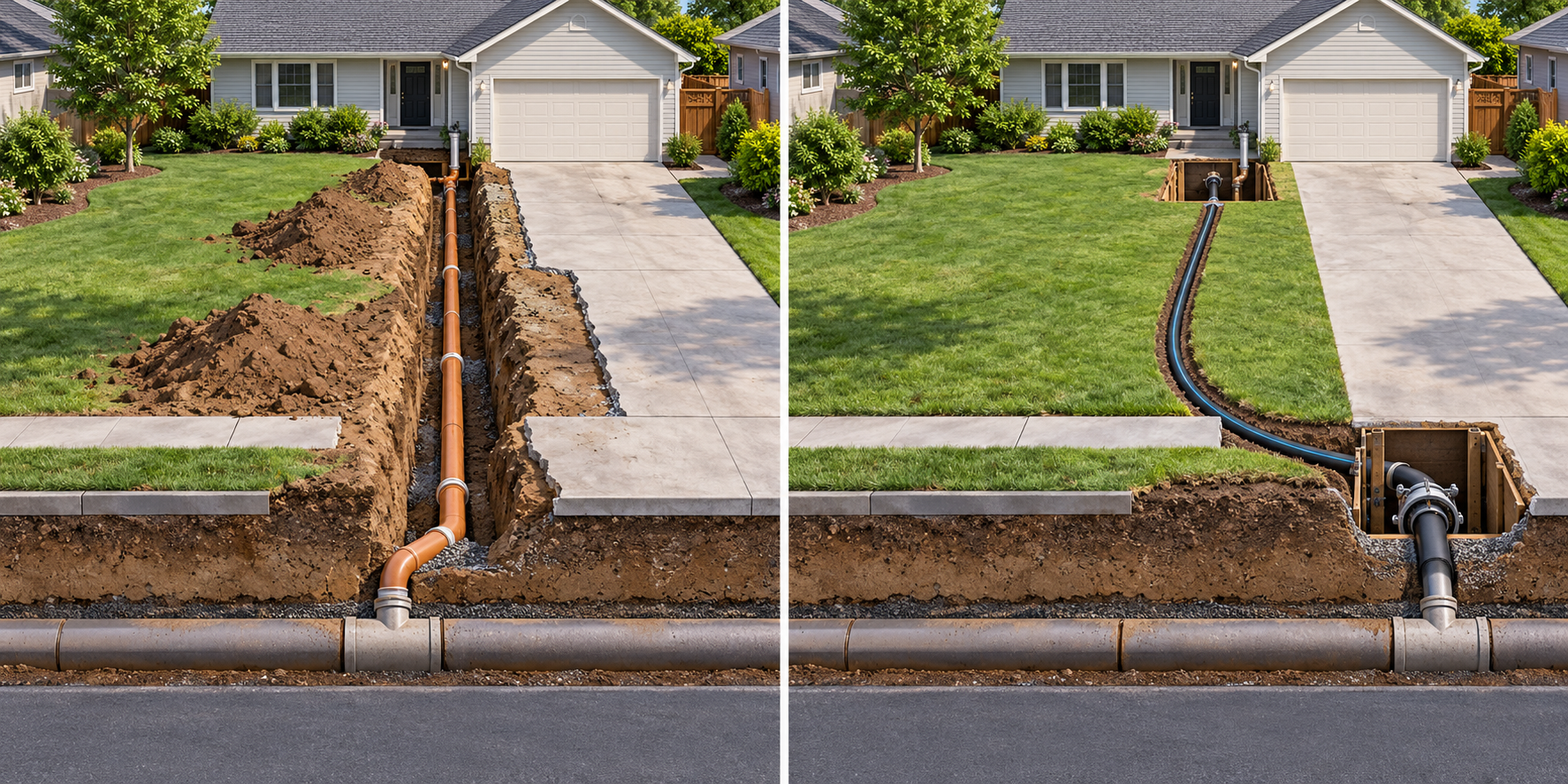
“Trenchless” is not one method and “open trench” is not one price. Trenchless work may mean CIPP lining, which rehabilitates an existing host pipe, or pipe bursting, which replaces it through access pits. Open-trench work excavates along more of the route and directly replaces or repairs the pipe. Compare complete project scopes, not a trenchless per-foot number with an excavation-only price.
Quick comparison
| Decision factor | Trenchless lining or bursting | Open trench |
|---|---|---|
| Surface disruption | Usually reduced, but access pits or openings remain | More of the route is disturbed |
| What it can accomplish | Rehabilitation or replacement on a suitable route | Direct access to pipe, connections, alignment, and surrounding condition |
| Main constraints | Host condition, geometry, alignment, utilities, access | Excavation, depth, soil, water, protection, restoration |
| Cost advantage | May reduce hardscape and landscape restoration | May be simpler when the route is already exposed or geometry must change |
| Best comparison | Installed method plus pits, connections, permits, restoration | Installed pipe plus excavation, backfill, permits, restoration |
Neither column is automatically cheaper or better.
What the methods mean
Seattle Public Utilities describes spot repair for a localized defect, open cut for a longer or multiple-defect section, pipe bursting through access pits with a replacement pipe, and CIPP lining using a resin-soaked tube cured inside the existing pipe. Vancouver also identifies open trenching, pipe bursting, and pipe relining as local renewal methods.
Lining leaves the host route in place and requires suitable condition and geometry. Bursting replaces the pipe but follows an existing alignment and needs pits. Open cut exposes the route and may correct conditions that a trenchless method cannot. These distinctions are useful for quote questions, not a substitute for property-specific assessment.
Cost comparison by layer
Investigation: Both methods may require cleaning, camera inspection, locating, and a defined defect or route. A blocked line can limit the camera, while a difficult locate makes any opening uncertain.
Access: Lining may use existing cleanouts but can need additional openings. Bursting needs launch and receiving pits. Open cut needs excavation along the route. Access is not zero merely because a proposal says trenchless.
Pipe and connections: Lining needs host-pipe compatibility and treatment of service connections. Bursting needs replacement pipe and connection work. Open trench exposes and reconstructs the route directly.
Restoration: Trenchless may reduce driveway, patio, lawn, or pavement work, but pits still have to be closed. Open cut may carry more restoration and disruption, especially under hardscape or a public road.
Administration: Permits, inspections, utility coordination, traffic control, and right-of-way requirements can apply to either method. Confirm them locally.
Cost context
Angi reports illustrative US 2026 trenchless project pricing of about $1,900 to $6,000, pipe lining around $135 to $150 per linear foot, and pipe bursting or lining around $150 to $190 per linear foot in one guide. Another guide reports a much broader trenchless range. The differences reflect scope and methodology. None is a Canadian rate or complete installed total.
Do not use the figures to conclude that trenchless is cheaper. Add preparation, pits, connection treatment, permits, inspection, and restoration before comparing with an open-trench proposal.
For a more local but still limited illustration, OCM’s Greater Toronto Area table lists open-cut house-to-main work at CAD $8,000–$22,000, CIPP at CAD $9,000–$18,000, and pipe bursting at CAD $11,000–$24,000. The table describes the open-cut full run as 30–60 feet and the bursting offer as a straight run with launch and receiving pits; its CIPP line assumes no taps along the run. HYDROPRO’s Vancouver guide separately displays $4,000–$12,000 for CIPP and $5,000–$15,000 for bursting, without a currency code or normalized project scope. It has no open-trench-specific comparator; its generic full-replacement price should not be treated as one. These are different providers’ marketing observations, not equivalent installed bids or a basis for declaring one method cheaper.
Price service limits and close-out with the method
The work plan can affect the household and the amount included in the bid. Portland says that on some City CIPP projects residents may be asked to limit water and sewer use while connections are temporarily sealed; the stated period is one to several hours, with 24–48 hours’ notice when limits are needed. This is a Portland municipal-project example, not a prediction for every private lateral job. Ask a contractor what happens to household service during the proposed work, whether bypass or another temporary arrangement is included, and whether the schedule creates any separate cost.
For a private CIPP job that requires local approval, ask what completion evidence the authority expects. Portland’s right-of-way/easement rule is one example requiring pre- and post-work video, a dimensioned as-built, and locate-marker evidence. Those records may add permit and close-out work even when the pipe installation itself is trenchless. Another jurisdiction may require different documents or none of these; verify the actual permit and include its fee and contractor coordination in the same comparison as restoration.
Suitability is the first filter
Trenchless methods may be inappropriate where the host pipe is severely collapsed, badly deformed, improperly aligned, or otherwise unable to receive the liner or bursting tool. A method that follows a bad slope may preserve the controlling problem. Open trench may be necessary when direct correction, new alignment, complex connection work, or full route visibility matters.
The Canadian private-side drainage guidance emphasizes that slope, lot conditions, discharge capacity, grading, and other site factors affect drainage choices, and describes itself as draft/general guidance rather than final requirements. That reinforces the broader point: method selection requires local and property-specific review.
Scenario comparisons
Straight line under an expensive driveway: Trenchless may earn a premium by reducing surface restoration if access pits fit and the route is suitable. Compare pit locations and final driveway obligations.
Collapsed section with poor slope: Open excavation may be more credible because it can expose and correct the route. A trenchless promise deserves evidence that it addresses both structure and function.
Long compatible deterioration in an open yard: Lining may offer a lower-disruption rehabilitation path, while open cut may provide a more direct replacement. Compare retained pipe, connections, preparation, and future access.
One isolated defect: Spot repair may be more coherent than either a full trenchless run or open-trench replacement. The choice depends on surrounding condition and whether access would be repeated.
Public right-of-way: Both methods may require local permits, inspection, traffic control, utility coordination, and restoration. Do not assume trenchless avoids public requirements.
Compare ownership-horizon value
Trenchless can reduce disruption and restoration today but may retain more of the existing route or require specialized future access. Open trench can cost more to restore but may expose the full condition and correct a route problem. A homeowner planning a driveway replacement may value coordination differently from one trying to preserve an established landscape.
Do not turn a shorter construction period into a guaranteed lower lifecycle cost. Compare recurrence, remaining pipe, future access, warranty, method suitability, and the cost of another mobilization.
Bid normalization checklist
- same endpoints, length, and affected condition;
- cleaning, camera, locate, and report;
- lining, bursting, spot repair, or open-cut method;
- pits, excavation, depth, utilities, and soil assumptions;
- service connections and public interface;
- permits, inspection, traffic, and right-of-way;
- backfill, driveway, paving, lawn, tree, and landscape restoration;
- service interruption, testing, documentation, and warranty;
- contingency triggers and homeowner approval.
Ask each contractor why its method is feasible and which observed conditions would make it change methods. A quote that cannot answer that question is not ready for a meaningful price comparison.
The practical choice
Choose trenchless when the owner wants rehabilitation or replacement, the route and host condition support it, access pits are manageable, and surface savings matter. Choose open trench when direct access is required, alignment or connections must change, the route is already exposed, or trenchless limitations outweigh restoration savings. Choose spot repair when the defect is genuinely isolated.
The correct comparison is not “no digging versus digging.” It is which complete project corrects the demonstrated sewer problem with acceptable access, disruption, cost, and retained risk.
Apply the comparison to the property
Start with the defect, not the contractor’s preferred equipment. A long compatible run beneath an expensive hardscape may favor a lower-disturbance method if pit access is feasible. A failed connection, severe collapse, bad slope, or route change may require direct excavation even when restoration is costly. A single localized defect may be better served by a spot repair than by either whole-run method. These are comparison cases; inspection and local requirements control the actual selection.
Next mark the endpoint and surface map. A 30–60-foot open-cut range, a no-taps CIPP range, and a bursting range with two pits are not interchangeable merely because each repairs sewer pipe. If one quote begins at the property line and another at the foundation, their totals describe different work. Identify public connection charges and restoration separately, especially where a route crosses a right-of-way.
Make the estimate useful before work begins
Ask each bidder to state whether cleaning and camera inspection are required, whether the route is suitable, which connections will be treated, and how the completed work will be verified. Request an allowance for the condition that would make its method unsuitable and the price of the fallback. A trenchless estimate that has no contingency for an inaccessible pit or failed host condition may look precise while leaving the largest project risk undefined.
The surface budget should include the area disturbed by access pits as well as the full trench. For an open-cut quote, ask about temporary and final reinstatement. For lining or bursting, ask what remains to be excavated and how the openings are restored. Compare service interruption, equipment access, permits, traffic, restoration, warranty, and retained pipe together. A smaller visible work area is one economic advantage, not proof of lower total cost.
Make sure the final bid includes the same testing, permit close-out, and surface endpoint for every method; otherwise the lower figure may stop earlier in the project.
Record which method assumptions remain unverified so a change in pipe condition can be priced before equipment is committed.