
Full replacement of a private residential sewer lateral is a project budget, not a pipe-only price. The total can include inspection, locating, excavation or access pits, new pipe, connections, permits, municipal inspection, traffic or right-of-way work, backfill, and restoration. Angi reports illustrative US trenchless project pricing of about $1,900 to $6,000, but also reports wide per-foot ranges that vary by method and scope. These are market observations, not a national rate card or Canadian pricing.
Define “full replacement”
Ask whether the proposed boundary runs from the building sewer to the public main, only from the house to the property line, or through a different locally defined segment. A private sewer lateral connects a property to the public system, but responsibility boundaries vary. A replacement may leave the public connection, an interior building drain, or a shared section outside the contractor’s scope.
The quote should show the route, approximate length, depth, endpoints, retained connections, and surface to be restored. If the route is not known, a locate or additional investigation is part of the budget risk.
A complete cost framework
| Component | What can change it |
|---|---|
| Inspection and locating | Blockage, poor access, uncertain route, depth, shared connection |
| Pipe and installation | Length, diameter, material, depth, alignment, connection details |
| Open excavation | Soil, groundwater, trench access, protection, equipment and spoil handling |
| Trenchless access | Launch/receiving pits, host-pipe condition, utilities and alignment |
| Public interface | Tap or connection work, permits, inspection, traffic and right-of-way |
| Restoration | Driveway, pavement, lawn, trees, patios, fences, walls or interior finishes |
The largest variation often comes from the layers outside the pipe. A short deep line under a street can be a larger project than a longer shallow line across an open yard.
Regional examples show why endpoints matter
OCM Excavation’s 2026 Greater Toronto Area table lists CAD $5,500–$12,000 for an open-cut house-to-property-line project described as 20–35 feet and 4–6 feet deep, CAD $4,500–$11,000 for a property-line-to-main section with a boulevard cut and saddle tap, and CAD $8,000–$22,000 for a 30–60-foot house-to-main run. Its page says the listed ranges include labor, pipe, permits, locates, backfill, compaction, and standard restoration, but exclude interior plumbing past the foundation, hazardous-soil disposal, and landscaping beyond the cut.
HYDROPRO’s Vancouver guide displays $8,000–$20,000+ for full replacement from house to city connection. The page says its replacement amounts include excavation, labor, new PVC, and basic backfill, while permits, surface restoration, and camera inspection are typically separate. It does not identify a currency code or describe this as an open-trench-only price. These one-provider observations have different boundaries and inclusions; they are not a comparison of equivalent bids, a regional average, or a Canada-wide range.
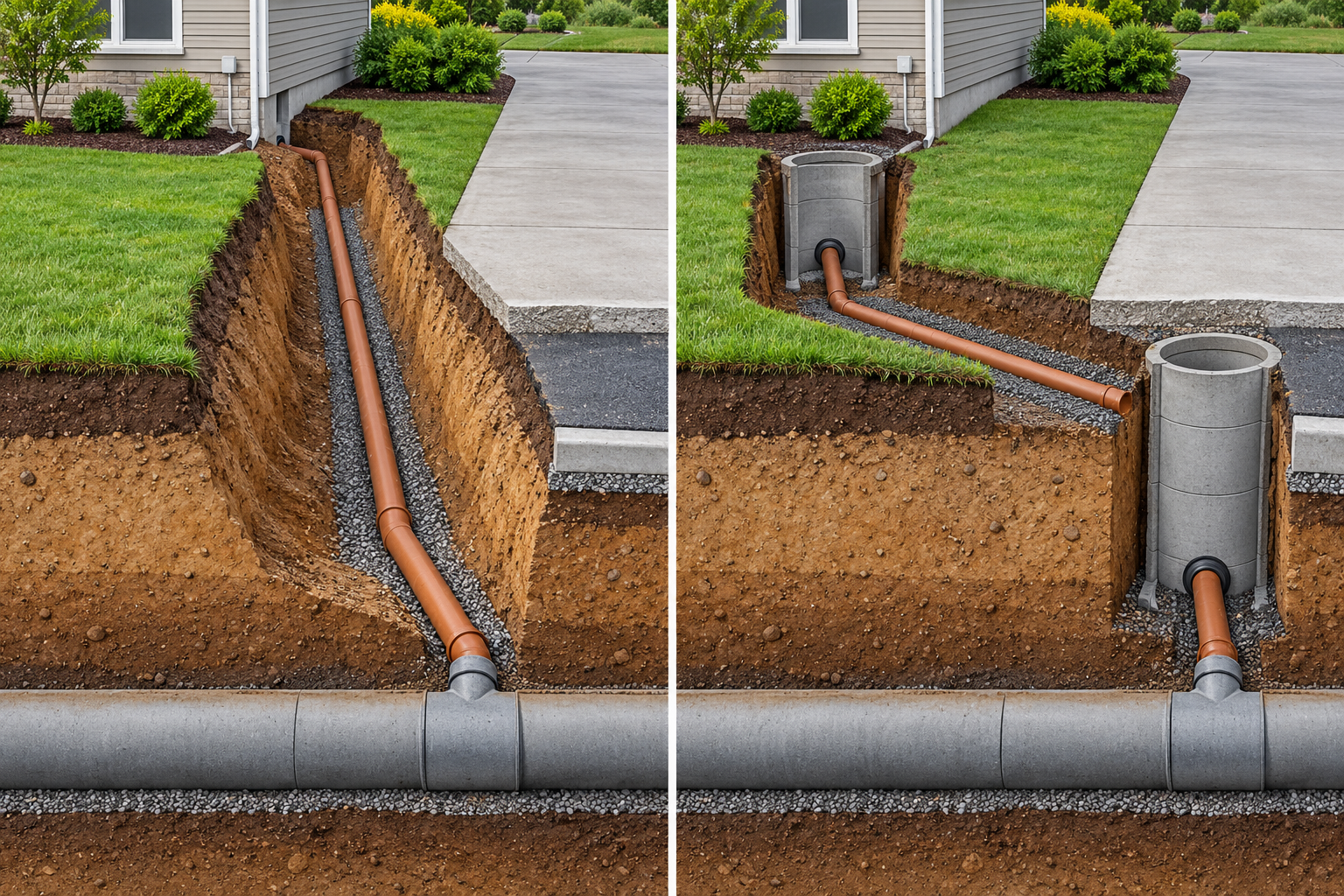
Open cut versus trenchless replacement
Open-trench replacement excavates along more of the route and replaces the pipe directly. It can make the entire condition visible and may be necessary for collapse, alignment, connections, or unsuitable host conditions. Its cost exposure includes excavation, backfill, access, and surface restoration.
Pipe bursting uses access pits to replace the existing pipe along a suitable route and can reduce surface disturbance compared with open cut. It is not zero excavation and may not fit every alignment, utility environment, or host condition. Vancouver identifies open trenching, pipe bursting, and pipe relining as local renewal methods while requiring local permitting and inspection; that is a useful comparison, not a universal approval.
What changes the total most
Length and depth: More pipe, deeper work, and more difficult equipment handling increase labor and spoil or restoration work.
Route: A direct open yard is different from a route beneath a driveway, mature tree, patio, structure, or public road.
Method: Trenchless work can reduce restoration while adding specialized equipment and access-pit costs. Open cut can be more straightforward technically while creating more surface work.
Connection work: The public main, private cleanout, building drain, and service connections may have different owners, permits, and inspection requirements.
Unknown condition: A camera may not show the whole route. Soil, groundwater, pipe alignment, and buried utilities can create allowances or change feasibility.
Three project cases
Shallow private-yard replacement: The route and endpoints are known, access is open, and restoration is limited. The contractor can give a comparatively defined installation price, but permits and connections still need confirmation.
Long line beneath hardscape: Surface restoration may dominate. Compare trenchless and open-trench totals including pits, excavation, pavement, landscaping, and the likelihood of future access.
Line crossing public right-of-way: Utility coordination, traffic control, public permits, inspection, and connection rules may be as important as the pipe. Do not assume the private contractor’s total includes municipal charges.
Responsibility before payment
A camera finding near the street does not establish that the city owns or will repair the segment. Some jurisdictions place owner responsibility to the main, while others use a property-line boundary. Shared lines and easements can change the analysis. Contact the utility before authorizing a full replacement if the defect may be public, shared, or under a right-of-way.
Normalize replacement quotes
Require each bidder to state the same route and endpoints, method, pipe material, length and depth assumptions, cleaning, locating, access, connections, permits, inspection, traffic control, excavation, backfill, restoration, taxes, and warranty. Ask whether the quote is fixed, unit-priced, or allowance-based, and what evidence permits a change.
Do not combine a trenchless per-foot rate with an open-trench total and call the lower figure cheaper. Compare complete project totals and the condition each method leaves behind. The method that costs less to install may cost more to restore or may not address alignment and collapse.
What the budget should show
Use three numbers when possible: a defined base case, an expected case including known access and restoration risks, and a difficult case tied to a specific uncertainty. The difficult case should not be an unlimited contingency. It should name the trigger—unknown depth, inaccessible connection, unsuitable host pipe, public-road permit, or concealed restoration—and require approval.
Replacement is the right economic comparison when evidence shows that repair or rehabilitation would leave too much distributed deterioration, recurring access, or method risk. It is not automatically justified by age or one camera label. A complete replacement quote earns its value by explaining what it replaces, what it does not, and why the route and restoration assumptions are credible.
Break a long route into priceable segments
On a route that crosses different surfaces or responsibility boundaries, ask for a drawing and segment schedule. The house-to-property-line section, a boulevard or road crossing, and the connection at the main can require different access, permits, restoration standards, and payer decisions. A combined total may be convenient, but it should still show what each segment includes so a utility response or scope change does not leave the homeowner unable to compare the remaining work.
The same logic applies to a long private run with one damaged section. Full replacement may be proposed because access would otherwise be repeated, but the contractor should distinguish the damaged length from sound retained pipe and price both the minimum repair and complete run when feasible. The comparison should include repeated mobilization, restoration, and the condition that remains—not an assumed percentage of “pipe life” saved by replacing more.
Make the restoration commitment specific
“Backfill and restore” can mean temporary fill, compacted soil, seed, patch paving, or replacement to a particular material and finish. Ask who removes and reinstalls the driveway, sidewalk, lawn, irrigation, trees, fences, and interior finishes, and whether the price includes final restoration after settlement or inspection. OCM’s cited GTA table includes standard restoration but excludes landscaping reconstructed beyond the cut; HYDROPRO says surface restoration is typically quoted separately. Those statements describe those providers’ pages only and show why another quote must define its own endpoint.
Also identify the party responsible for disposal, utility coordination, traffic control, and permit close-out. A contractor’s pipe total can be accurate while omitting an authority charge or restoration trade. The complete budget should label every part as included, separately quoted, allowance, or homeowner-arranged.
If the full route cannot be inspected, separate the confirmed replacement length from any allowance for unseen sections. Ask what observation would trigger adding pipe, how that work will be priced, and whether the project can pause for approval. This turns a broad uncertainty into a controlled decision rather than an open-ended contingency.
Where one section crosses a road, easement, or neighbor’s property, confirm access rights and authority requirements before the contractor prices it as an ordinary private-yard run. That boundary may alter the method, schedule, and restoration obligation.
For the owner, a useful replacement budget therefore has a confirmed construction amount, local authority amounts, and clearly marked allowances. The total should identify which party supplies each figure and when it becomes binding.
Keep a change record during a full replacement
When the route or depth changes after excavation, record the exposed condition, revised length, added connection or restoration work, and the approval for each change. Ask the contractor to update the drawing and final invoice to reflect the installed project. That paper trail makes a complex replacement easier to maintain and separates necessary concealed-condition work from optional surface or capacity upgrades.