
Connecting a home to municipal sanitary sewer is a coordinated utility project. It may include private-side pipe construction, a public connection or tap, excavation, permits, inspections, contractor qualification, right-of-way work, municipal charges, and surface restoration. There is no responsible national connection price because eligibility, route, public interface, and fees are intensely local.
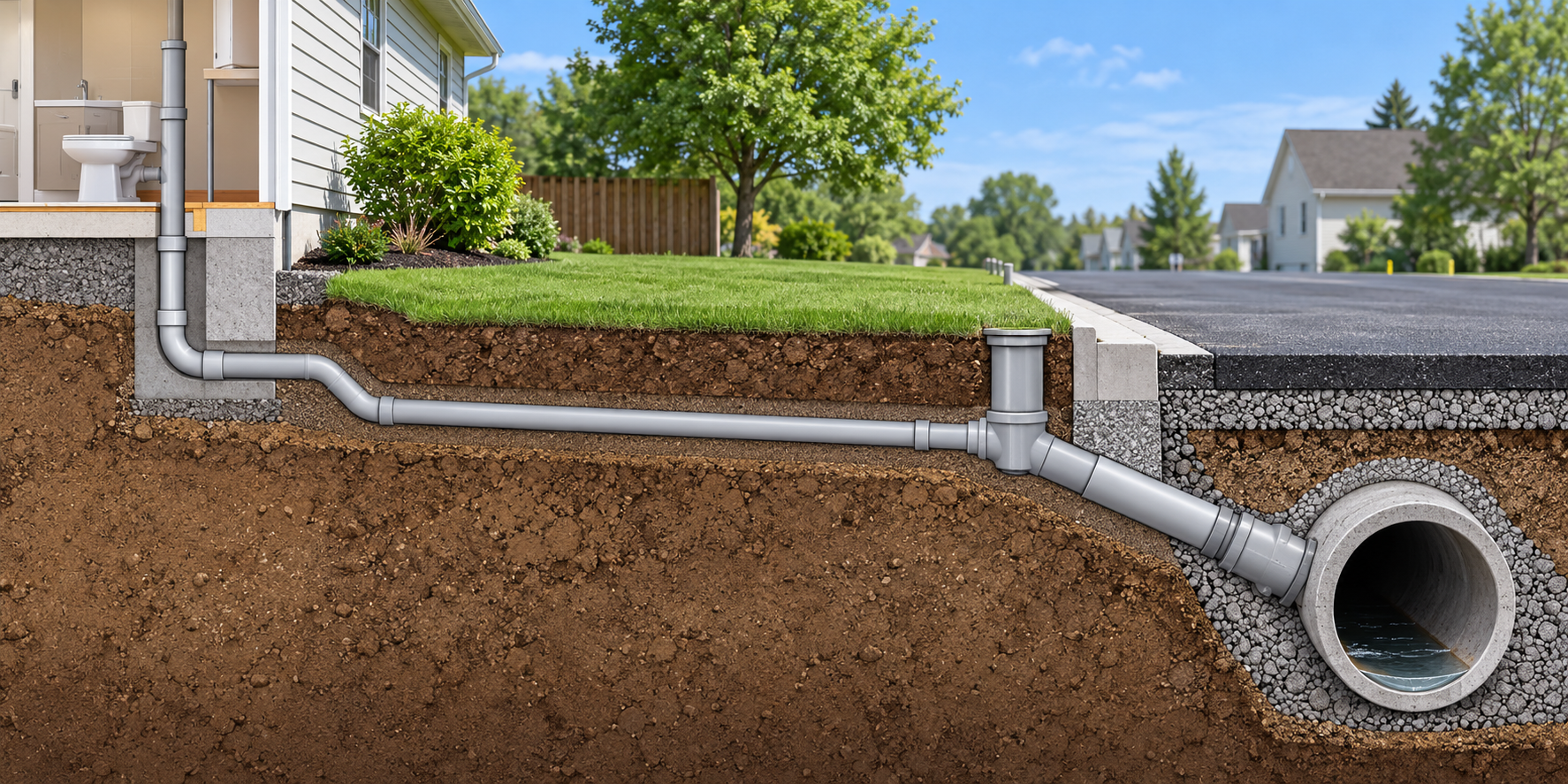
Separate private and public work
The private-side portion runs from the building plumbing toward the property line or another locally defined boundary. The public interface may include the connection to the main, a road or sidewalk opening, utility review, inspection, and restoration. The owner or builder may be responsible for private work even when the public sewer is nearby.
Calgary, for example, states that homeowners or builders are responsible for providing water and sewer service connections from the property line to the building plumbing, at the owner or builder’s expense, using the applicable contractor and bylaw framework. That is a Canadian example, not a Canada-wide rule.
Project cost layers
| Layer | Main drivers |
|---|---|
| Feasibility | Sewer availability, elevation, capacity, route, and connection approval |
| Private construction | Distance, depth, pipe, slope, access, and building connection |
| Public interface | Tap, connection, inspection, utility coordination, and right-of-way |
| Administration | Permits, deposits, fees, contractor qualifications, and drawings |
| Restoration | Soil, lawn, driveway, sidewalk, pavement, landscaping, and traffic controls |
| Existing system | Septic abandonment or modification as a separate related scope |
The route and elevation can determine whether gravity connection is feasible or whether a different pumping or design solution is required. Those are property-specific professional questions.
Three connection scenarios
Sewer at the property line: The private run is short and access is ordinary, but the owner still needs current utility requirements, connection approval, permits, inspections, and restoration confirmation.
Long or deep private route: Distance, depth, excavation, soil, access, and surface restoration become major cost layers. A public main’s proximity does not make the private construction inexpensive.
Road or sidewalk crossing: Right-of-way permits, traffic control, utility coordination, public restoration standards, and municipal inspection can sit outside a contractor’s private quote. Ask for those charges directly from the authority.
Check for recurring charges tied to the connection
An approved connection may create an ongoing system charge in addition to construction and permit costs. King County, Washington, for example, says its capacity charge applies to certain new connections, reconnections after five years, additions, or changes of use when wastewater is treated at a County plant. The current property owner is responsible, and the charge is billed over 15 years unless paid off early. The County publishes a 2026 residential rate of $77.99 per customer-equivalent per month; the assigned amount varies by property type and size. This is a local system-capacity charge, separate from a contractor’s lateral work and ordinary sewer service. Ask the utility whether the parcel, treatment plant, connection date, and project type trigger a recurring charge, and how it transfers if ownership changes.
The fees and inspections guide separates one-time charges from continuing obligations. If a known connection or lateral project needs a payment route, the assistance and financing guide explains why local eligibility and approval must be confirmed before budgeting an offset.
Connection versus septic conversion
The municipal connection is one side of a septic-to-sewer conversion. Septic tank abandonment, decommissioning, drainfield work, or other onsite-system requirements belong to the separate septic decision. Obtain a coordinated scope so one contractor’s price does not imply that the other system has been legally or physically closed.
Permits and inspection
Seattle requires permits and inspection for certain side-sewer repair work in its jurisdiction, while Calgary describes private connection responsibility and qualified contractors. Vancouver describes local renewal methods and permit/inspection coordination. These examples show why a homeowner must verify the actual municipality rather than average rules into one assumption.
Ask who applies for permits, who schedules inspection, whether municipal charges are paid directly, and what happens if work cannot be covered until approval. Keep connection drawings, inspection records, and final route information.
How to budget without a false range
Use a feasibility budget, a private construction quote, a public and administrative allowance, and a restoration allowance. Request a difficult case tied to specific unknowns such as depth, right-of-way, unknown utility, connection elevation, or unsuitable soil. Avoid a single contingency that gives no approval control.
Canadian homeowners should obtain local CAD quotes. US cost observations cannot be converted mechanically into Canadian pricing, and municipal fees vary even within one country.
Quote checklist
- service availability and connection point;
- private and public endpoints;
- route, depth, length, and elevation assumptions;
- pipe, slope, access, excavation, and building connection;
- tap or interface work;
- permits, inspection, utility review, and contractor status;
- road, sidewalk, traffic, and restoration requirements;
- taxes, deposits, and municipal fees;
- septic handoff and exclusions;
- final documentation and warranty.
Who should be contacted first
Start with the utility or municipality for service availability, connection rules, public-interface requirements, and current fees. Then obtain a contractor or designer scope for the private work. If the project crosses an easement, shared line, or public road, settle those permissions before treating a contractor total as executable.
A realistic sewer-connection budget is built from the boundary outward: building, private route, public interface, administration, and restoration. The public main being nearby is only the beginning of the cost question.
Check eligibility and sequence before construction
Before obtaining a final installation bid, confirm that a connection is available at the proposed location, that the property’s elevation and route can serve the building, and that the authority accepts the proposed interface. A sewer main in the street does not prove that a new tap, capacity, grade, or connection location is available. If gravity service is not straightforward, the project may need a different professionally designed configuration.
Sequence can affect cost. Utility approval, drawings, permits, contractor qualification, and inspection may need to occur before excavation. A private contractor may price the pipe while the authority prices the public connection. A septic contractor may be needed for the existing onsite system. Ask every party to identify its predecessor and successor so the homeowner does not pay twice for discovery, restoration, or an unfinished connection.
Keep a written list of assumptions: service point, route, depth, connection elevation, public work, private work, restoration standard, taxes, and exclusions. When those assumptions change, the revised quote is easier to evaluate than a new unexplained total.
Separate a new connection from a lateral replacement
A new municipal connection can include establishing an approved tap or interface and building a private route to the property, while a lateral replacement renews a connection that already exists. A project may also be a conversion from an onsite septic system. Ask the authority which project type it recognizes, whether the parcel is eligible, what point is available, and whether capacity or elevation constraints apply. Those answers determine what design and charges belong in the estimate.
For a new service, request separate scopes for private pipe, public work, utility administration, and any existing-system changes. For an existing connection, confirm whether the main connection can be reused, whether the work stops at the property line, and whether road or sidewalk permits are still needed. A line near the street may still require substantial private construction; physical proximity does not establish a free or simple connection.
Build a route and elevation budget before bidding
The distance from building to service point, depth, slope, soil, route obstacles, and surface type shape the private work. If gravity drainage is uncertain, obtain the necessary professional assessment before comparing a gravity line with a pumping arrangement. A route that crosses a driveway, retaining feature, neighboring property, or public road may require additional permission and restoration. Ask for a plan showing the route, endpoints, known utility crossings, and what remains unknown.
The contractor should identify the amount of pipe, access, connections, and restoration included. An authority may separately charge for the main tap, inspection, or public restoration. Keep those figures as separate lines rather than combining a public fee with a private per-foot price. That makes later scope changes easier to track.
Coordinate the conversion and existing property systems
When a home moves from septic to municipal sewer, connection work and onsite-system closure may have different contractors, permits, and requirements. Ask which party disconnects the former system, handles the tank or field, documents completion, and restores the area. This article does not give septic abandonment instructions; include that specialist work as a separate estimate and verify the local authority’s requirements.
If several properties share a route or require a common extension, determine who may access the land, who will own each segment, and how maintenance will be allocated before design and construction. Easements or neighbor agreements can affect both the route and the future cost. Resolve these questions early enough that a contractor is not pricing a connection the owner cannot legally build.
Track the project from application through close-out
Keep the service application, drawing, fee schedule, permit, inspection requirements, contractor approval, connection sign-off, and final route map. Ask who books inspections and whether the work must remain visible until approval. Clarify what happens if a connection elevation, utility conflict, or local requirement changes after excavation begins and who authorizes the revised price.
The final handover should show the accepted connection point, as-built route if available, materials, inspection result, and any remaining onsite-system or maintenance obligation. These records support future repair, locating, sale, and responsibility decisions. A complete connection budget includes not only getting wastewater to the main but also proving that the new system was accepted and documenting what the owner must maintain.
The owner may receive separate invoices from the designer, private contractor, utility, restoration trade, and septic provider. Reconcile each against the same approved route and identify which cost is a fixed fee, construction amount, allowance, or deposit. This prevents a partial private quote from being mistaken for the entire conversion budget.
Do not schedule irreversible work until the connection point, design, and public interface are approved under the local process. That sequence protects the estimate from being based on an unaccepted route or tap location.